

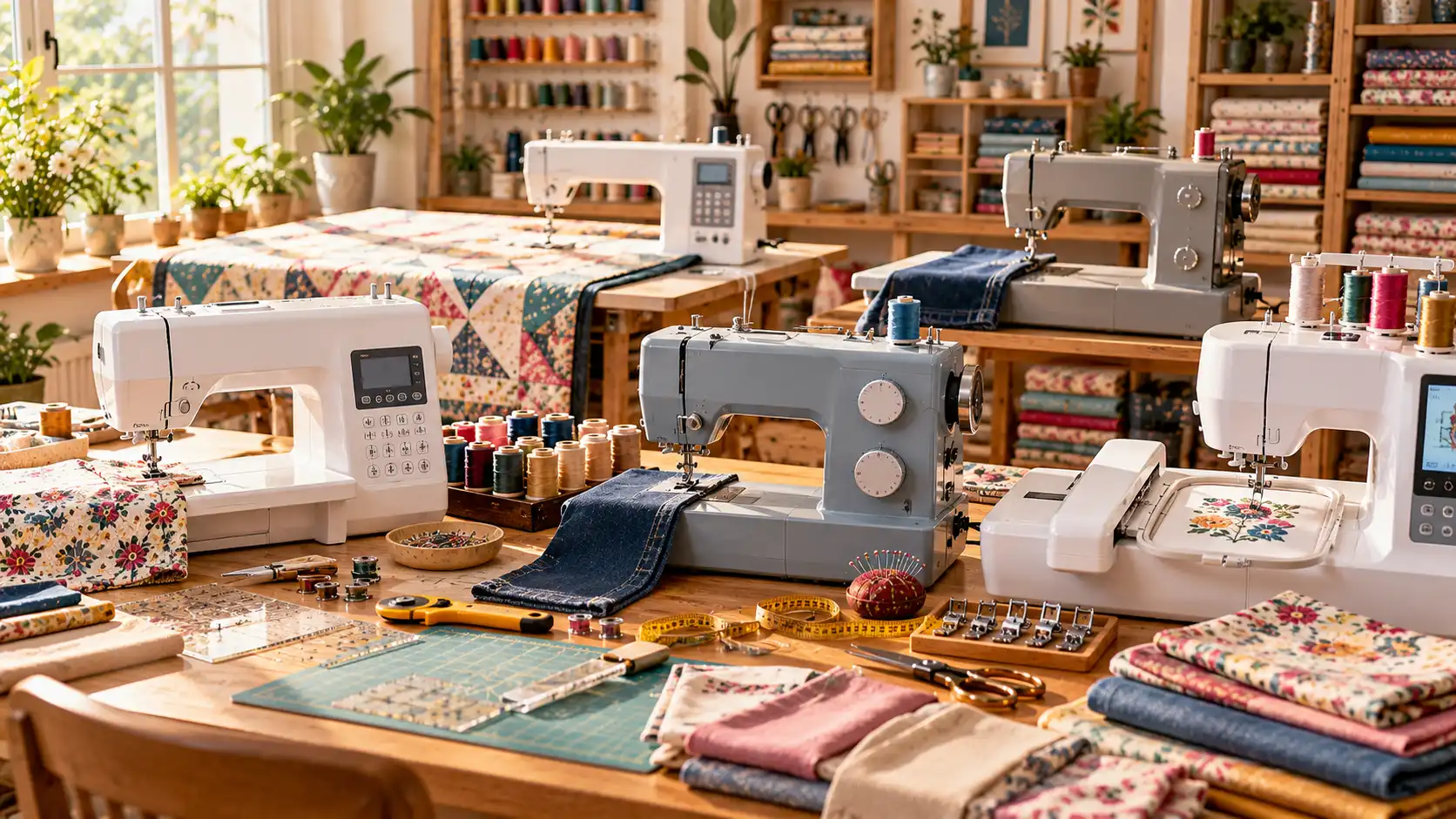
Buying a sewing machine sounds simple until you actually start shopping.
One machine has 70 stitches. Another has 37. A heavy-duty model promises to power through thick fabric, while a computerized machine offers automatic threading, speed control, dozens of stitches, and a long list of accessories. Then you find machines designed specifically for quilting, garment sewing, or embroidery.
And suddenly, choosing the best sewing machine doesn’t feel simple at all.
The real problem isn’t finding a machine with the most features. It’s finding one that fits the way you actually sew.
If you’re not sure which category fits your projects, our guide to the different types of sewing machines is a good place to start.
A beginner may need straightforward controls and room to grow. Someone sewing denim needs dependable fabric feeding and enough power for heavier layers. A quilter may care more about workspace and stitch control, while someone making clothes needs reliable buttonholes, useful stretch stitches, and consistent stitching across different fabrics.
That’s why we didn’t treat “best” as a single-size-fits-all label. We compared machines by the problems they are designed to solve, looked at current manufacturer specifications and availability, considered independent hands-on testing and expert reviews, and evaluated where each machine makes the most sense for a real sewist.
For example, TechGearLab tested several machines in our lineup across fabrics including satin, silk, cotton jersey, and chiffon, and also evaluated demanding projects such as multi-layer denim, zippers, and quilting. Its testing found particularly strong stitch performance from models including the Brother HC1850, Juki HZL-F300, Brother CS7000X, and Singer 9960.
The result is a list of 10 machines with 10 different reasons to buy them.
Table of Contents
- 1. Quick Answer: The Best Sewing Machines of 2026
- 2. Which Sewing Machine Should You Actually Buy?
- 2.1. If You Want One Machine for Most Everyday Sewing
- 2.2. If Your Budget Is the Main Concern
- 2.3. If You're Completely New to Sewing
- 2.4. If You Sew Denim, Canvas, or Multiple Layers
- 2.5. If Quilting Is Your Main Hobby
- 2.6. If You Mainly Make Clothes
- 2.7. If You've Outgrown Your First Sewing Machine
- 2.8. If You Want a Premium Sewing Machine
- 2.9. If You Need Something Lightweight
- 2.10. If You Want Sewing and Embroidery in One Machine
- 3. 1. Brother CS7000X — Best Overall
- 4. 2. Janome 2212 — Best Budget Sewing Machine
- 5. 3. Brother ST371HD — Best Beginner Sewing Machine
- 6. 4. Singer Heavy Duty 4452 — Best Heavy-Duty Sewing Machine
- 7. 5. Juki TL-2010Q — Best Sewing Machine for Quilting
- 8. 6. Brother HC1850 — Best Sewing Machine for Making Clothes
- 9. 7. Singer Quantum Stylist 9960 — Best Sewing Machine for Advanced Sewists
- 10. 8. Juki HZL-F600 — Best Premium Sewing Machine
- 11. 9. Brother GX37 — Best Lightweight Sewing Machine
- 12. 10. Brother SE2000 — Best Sewing & Embroidery Machine
- 13. 11. Is a Used or Vintage Sewing Machine Worth Buying?
- 14. Mechanical vs. Computerized Sewing Machines
- 15. Essential Sewing Machine Features That Actually Matter
- 15.1. 1. Stitch Quality
- 15.2. 2. Fabric Feeding
- 15.3. 3. Adjustable Sewing Speed
- 15.4. 4. Automatic Needle Threader
- 15.5. 5. Bobbin System
- 15.6. 6. One-Step Buttonhole
- 15.7. 7. Needle Up/Down
- 15.8. 8. Free Arm
- 15.9. 9. Adjustable Presser-Foot Pressure
- 15.10. 10. Automatic Thread Cutter
- 15.11. 11. Extension Table
- 15.12. 12. Walking Foot
- 15.13. 13. Drop Feed
- 15.14. 14. Machine Weight and Stability
- 15.15. 15. Presser Feet and Accessories
- 15.16. 16. Workspace
- 15.17. 17. Built-In Stitch Count
- 16. Which Features Matter Most for Different Sewists
- 17. How Much Should You Spend on a Sewing Machine?
- 17.1. Under $150: Basic Sewing and Occasional Use
- 17.2. $150–$300: The Sweet Spot for Many Home Sewists
- 17.3. $300–$600: More Capability for Serious Hobbyists
- 17.4. $600–$1,000+: Advanced Sewing
- 17.5. $1,000+: Premium and Specialized Machine
- 17.6. What About Sewing for Income?
- 17.7. Don't Forget the Cost of Everything Around the Machine
- 17.8. A Simple Sewing Machine Budget Guide
- 18. How to Choose the Best Sewing Machine for Your Needs
- 19. The Biggest Buying Mistake to Avoid
- 20. How to Maintain Your Sewing Machine
- 20.1. 1. Clean the Machine Regularly
- 20.2. 2. Clean the Bobbin Area
- 20.3. 3. Change Your Needle Regularly
- 20.4. 4. Use the Correct Needle for the Fabri
- 20.5. 5. Keep the Machine Covered
- 20.6. 6. Don't Ignore the Thread
- 20.7. 7. Re-Thread Before Adjusting Tension
- 20.8. 8. Oil Only When the Manufacturer Says To
- 20.9. 9. Listen for Changes
- 20.10. 10. Check the Feed Dogs
- 20.11. 11. Clean Your Presser Feet
- 20.12. 12. Don't Pull the Fabric
- 20.13. 13. Have the Machine Professionally Serviced
- 20.14. A Simple Maintenance Schedule
- 21. Common Sewing Machine Problems You Can Often Troubleshoot
- 22. Sewing Machine FAQ
- 22.1. 1. Do I need a computerized sewing machine as a beginner, or is mechanical fine?
- 22.2. 2. Can I learn to sew on a cheap sewing machine?
- 22.3. 3. Top-load vs. front-load bobbin: does it matter for beginners?
- 22.4. 4. Do beginner sewing machines work for quilting?
- 22.5. 5. Is a serger the same thing as a sewing machine?
- 22.6. 6. What is the best sewing machine for beginners
- 22.7. 7. What is the best sewing machine for making clothes?
- 22.8. 8. What is the best sewing machine for quilting?
- 22.9. 9. Can I sew denim on a regular sewing machine?
- 22.10. 10. My sewing machine is making a grinding noise. Do I need a new one?
- 22.11. 11. How often should I clean my sewing machine?
- 22.12. 12. How long should a sewing machine last?
- 22.13. 13. Should I buy a sewing machine online or from a dealer?
- 22.14. 14. Is an expensive sewing machine always better?
- 22.15. 15. Should I buy a used or vintage sewing machine?
- 22.16. Final FAQ Takeaway
- 23. Conclusion: Choose the Machine That Fits Your Sewing
Quick Answer: The Best Sewing Machines of 2026
Best Overall: Brother CS7000X (go to the product review)
Best Budget: Janome 2212
Best Beginner Sewing Machine: Brother ST371HD
Best Heavy-Duty: Singer Heavy Duty 4452
Best Sewing Machine for Quilting: Juki TL-2010Q
Best Sewing Machine for Making Clothes: Brother HC1850
Best for Advanced Sewists: Singer Quantum Stylist 9960
Best Premium Sewing Machine: Juki HZL-F600
Best Lightweight Sewing Machine: Brother GX37
Best Sewing & Embroidery Machine: Brother SE2000
The Brother CS7000X takes our top spot because it offers a particularly useful balance of versatility, convenience, and value. Brother currently lists 70 built-in stitches, automatic needle threading, speed control, a wide table, 10 included presser feet, and a Quick-Set bobbin system. Independent testing has also found it to be a strong all-around performer across several common fabrics and projects.
But “best overall” doesn’t mean it is automatically the right choice for you.
If you’re trying to spend as little as possible, the Janome 2212 may make more sense. If you’re learning from scratch, the Brother ST371HD offers a simpler path into sewing. If you regularly work with heavier fabrics, the Singer Heavy Duty 4452 solves a different problem entirely.
That’s the key to using this guide: don’t choose the machine with the longest feature list. Choose the machine that solves your sewing problem.
A note about our recommendations
Sewing machines change over time. Models can be discontinued, replaced, or become harder to find, while prices can vary significantly between retailers.
For that reason, we focus on why a machine is worth considering, rather than treating a temporary price or a large stitch count as proof that it is better.
And every recommendation has a limitation. A machine that is excellent for one sewist can be a frustrating choice for another.
That’s why you’ll find a “Skip This Machine If…” section in every review below.
Because sometimes the most useful thing we can tell you isn’t why you should buy a machine, it’s when you shouldn’t.
Which Sewing Machine Should You Actually Buy?
The best sewing machine for you depends less on your sewing level and more on what you expect the machine to do.
Think about your next few projects, not just the project sitting on your table today. A machine that works beautifully for simple repairs may become frustrating if you start making quilts. A lightweight beginner machine may be perfect for learning but limiting once you start sewing heavier fabrics.
Here’s the simplest way to narrow down the choices.
If You Want One Machine for Most Everyday Sewing
Choose the Brother CS7000X.
This is our Best Overall because it offers a broad range of useful features without pushing you into the price or complexity of a premium machine. It’s a sensible starting point for clothing repairs, crafts, quilting projects, home sewing, and everyday alterations.
If you’re thinking, “I don’t know exactly what I’ll sew yet, but I want a machine that gives me room to experiment,” this is the machine I’d look at first.
If Your Budget Is the Main Concern
Choose the Janome 2212.
Sometimes you don’t need a computerized machine with dozens of automated features. If your goal is straightforward sewing at a lower price, a simple mechanical machine can make more sense.
The Janome 2212 is particularly appealing if you prefer physical dials and uncomplicated controls.
If You're Completely New to Sewing
Choose the Brother ST371HD.
Your first machine shouldn’t make learning harder than it already is.
You want controls you can understand, useful everyday stitches, straightforward threading, and enough capability that you won’t immediately feel forced to upgrade.
The ST371HD is our choice for beginners because it gives you that balance without overwhelming you with unnecessary complexity.
If You Sew Denim, Canvas, or Multiple Layers
Choose the Singer Heavy Duty 4452.
This is where choosing a machine based purely on popularity can go wrong.
A machine designed primarily for lightweight home sewing isn’t necessarily the right tool for thick denim seams, canvas bags, or multiple layers of fabric.
If heavier materials are a regular part of your sewing, the 4452 deserves your attention.
If Quilting Is Your Main Hobby
Choose the Juki TL-2010Q.
Quilters have different priorities from someone who mainly alters clothing.
Workspace, fabric control, straight-stitch quality, speed control, and handling large pieces of material become much more important.
The TL-2010Q is a particularly specialized choice, and that’s exactly why it stands out.
If You Mainly Make Clothes
Choose the Brother HC1850.
Garment sewing requires more than simply having a lot of stitches.
You need useful stitch options, reliable fabric feeding, practical buttonholes, and enough control to work with different fabrics.
The HC1850 is our choice for sewists who expect clothing construction to be a major part of their sewing.
If You've Outgrown Your First Sewing Machine
Choose the Singer Quantum Stylist 9960.
This is a different situation from buying your first machine.
Maybe you’ve already learned how to thread a machine, sew seams, install zippers, make buttonholes, and finish basic projects. Now you’re starting to notice what your current machine can’t do.
That’s when a more capable computerized machine starts to make sense.
The 9960 gives experienced sewists a much broader set of stitches and controls to explore.
If You Want a Premium Sewing Machine
Choose the Juki HZL-F600.
If you’re willing to spend more for advanced features, greater control, and a more sophisticated sewing experience, the HZL-F600 is our premium pick.
The important question, though, is whether those additional capabilities will actually improve your sewing.
If you mostly sew simple repairs once a month, probably not.
If you sew frequently and want a machine you can grow into, the answer may be very different.
If You Need Something Lightweight
Choose the Brother GX37.
Not everyone has a permanent sewing room.
If your machine needs to come out of a closet, sit on a dining table, and then be packed away again, size and weight become part of the buying decision.
The GX37 is designed around simplicity rather than an enormous collection of computerized features.
If You Want Sewing and Embroidery in One Machine
Choose the Brother SE2000.
This is the choice for someone who doesn’t want to buy a conventional sewing machine now and an embroidery machine later.
The SE2000 combines sewing and computerized embroidery in one machine, making it a very different proposition from the other models in this guide.
If embroidery isn’t something you plan to do, however, there’s little reason to spend extra money on those capabilities.
1. Brother CS7000X — Best Overall
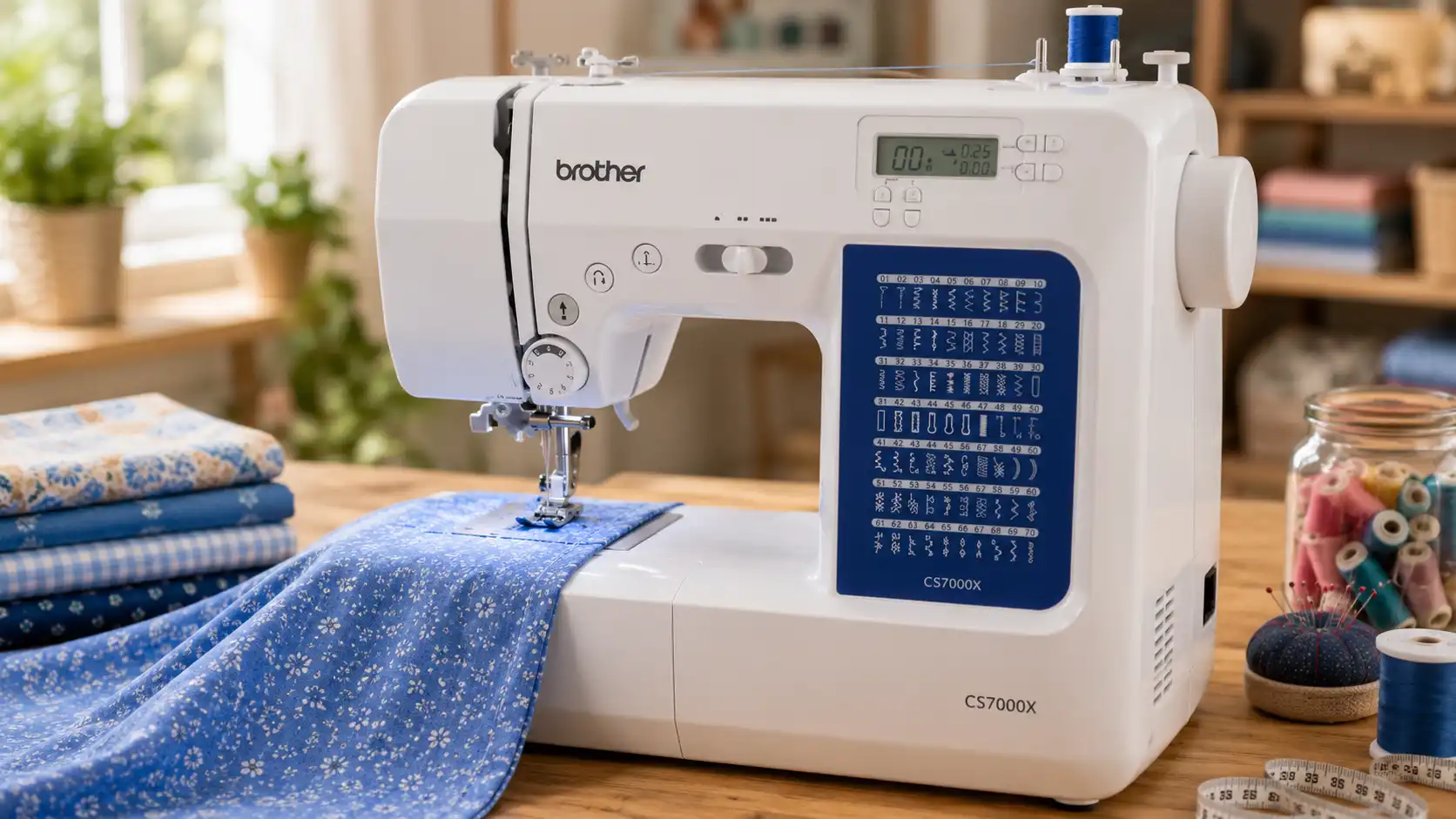
If you want one sewing machine that can handle a wide range of everyday projects without becoming complicated, the Brother CS7000X is our top pick.
It hits a useful middle ground. You get computerized controls, 70 built-in stitches, seven one-step buttonhole styles, adjustable sewing speed, automatic needle threading, a Quick-Set bobbin, a wide extension table, and 10 included presser feet. Brother also includes a walking foot and quilting foot, which makes the machine more versatile than its relatively modest price suggests. (Brother)
Why We Picked the Brother CS7000X
The biggest reason is balance.
You don’t need to spend hundreds or thousands of dollars more just to get useful features. At the same time, you aren’t locked into the limitations of a very basic mechanical machine.
The CS7000X gives a beginner enough guidance to get started while providing enough flexibility for someone whose projects become more ambitious over time.
That versatility is supported by independent testing. Better Homes & Gardens tested 24 sewing machines over more than 44 hours and named the CS7000X its Best Overall machine, praising its combination of user-friendliness, performance, and value. (Better Homes & Gardens)
TechGearLab also found the CS7000X particularly easy to operate, giving it a 9.2/10 for ease of use in its testing. It successfully handled basic stitches across multiple fabrics and even sewed through eight layers of 12-ounce denim without struggling. (TechGearLab)
That doesn’t mean it’s perfect.
What We Like
- 70 built-in stitches give you plenty of room to experiment without overwhelming you with hundreds of options.
- Automatic needle threading makes setup easier once you get used to the mechanism.
- Adjustable sewing speed is useful when you’re learning or working on precise sections.
- Quick-Set bobbin makes bobbin installation straightforward.
- 10 presser feet cover many common sewing tasks.
What We Don't Like
The CS7000X isn’t the machine I’d choose if perfect buttonholes are your highest priority.
TechGearLab’s testing found that buttonholes were the machine’s biggest weakness. It produced clean results on cotton muslin but struggled more with materials such as jersey and silk, including uneven stitching and tight sections that could make the buttonhole difficult to open. (TechGearLab)
The LCD screen is also small and unlit, although the machine’s sewing light itself performed well in TechGearLab’s testing. (TechGearLab)
Skip This Machine If...
You regularly make garments where buttonhole quality is critical, or you primarily sew demanding heavy-duty materials.
The CS7000X can handle a surprising amount for its size, but that doesn’t make it a dedicated heavy-duty or premium garment machine. If thick fabric is your main concern, the Singer Heavy Duty 4452 later in this guide is a more appropriate choice. If advanced garment sewing is your priority, the Singer Quantum Stylist 9960 deserves a closer look.
Key Specifications
Feature | Brother CS7000X |
Machine type | Computerized |
Built-in stitches | 70 |
Buttonhole styles | 7 |
Maximum sewing speed | 750 stitches/minute |
Bobbin | Quick-Set, top-loading |
Needle threader | Automatic |
Presser feet included | 10 |
Free arm | Yes |
Extension table | Yes |
Walking foot | Included |
Quilting foot | Included |
Weight | 10.5 lb |
Warranty | 25-year limited warranty |
Manufacturer specifications are based on Brother’s current product listing. (Brother)
Our Verdict
The Brother CS7000X is the best sewing machine for the person who wants versatility without unnecessary complexity or a premium price.
It’s particularly compelling if you’re starting out but don’t want to buy a machine you’ll immediately outgrow.
The most convincing part isn’t its 70 stitches. It’s the combination of easy controls, useful accessories, speed control, quilting capability, and broad everyday versatility.
And that’s why it earns the Best Overall position in our lineup.
2. Janome 2212 — Best Budget Sewing Machine
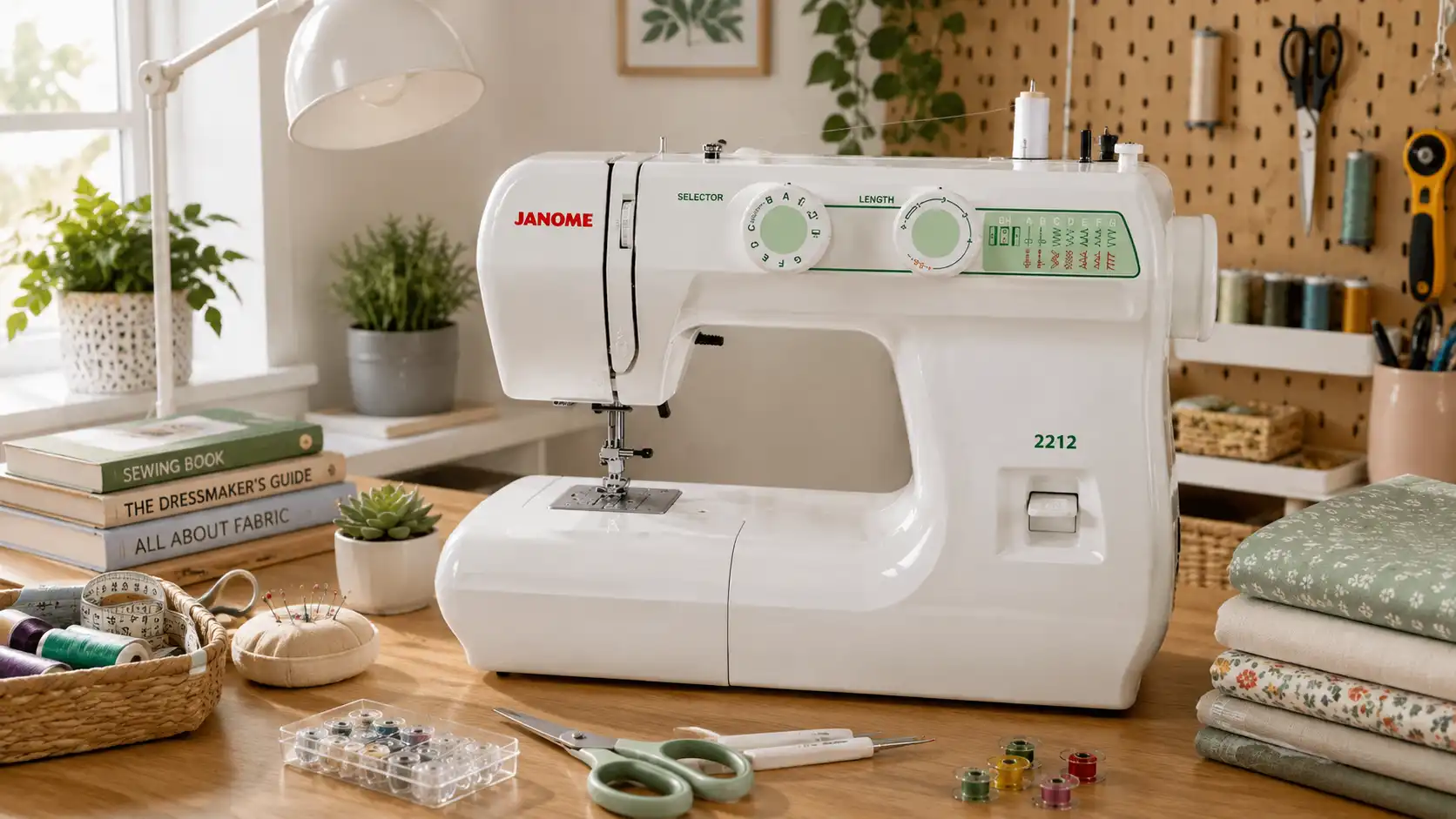
When you’re buying your first sewing machine, it’s easy to assume that spending more automatically means getting a better machine.
It doesn’t.
If your main goal is hemming clothes, making simple repairs, sewing basic garments, or learning the fundamentals, you may not need a computerized machine with dozens of automated features. The Janome 2212 takes the opposite approach: it keeps things simple and focuses on the basic tools you actually need to sew.
That’s why we’ve chosen it as our Best Budget Sewing Machine.
Why We Picked the Janome 2212
The Janome 2212 is a mechanical sewing machine built around straightforward controls. It has 12 built-in stitches, adjustable stitch length and width, a four-step buttonhole, a free arm, and a front-loading bobbin system.
There’s no LCD screen to navigate and no large menu of computerized settings to learn. You select your stitch with a dial and adjust the settings you need.
For someone who finds computerized machines intimidating, that simplicity can be an advantage.
Recent hands-on reviews also consistently describe the 2212 as a practical machine for beginners and everyday sewing. One 2026 review found it handled cotton, light denim, knit fabric, and basic quilting during several weeks of use, while noting that its limitations become more noticeable with stretch fabrics and modern convenience features.
There’s also some interesting long-term community experience behind this model. In a recent r/sewing discussion, a sewing teacher said they had used Janome 2212 machines for teaching since 2009 and described them as reliable and easy to maintain, reporting that students had used them for projects ranging from quilts to overalls and canvas. That’s one user’s experience rather than a controlled test, but it illustrates why this simple mechanical design continues to appeal to sewists.
What We Like
- Simple mechanical controls make it easy to understand what each setting does.
- 12 useful stitches cover the fundamentals without overwhelming a beginner.
- Adjustable stitch length and width give you more control than very basic entry-level machines.
- Four-step buttonhole lets you make basic buttonholes without buying a separate attachment.
- Free arm is useful for sleeves, cuffs, hems, and other narrow areas.
What We Don't Like
The biggest drawback is that the Janome 2212 doesn’t offer many of the conveniences you’ll find on similarly priced computerized machines.
There’s no automatic needle threader, and the buttonhole is a four-step design rather than the one-step systems found on many computerized competitors. It also doesn’t provide the kind of speed-control and electronic assistance that some beginners appreciate.
Its limitations become more noticeable when you move into stretch fabrics. Recent hands-on testing has reported inconsistent results on highly elastic fabrics, while another 2026 review noted that the machine is better suited to straightforward everyday sewing than demanding or industrial-type work.
That’s not necessarily a deal-breaker. It simply tells you what kind of machine you’re buying.
Skip This Machine If...
You want automatic needle threading, one-step buttonholes, speed control, extensive decorative stitches, or regularly work with challenging stretch fabrics.
In that situation, spending a little more on a computerized machine such as the Brother CS7000X or choosing a different machine designed around your specific projects may save you frustration.
Key Specifications
Feature | Janome 2212 |
Machine type | Mechanical |
Built-in stitches | 12 |
Buttonhole | 4-step |
Stitch width | Up to 5 mm |
Stitch length | Up to 4 mm |
Bobbin | Front-loading |
Needle threader | Manual |
Free arm | Yes |
Drop feed | Yes |
Presser feet | 6 |
Maximum sewing speed | Up to 860 stitches/minute |
Weight | About 13 lb |
Warranty | 25-year limited warranty |
Specifications can vary by market and package, so check the manufacturer’s current documentation and retailer listing before purchasing.
Who Should Buy the Janome 2212?
The best match is someone who says:
“I don’t need my sewing machine to do everything. I just want a reliable machine that teaches me the basics and handles everyday sewing.”
That’s where the Janome 2212 makes sense.
It’s particularly suitable for:
- hemming pants and skirts
- basic clothing repairs
- simple garments
- pillow covers
- tote bags
Our Verdict
The Janome 2212 is our Best Budget Sewing Machine because it focuses on the fundamentals rather than loading the machine with features you may never use.
It’s not the most technologically advanced machine on this list, and that’s precisely the point.
If your priority is simple, affordable mechanical sewing, the 2212 is a sensible choice. If you want more automation, easier buttonholes, speed control, or greater versatility, the Brother CS7000X, higher up our list, is likely the better investment.
For a budget machine, knowing what you’re not getting is just as important as knowing what you are.
3. Brother ST371HD — Best Beginner Sewing Machine
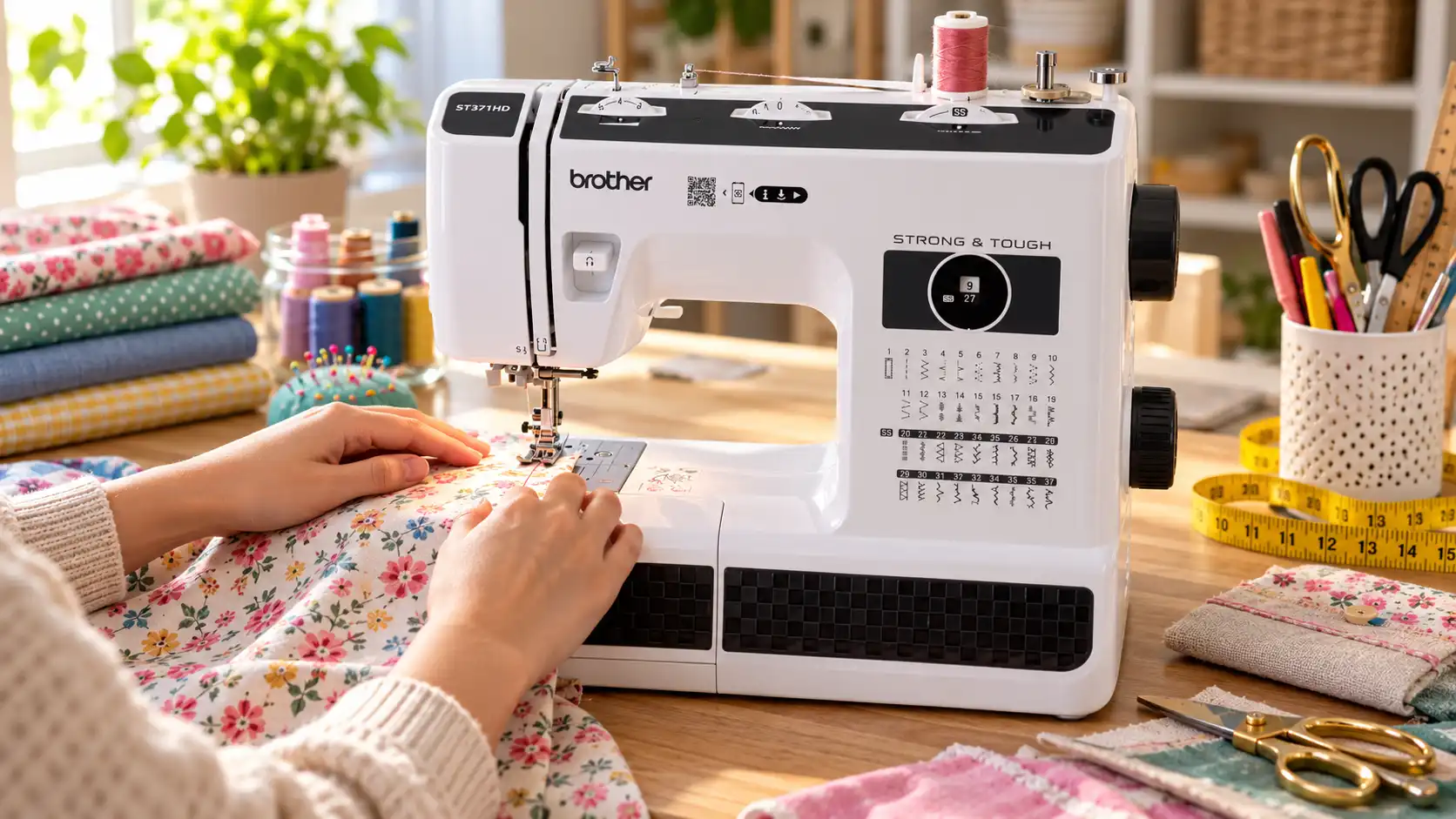
Starting your first sewing project can be intimidating enough without having to learn a complicated machine at the same time.
That’s why we don’t think the best beginner sewing machine should simply be the cheapest model you can find. A good first machine should make the fundamentals easier to learn while giving you enough flexibility to move beyond simple practice seams.
For that reason, the Brother ST371HD earns our Best Beginner Sewing Machine award.
Why We Picked the Brother ST371HD
The ST371HD takes a straightforward mechanical approach. It has 37 built-in stitches, a one-step automatic buttonhole, an automatic needle threader, a Quick-Set drop-in bobbin, six included presser feet, a free arm, and drop-feed capability. Brother also includes heavyweight needles and a metal needle plate designed to help with fabric feeding. (Brother)
That combination is useful for a beginner because you get the important sewing functions without having to navigate a large computerized menu.
The Spruce independently tested 27 sewing machines and selected the ST371HD as its top beginner pick, highlighting its straightforward interface, fabric handling, quiet operation, 37 stitches, and automatic buttonhole. Its testers also found it capable of handling both lighter cotton and thicker denim. (The Spruce)
There’s a particularly useful point here: 37 stitches are enough for most beginners.
You don’t need hundreds of decorative stitches to learn how to sew. Straight stitching, zigzag stitching, stretch stitches, buttonholes, zipper sewing, and basic finishing techniques will take you a long way.
What We Like
- Simple mechanical controls make the machine relatively easy to understand.
- 37 built-in stitches provide useful variety without becoming overwhelming.
- One-step automatic buttonhole is a valuable feature for beginners.
- Automatic needle threader simplifies one of the more frustrating setup tasks.
- Quick-Set drop-in bobbin makes bobbin installation straightforward.
What We Don't Like
The ST371HD is a mechanical machine, so you won’t get some of the conveniences found on the Brother CS7000X.
There’s no computerized display, start/stop button, automatic thread cutter, or electronic speed-control system. You’re working directly with the machine’s dials and foot pedal.
That simplicity is helpful for learning, but it may feel limiting once you become an experienced sewist.
There’s also an important contradiction in the independent evidence worth knowing about. The Spruce’s more recent testing recommends the ST371HD as its top beginner machine, while TechGearLab’s older hands-on testing scored it poorly, citing mediocre stitch quality and below-average buttonholes. (The Spruce)
That’s exactly why we don’t want to present any sewing machine as perfect.
Different testing methods, samples, and use cases can produce different results.
Skip This Machine If...
You want computerized convenience, extensive stitch customization, automatic thread cutting, or a machine that can grow into more advanced sewing without eventually needing an upgrade.
In that case, the Brother CS7000X is the better choice.
And if you already know that you’ll be sewing thick denim, canvas, or multiple layers regularly, the Singer Heavy Duty 4452 later in this guide is worth considering instead.
Key Specifications
Feature | Brother ST371HD |
Machine type | Mechanical |
Built-in stitches | 37 |
Buttonhole styles | 1 one-step |
Maximum sewing speed | 800 stitches/minute |
Bobbin | Quick-Set drop-in |
Needle threader | Automatic |
Presser feet included | 6 |
Free arm | Yes |
Drop feed | Yes |
Automatic thread cutter | No |
Start/stop button | No |
Weight | 14.3 lb |
Dimensions | 12.21 × 16.10 × 7.87 in |
Specifications are based on Brother’s current product information. (Brother)
Who Should Buy the Brother ST371HD?
This machine makes the most sense if you’re thinking:
“I want to learn properly, but I don’t want my first sewing machine to feel complicated.”
It’s a good fit for:
- beginners learning basic sewing
- clothing repairs
- simple garments
- craft projects
- hemming
There’s also an advantage to learning on a mechanical machine: you become more familiar with stitch length, width, and thread tension instead of relying on a computer to make every adjustment for you.
The Spruce’s testing team made a similar point, noting that the machine’s dials and knobs give beginners direct control over stitch selection, width, length, and tension. (The Spruce)
Our Verdict
The Brother ST371HD is a strong choice if your priority is learning sewing without unnecessary complexity.
It doesn’t try to compete with premium computerized machines. Instead, it gives you the fundamentals: useful stitches, an automatic buttonhole, easy needle threading, practical presser feet, and a straightforward mechanical interface.
Its biggest advantage is also its biggest limitation: simplicity.
If that’s what you’re looking for, it’s a very sensible first machine. If you already know you want advanced computerized features, the Brother CS7000X, higher on our list, is the better long-term choice.
4. Singer Heavy Duty 4452 — Best Heavy-Duty Sewing Machine
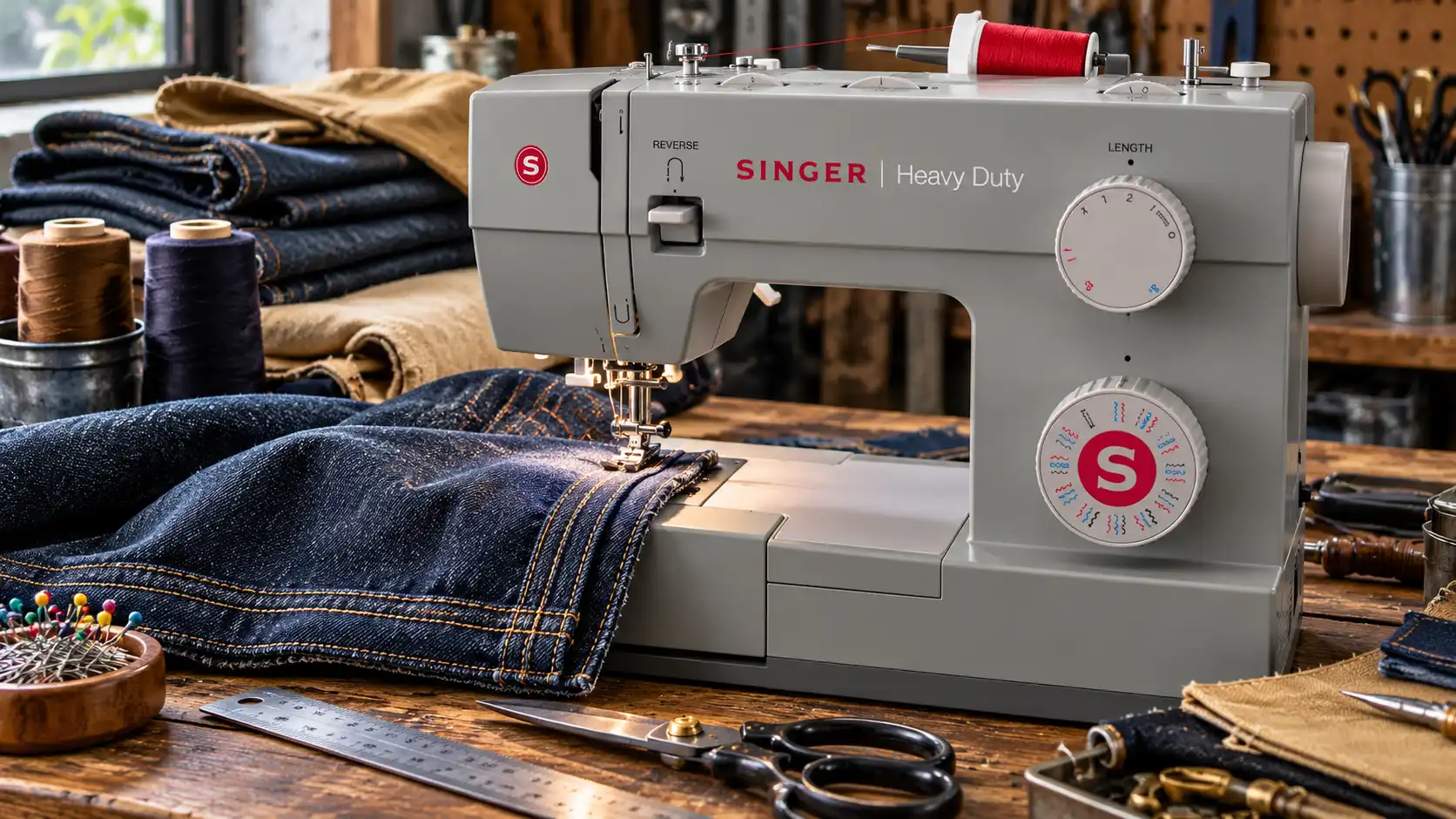
The needle struggles. The fabric barely moves. The motor sounds unhappy. You start wondering whether you chose the wrong machine in the first place.
That’s why we don’t think the best beginner sewing machine should simply be the cheapest model you can find. A good first machine should make the fundamentals easier to learn while giving you enough flexibility to move beyond simple practice seams.
That’s the problem the Singer Heavy Duty 4452 is designed to address.
It isn’t the machine I’d recommend simply because the word Heavy Duty appears on the front. In fact, independent testing has raised legitimate questions about how well the 4452 lives up to that name. But for sewists who want a fast mechanical machine with a metal frame, strong motor, and useful heavy-fabric features, it remains an important option to consider.
Why We Picked the Singer 4452
The 4452 is built around a straightforward mechanical design rather than computerized controls.
Singer lists 32 built-in stitches and 110 stitch applications, a maximum sewing speed of 1,100 stitches per minute, a one-step buttonhole, adjustable presser-foot pressure, an automatic needle threader, a built-in thread cutter, and a top-loading bobbin. It also includes a non-stick foot, even-feed/walking foot, zipper foot, button-sewing foot, and all-purpose foot. (Needle Down)
Those features make the 4452 particularly interesting for projects involving denim, canvas, multiple fabric layers, bags, home décor, and other medium-to-heavy materials.
But there’s an important distinction.
A “heavy-duty” home sewing machine isn’t an industrial machine. If you’re regularly sewing upholstery, thick leather, or very demanding commercial work, you may need a specialized or industrial machine instead.
What We Like
- 1,100 stitches per minute gives experienced users plenty of speed for long seams.
- 32 built-in stitches / 110 applications cover everyday utility and decorative sewing.
- One-step buttonhole is more convenient than the four-step systems found on some inexpensive mechanical machines.
- Adjustable presser-foot pressure can help when working with different fabric types.
- The automatic needle threader makes setup easier.
What We Don't Like
Here’s where we need to be honest.
The 4452’s reputation isn’t completely consistent.
TechGearLab tested the machine and gave it an overall score of 57, with particularly disappointing results in its sewing tests. Its testers reported inconsistent thread tension, weak zigzag performance, and poor results when sewing multiple layers of denim. In one denim test, the needle even bent and struck the presser plate. (TechGearLab)
That’s a significant criticism, especially for a machine marketed as heavy-duty.
At the same time, more recent owner experiences are considerably more positive. A recent Reddit discussion includes owners reporting years of trouble-free use, while others describe the 4452 as noisy, fast, or inconsistent. In other words, the owner experience appears to vary considerably. (Reddit)
That difference is worth telling you rather than hiding it.
Skip This Machine If...
You expect a home sewing machine to behave like an industrial machine.
The 4452 can be a useful choice for heavier home sewing, but don’t buy it expecting it to effortlessly replace an industrial machine for upholstery, thick leather, or continuous commercial production.
It’s also worth considering another model if you prioritize exceptionally consistent stitch quality over speed and mechanical simplicity.
Key Specifications
Feature | Singer Heavy Duty 4452 |
Machine type | Mechanical |
Built-in stitches | 32 |
Stitch applications | 110 |
Buttonhole | 1-step |
Maximum sewing speed | 1,100 stitches/minute |
Maximum stitch width | 6 mm |
Maximum stitch length | 4 mm |
Bobbin | Top-loading |
Needle threader | Automatic |
Free arm | Yes |
Walking/even-feed foot | Included |
Thread cutter | Built-in |
Weight | About 14.5 lb |
Specifications are based on current manufacturer/product information and independent testing. (Needle Down)
Who Should Buy the Singer 4452?
The 4452 makes the most sense if your sewing regularly involves:
- Denim
- Canvas
- Multiple layers of fabric
- Bags and totes
- Home décor projects
It’s also a good fit if you prefer mechanical controls and don’t want to learn a computerized interface.
However, if most of your sewing consists of lightweight cotton, simple garments, and occasional repairs, you may not benefit enough from the 4452’s heavy-duty design to justify choosing it over a more versatile computerized machine.
Our Verdict
The Singer Heavy Duty 4452 remains our heavy-duty pick because it offers a fast, mechanically controlled machine with features specifically aimed at heavier home sewing.
But we’re not going to pretend the “Heavy Duty” label guarantees perfect performance on every thick fabric.
Independent testing has exposed some weaknesses, while many owners report good long-term experiences. (TechGearLab)
That makes the 4452 a machine you should choose because it fits your particular projects, not because the name promises more than any home sewing machine can realistically deliver.
If you want to compare it against its lighter-duty sibling, see our full Singer Heavy Duty 4423 review.
5. Juki TL-2010Q — Best Sewing Machine for Quilting
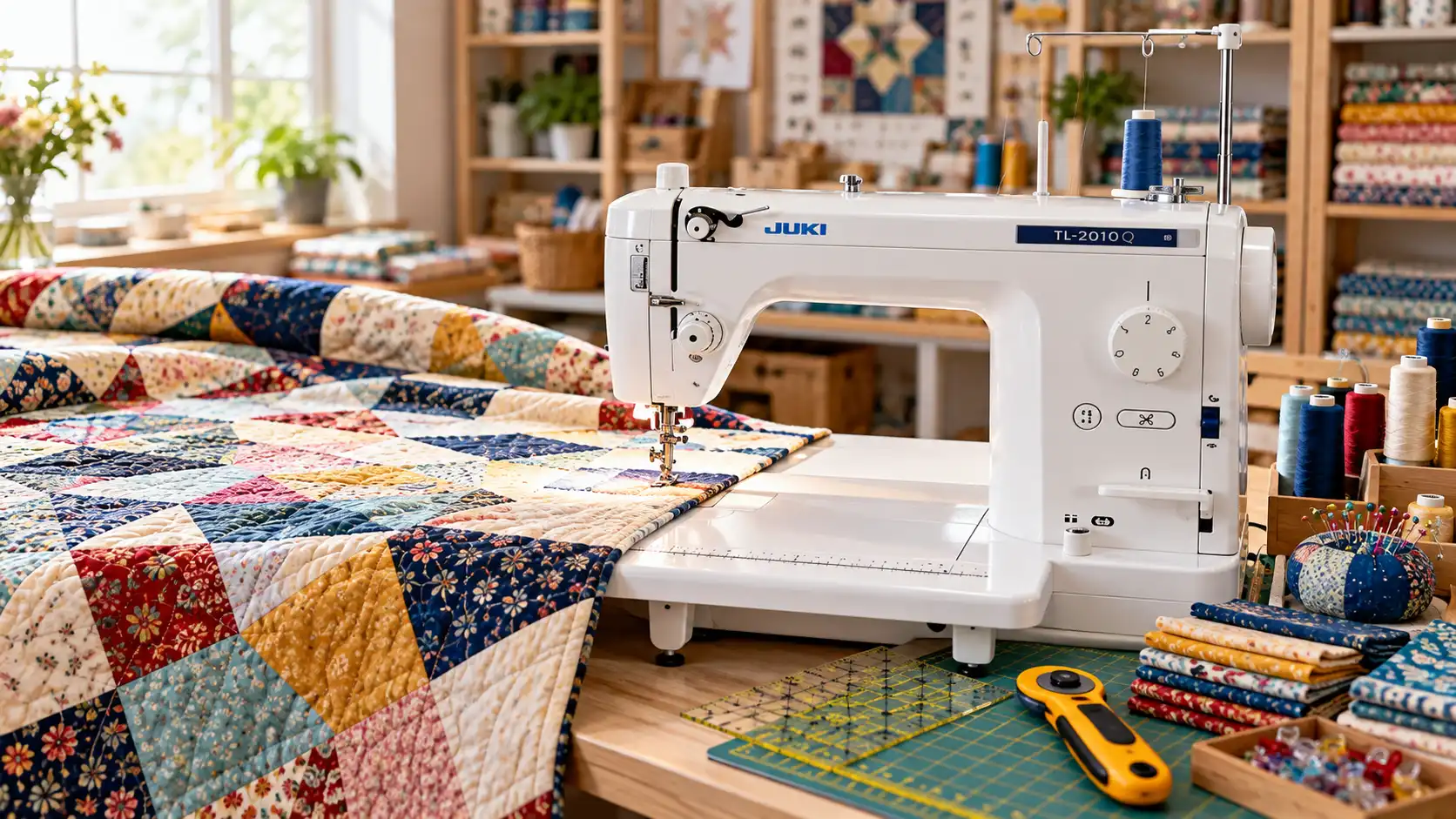
Quilting changes what you need from a sewing machine.
A machine that feels perfectly comfortable when you’re sewing a small garment can become frustrating when you’re pushing a large quilt through a cramped workspace. You need control, consistent straight stitches, room to work, and a way to manage several layers of fabric without constantly fighting the machine.
That’s where the Juki TL-2010Q stands apart.
It isn’t a general-purpose computerized machine packed with hundreds of decorative stitches. It’s a single-needle, straight-stitch machine designed specifically for precision sewing, quilting, tailoring, apparel, and home décor. JUKI classifies it among its semi-professional machines. (Juki)
Why We Picked the Juki TL-2010Q
It focuses on doing straight stitching extremely well.
The TL-2010Q combines a large work area with adjustable speed control, an automatic thread trimmer, needle-up/needle-down control, adjustable presser-foot pressure, a knee lifter, drop feed, and an included 1/4-inch quilting foot.
Its maximum sewing speed is 1,500 stitches per minute, but you can reduce the maximum speed with a slide control to make detailed quilting work easier. JUKI specifically describes this as useful for free-motion quilting and situations where you need a fixed sewing speed. (Juki)
The machine also uses an aluminum die-cast arm and bed. According to JUKI, this construction helps reduce vibration while sewing and provides a durable platform for precision stitching. (Juki)
What We Like
- Large sewing area gives you more room when working with quilts and other bulky projects.
- 1,500 SPM maximum speed is useful when sewing long seams.
- Adjustable maximum speed lets you slow the machine down for precision work.
- Automatic thread trimming cuts both needle and bobbin threads.
- The needle-down function is particularly useful when pivoting corners and working through quilted sections.
What We Don't Like
There’s one limitation you absolutely need to understand before buying this machine:
It is a straight-stitch machine.
That means you don’t get the zigzag, decorative, stretch, or utility stitch selection found on the Brother CS7000X, for example.
For a quilter who primarily pieces quilt blocks and does straight-line quilting, that’s hardly a problem.
For someone who wants one machine for sewing clothes, repairing garments, making buttonholes, and doing decorative stitching, it’s a very different story.
You also need to account for its 25.4-pound weight. JUKI calls it portable, but “portable” doesn’t mean lightweight in the same sense as a small beginner machine. (Juki)
Skip This Machine If...
You want one machine for general-purpose sewing with lots of stitch options.
The TL-2010Q is specialized.
If you need zigzag stitches, stretch stitches, decorative stitches, or automatic buttonholes, choose a conventional computerized or mechanical sewing machine instead.
And if you’re buying your first sewing machine and aren’t sure whether quilting will become your main hobby, the Brother CS7000X is a more versatile starting point.
Key Specifications
Feature | Juki TL-2010Q |
Machine type | Semi-professional / straight-stitch |
Stitch type | 1-needle lockstitch |
Maximum speed | 1,500 stitches/minute |
Speed control | Yes |
Stitch length | Up to 6 mm |
Automatic thread trimmer | Yes |
Automatic needle threader | Yes |
Needle up/down | Yes |
Drop feed | Yes |
Presser-foot pressure | Adjustable |
Knee lifter | Yes |
Auxiliary table | Included |
1/4-inch quilting foot | Included |
Even-feed foot | Included |
Weight | 25.4 lb |
Sewing area | 8.5 × 6 in. arm area |
Auxiliary table | Approximately 23 × 13 in. |
Specifications are based on JUKI’s current product information. (Juki)
Who Should Buy the Singer 4452?
This machine makes the most sense if you find yourself saying:
“Quilting is what I actually want to do. I don’t need hundreds of stitches; I need precision and control.”
It’s particularly well suited to:
- quilt piecing
- straight-line quilting
- free-motion quilting
- large quilts
- multiple fabric layers
The large auxiliary table is particularly helpful because bulky quilt projects can quickly overwhelm the small bed of an ordinary sewing machine.
And the knee lifter is one of those features that may seem unnecessary until you’ve spent hours quilting. Being able to raise the presser foot with your knee while keeping both hands on the project can make fabric positioning considerably easier.
Our Verdict
The Juki TL-2010Q is our Best Sewing Machine for Quilting because it prioritizes the things serious quilters actually need: precision straight stitching, fabric control, workspace, speed control, and features designed around quilting.
It isn’t the most versatile machine here, and that’s intentional.
If you’re looking for one machine to do a little bit of everything, choose something like the Brother CS7000X.
But if quilting is the reason you’re buying a sewing machine, the TL-2010Q’s specialized design makes much more sense.
For more on choosing a machine specifically for quilting, see our full guide to the best sewing machines for quilting and how to choose a sewing machine for quilting.
6. Brother HC1850 — Best Sewing Machine for Making Clothes
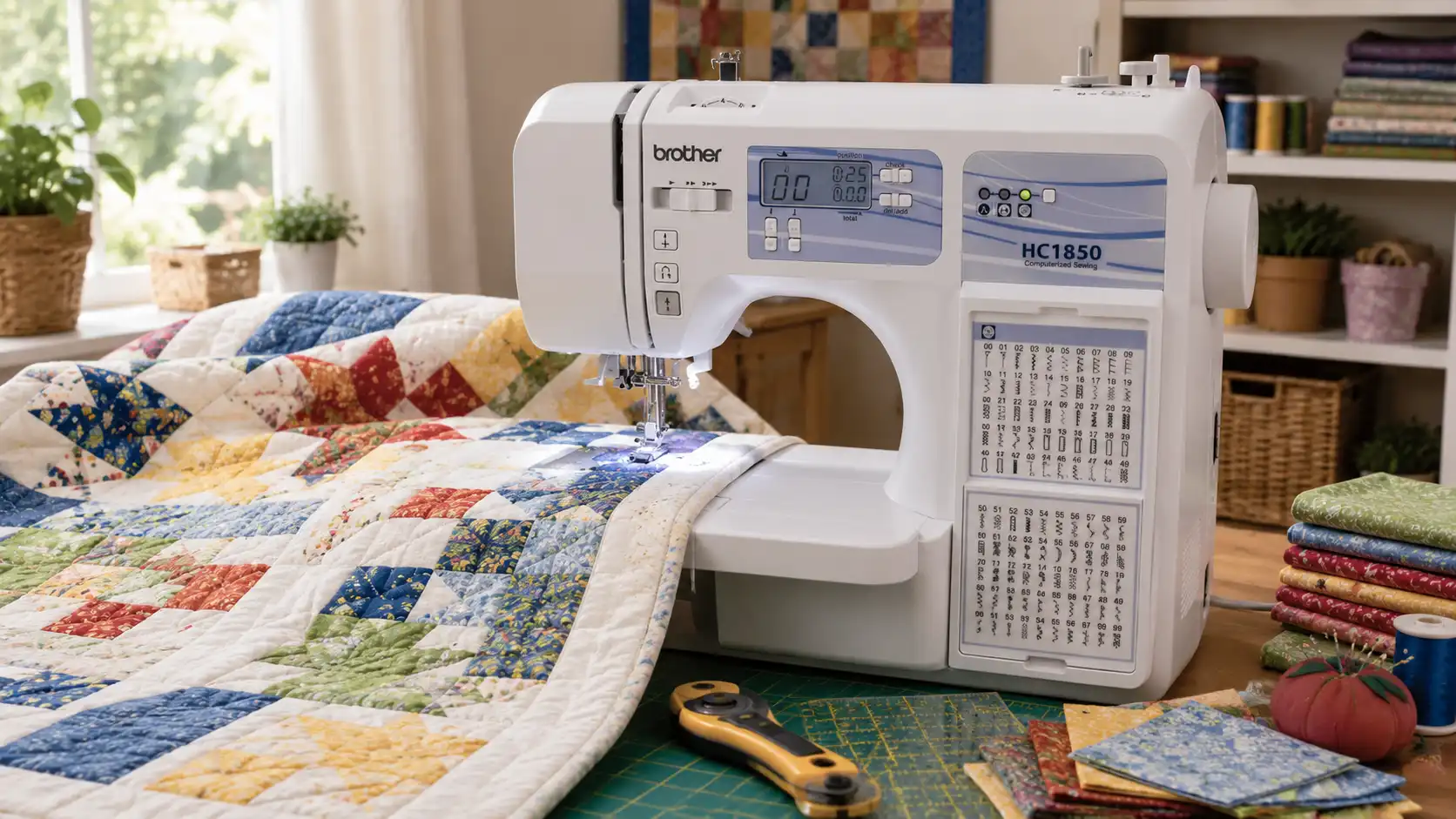
Making clothes asks more of a sewing machine than simply sewing a straight line.
You need to move from seams to curves, handle different fabric weights, create buttonholes, sew zippers, work with stretch fabrics, and make precise adjustments without constantly fighting the machine. A machine can have hundreds of stitches and still be a poor choice for garment sewing if the basics aren’t reliable.
That’s why the Brother HC1850 is our pick for the Best Sewing Machine for Making Clothes.
Why We Picked the Brother HC1850
The HC1850 is a computerized sewing machine designed around versatility. Brother lists 185 built-in stitches, including 55 alphanumeric stitches, eight one-step buttonhole styles, adjustable sewing speed, automatic needle threading, a Quick-Set bobbin, a start/stop button, and a wide detachable table. It also includes eight presser feet, including zipper, zigzag, blind-stitch, button-sewing, and buttonhole feet. (latinamerica.brother.com)
Those features matter for garment sewing because you’re rarely doing just one type of seam.
A pair of trousers might require straight stitching, a zipper, a buttonhole, edge finishing, and careful work around curved sections. A knit top introduces another challenge because stretch fabrics require different handling from woven cotton.
The HC1850 gives you a broad selection of practical stitches and controls without moving into the price and complexity of a premium machine.
Independent testing also gives this model a strong foundation. TechGearLab ranked the HC1850 #2 out of 13 machines in its testing, giving it a 79/100 overall score and a particularly strong 9.3/10 for ease of use. Its main weakness was buttonhole performance rather than general sewing capability. (TechGearLab)
What We Like
- 185 built-in stitches provide plenty of options for garment construction and decorative work.
- Eight one-step buttonhole styles give you more flexibility when making shirts, dresses, jackets, and other garments.
- Adjustable sewing speed is useful when sewing curves, corners, and detailed sections.
- Automatic needle threading simplifies machine setup.
- Quick-Set bobbin makes bobbin loading straightforward.
What We Don't Like
The HC1850 isn’t perfect for every garment sewist.
TechGearLab’s testing found that buttonholes were its biggest weakness, despite the machine’s otherwise strong performance. It scored just 5.6/10 in its buttonhole testing, with some materials producing uneven or tight stitching. (TechGearLab)
It also lacks an automatic thread cutter and adjustable presser-foot pressure. Brother’s current product specifications list the thread cutter as unavailable and presser-foot pressure as non-adjustable. (latinamerica.brother.com)
Those aren’t deal-breakers for everyday garment sewing, but they become more relevant if you’re an experienced sewist who expects premium-level control.
There’s also an important point about the machine’s age. Brother still maintains a U.S. support page and documentation for the HC1850, while its current Latin American product page remains active; it isn’t as prominently positioned in Brother’s current U.S. retail lineup as newer models. (Brother Support)
Check current Amazon availability before purchasing, because availability can change.
Skip This Machine If...
You want a current-generation premium machine with automatic thread cutting, adjustable presser-foot pressure, or advanced garment-sewing controls.
You should also look elsewhere if you’re specifically looking for an embroidery machine. The HC1850 can create basic lettering with its built-in alphanumeric stitches, but it is not an embroidery machine with an embroidery hoop and a computerized embroidery system. (latinamerica.brother.com)
If you want sewing and embroidery together, our Brother SE2000 later in this guide is the more appropriate choice.
Key Specifications
Feature | Brother HC1850 |
Machine type | Computerized |
Built-in stitches | 185 |
Alphanumeric stitches | 55 |
Buttonhole styles | 8 one-step |
Maximum sewing speed | 850 stitches/minute |
Stitch width | Up to 7 mm |
Stitch length | Up to 5 mm |
Bobbin | Quick-Set, top-loading |
Needle threader | Automatic |
Start/stop button | Yes |
Speed control | Yes |
Needle up/down | Yes |
Presser feet included | 8 |
Wide table | Yes |
Automatic thread cutter | No |
Adjustable presser-foot pressure | No |
Weight | About 13.2 lb |
Specifications are based on Brother’s current HC1850 documentation/product information. (latinamerica.brother.com)
What Makes a Sewing Machine Good for Making Clothes?
For garment sewing, don’t get distracted by stitch count alone. What matters is good buttonholes, stretch stitches for knits, a zipper foot, adjustable speed, needle up/down for pivoting corners, reliable fabric feeding, and enough workspace for larger pieces. The HC1850 checks these boxes, which is why its versatility matters more to us than its 185-stitch count.
A July 2026 r/sewing discussion involved a sewist choosing between the HC1850 and Singer Quantum Stylist 9960 specifically for making apparel, weighing practical requirements like a top-loading bobbin and easy buttonholes rather than chasing the highest stitch count (Reddit), exactly the approach we’d recommend: ask what makes your actual sewing easier, not which machine has the biggest number on the box.
Who Should Buy the Brother HC1850?
The HC1850 is particularly suitable for someone who wants to make:
- Dresses
- Skirts
- Shirts
- Children’s clothing
- Pajamas
It’s especially attractive if you’re moving beyond basic repairs and want a machine that gives you more stitch and buttonhole options without jumping immediately into premium pricing.
Our Verdict
The Brother HC1850 is our Best Sewing Machine for Making Clothes because it combines useful garment-sewing features with a relatively approachable computerized interface.
Its 185 stitches aren’t the main reason we recommend it. The more important combination is buttonhole variety, speed control, needle positioning, useful presser feet, easy threading, and versatile stitch options.
There is one caveat: its current U.S. retail availability isn’t as straightforward as some newer Brother models, so verify that the machine is currently available from a reputable Amazon seller or retailer before purchasing. Brother continues to provide U.S. documentation and support for the model. (Brother Support)
If you find a good current listing at a reasonable price, however, the HC1850 remains a compelling choice for the home sewist whose main goal is making clothes rather than simply owning the machine with the most features.
7. Singer Quantum Stylist 9960 — Best Sewing Machine for Advanced Sewists
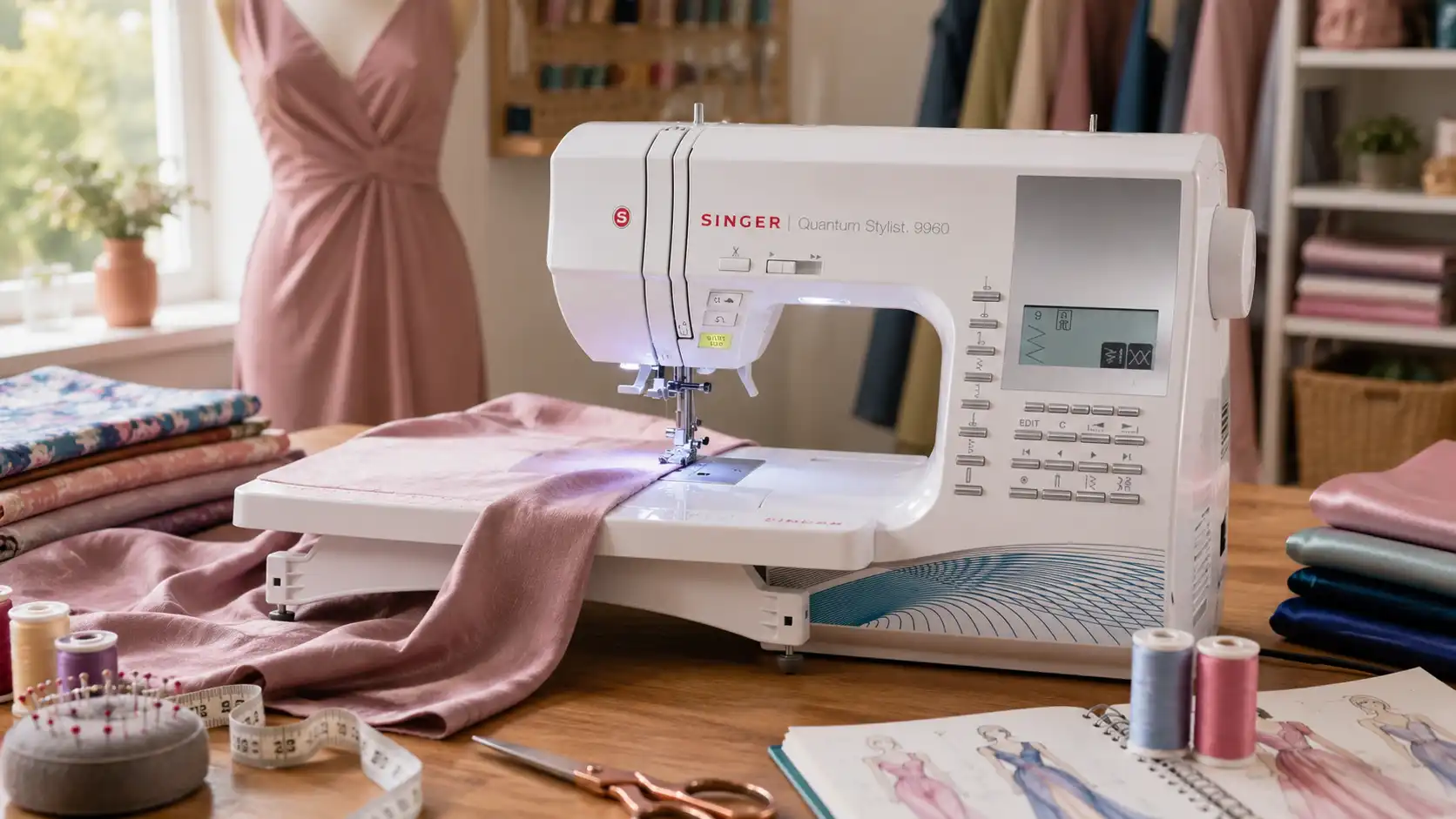
There comes a point when a basic sewing machine starts getting in your way.
You’ve learned how to sew straight seams. You’ve made garments, altered clothes, perhaps tried quilting or decorative stitching. Then you find yourself wanting more control: more stitch options, better customization, faster setup, and features that make complicated projects less tedious.
That’s where the Singer Quantum Stylist 9960 comes in.
We chose it as our Best Sewing Machine for Advanced Sewists because it gives experienced users substantially more control and creative flexibility than a basic mechanical machine.
Why We Picked the Singer 9960
The 9960 is built for sewists who have moved beyond the basics.
Singer lists 600 built-in stitches and 1,172 stitch applications, along with 13 one-step buttonhole styles, five alphanumeric fonts, stitch sequencing, mirror imaging, elongation, speed control, needle up/down, an automatic needle threader, and an automatic thread cutter. (singer.com)
That’s a lot of capability.
But the important distinction is that the machine isn’t valuable simply because it has a huge stitch count. Its real advantage is the control those features give an experienced sewist.
You can customize stitches, combine decorative patterns, save sequences, adjust sewing speed, and use different buttonhole styles depending on the garment or project.
TechGearLab also tested the 9960 and gave it a 79/100 overall score, placing it among the stronger machines in its comparison. Its testing found particularly strong performance in stitch quality, though it noted some shortcomings in ease of use and buttonhole performance. (techgearlab.com)
What We Like
- 1,172 stitch applications give advanced sewists enormous creative flexibility.
- 600 built-in stitches provide an unusually broad selection.
- 13 one-step buttonhole styles allow you to match buttonholes to different garments.
- Stitch sequencing lets you combine patterns into customized sequences.
- Mirror imaging and elongation provide additional stitch customization.
What We Don't Like
The 9960’s biggest strength can also be its biggest weakness
There is a lot to learn.
If you’re completely new to sewing, 600 stitches and extensive customization options aren’t necessarily helpful. They can make the machine feel more complicated than you need.
TechGearLab’s testing reflects this. It gave the 9960 a lower 7.3/10 ease-of-use score, noting that the large number of stitches and controls can make the machine more difficult to navigate. (techgearlab.com)
The machine also isn’t particularly lightweight. At around 20 lb, it isn’t something you’ll want to move constantly between storage and your sewing table.
Skip This Machine If...
You’re buying your first sewing machine and want something simple.
You probably don’t need 600 stitches when you’re still learning how to thread the machine and sew a straight seam.
You should also skip it if your main priority is heavy-duty sewing. The Singer 4452 earlier in this guide is better suited to that specific job.
Key Specifications
Feature | Singer Quantum Stylist 9960 |
Machine type | Computerized |
Built-in stitches | 600 |
Stitch applications | 1,172 |
Buttonhole styles | 13 |
Alphanumeric fonts | 5 |
Maximum sewing speed | 850 stitches/minute |
Stitch width | Up to 7 mm |
Stitch length | Up to 5 mm |
Bobbin | Top-loading |
Needle threader | Automatic |
Thread cutter | Automatic |
Needle up/down | Yes |
Speed control | Yes |
Stitch sequencing | Yes |
Mirror imaging | Yes |
Elongation | Yes |
Free arm | Yes |
Weight | About 20 lb |
Specifications are based on Singer’s current product information. (singer.com)
Who Should Buy the Singer 9960?
The 9960 makes sense if you’ve reached the point where you know what you want your sewing machine to do.
It’s particularly useful for:
- Experienced garment sewists
- Advanced home sewing
- Decorative stitching
- Custom garments
- Quilting
It’s also a good machine for someone who enjoys experimenting.
Maybe you want to combine decorative stitches into patterns. Maybe you’re making garments and want different buttonhole styles. Maybe you’ve started quilting and want more creative options.
That’s where having a huge selection becomes useful.
Our Verdict
The Singer Quantum Stylist 9960 is our Best Sewing Machine for Advanced Sewists because it gives experienced users an unusually broad combination of stitch variety, customization, automation, and control.
Its massive stitch library isn’t what makes it a great machine.
The real advantage is that you can grow into the machine rather than quickly outgrow it.
For a beginner, we’d choose the Brother ST371HD or Brother CS7000X.
For someone who already knows their way around a sewing machine and wants considerably more creative control, the 9960 is a much more compelling proposition.
8. Juki HZL-F600 — Best Premium Sewing Machine
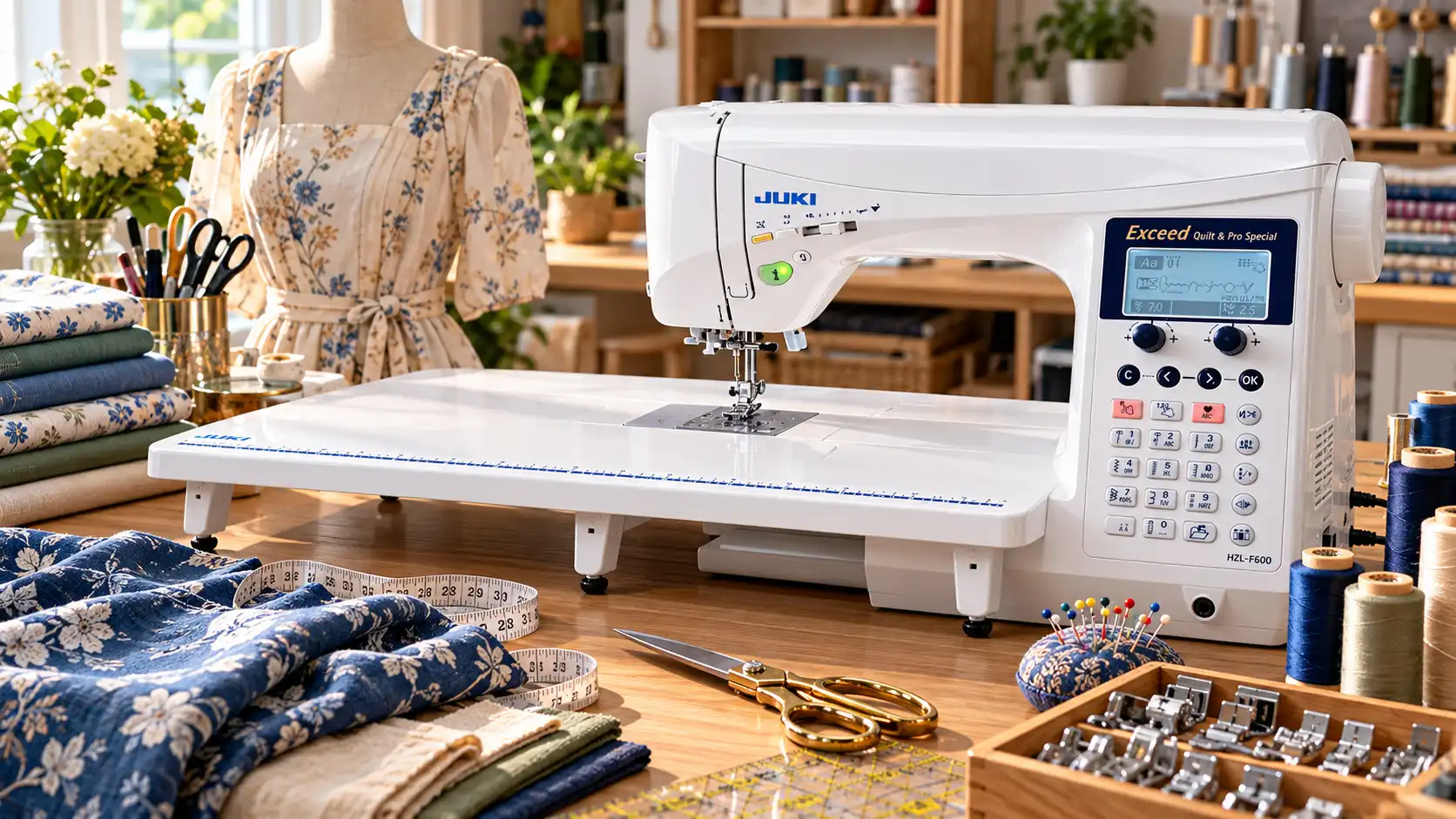
If you’ve already mastered the basics, you may eventually reach a point where your sewing machine becomes the limiting factor.
You want smoother control, more workspace, better fabric handling, automatic thread trimming, more sophisticated buttonholes, and features that make long sewing sessions easier. At that point, paying more for a premium machine can make sense.
The Juki HZL-F600 is our Best Premium Sewing Machine because it combines advanced computerized features with the kind of fabric control and workspace that experienced sewists tend to appreciate.
Why We Picked the Juki HZL-F600
The HZL-F600 sits near the top of JUKI’s home-sewing range without moving into the extremely expensive territory of large professional or combination machines.
JUKI lists 225 stitch patterns, 16 sensor-controlled buttonhole patterns, four fonts for lettering, automatic thread trimming, automatic needle threading, automatic thread tension, a 7-point feed dog system, and a large sewing area. (juki.co.jp)
One of its most interesting features is JUKI’s box-feed system.
Rather than relying on a conventional feed motion, the system is designed to move the feed dogs in a way that maintains more consistent contact with the fabric. JUKI says this helps produce even fabric feeding and high-quality stitches across different materials. (juki.co.jp)
That matters more as your projects become more demanding.
A beginner might never notice a small difference in fabric feeding. An experienced sewist working on a fitted garment, quilt, or long seam certainly can.
What We Like
- 225 stitch patterns provide plenty of utility and decorative options.
- 16 automatic buttonhole patterns give you considerable flexibility for garments and other projects.
- Automatic thread trimming cuts both needle and bobbin threads at the press of a button.
- Automatic needle threading simplifies machine setup.
- Automatic thread tension reduces the need for constant manual adjustments.
What We Don't Like
The obvious drawback is price.
A premium machine only represents good value if you’ll actually use the features you’re paying for.
If you’re sewing two hems a month, you probably don’t need automatic thread trimming, 225 stitch patterns, multiple buttonhole styles, or advanced fabric-feeding systems.
The HZL-F600 is also a substantial machine. At approximately 9.8 kg (21.6 lb), it isn’t the kind of machine most people will want to carry around constantly. (juki.co.jp)
And although it offers many stitches, it isn’t an embroidery machine. If computerized embroidery is your priority, the Brother SE2000 later in this guide is the more appropriate choice.
Skip This Machine If...
You’re a beginner on a tight budget, or you only sew occasionally.
You’d be paying for capabilities you’re unlikely to use.
For most first-time sewists, the Brother CS7000X or Brother ST371HD offers a much more sensible entry point.
The HZL-F600 makes more sense when sewing has become a serious hobby, a regular part of your work, or a skill you’re committed to developing.
Key Specifications
Feature | Juki HZL-F600 |
Machine type | Computerized |
Stitch patterns | 225 |
Buttonhole patterns | 16 |
Lettering fonts | 4 |
Maximum sewing speed | 900 stitches/minute |
Feed system | 7-point feed dog |
Automatic thread tension | Yes |
Automatic thread trimming | Yes |
Automatic needle threading | Yes |
Needle up/down | Yes |
Speed control | Yes |
Knee lifter | Yes |
Presser-foot pressure | Adjustable |
Free-motion sewing | Yes |
Bobbin | Top-loading |
Weight | Approximately 21.6 lb |
Specifications are based on JUKI’s current product information. (juki.co.jp)
Who Should Buy the Juki HZL-F600?
The HZL-F600 is best suited to sewists who:
- Sew frequently
- Make garments regularly
- Quilt or work with larger projects
- Want more precise fabric control
- Value automatic thread trimming
It’s particularly attractive if you’ve already owned a basic or mid-range machine and know exactly which limitations are slowing you down.
That’s an important distinction.
Don’t buy a premium sewing machine because you think expensive automatically means better. Buy one because you can identify the problems the extra features will solve.
Our Verdict
The Juki HZL-F600 is our Best Premium Sewing Machine because its value comes from the entire package rather than one headline specification.
Its strong fabric-feeding system, large workspace, automatic thread trimming, sophisticated buttonholes, adjustable controls, and premium conveniences make it a substantial upgrade for experienced sewists.
But if you’re still learning the basics, don’t feel pressured to spend this much.
A premium machine should make an experienced sewist’s work easier, faster, and more controlled, not simply make the shopping receipt larger.
9. Brother GX37 — Best Lightweight Sewing Machine
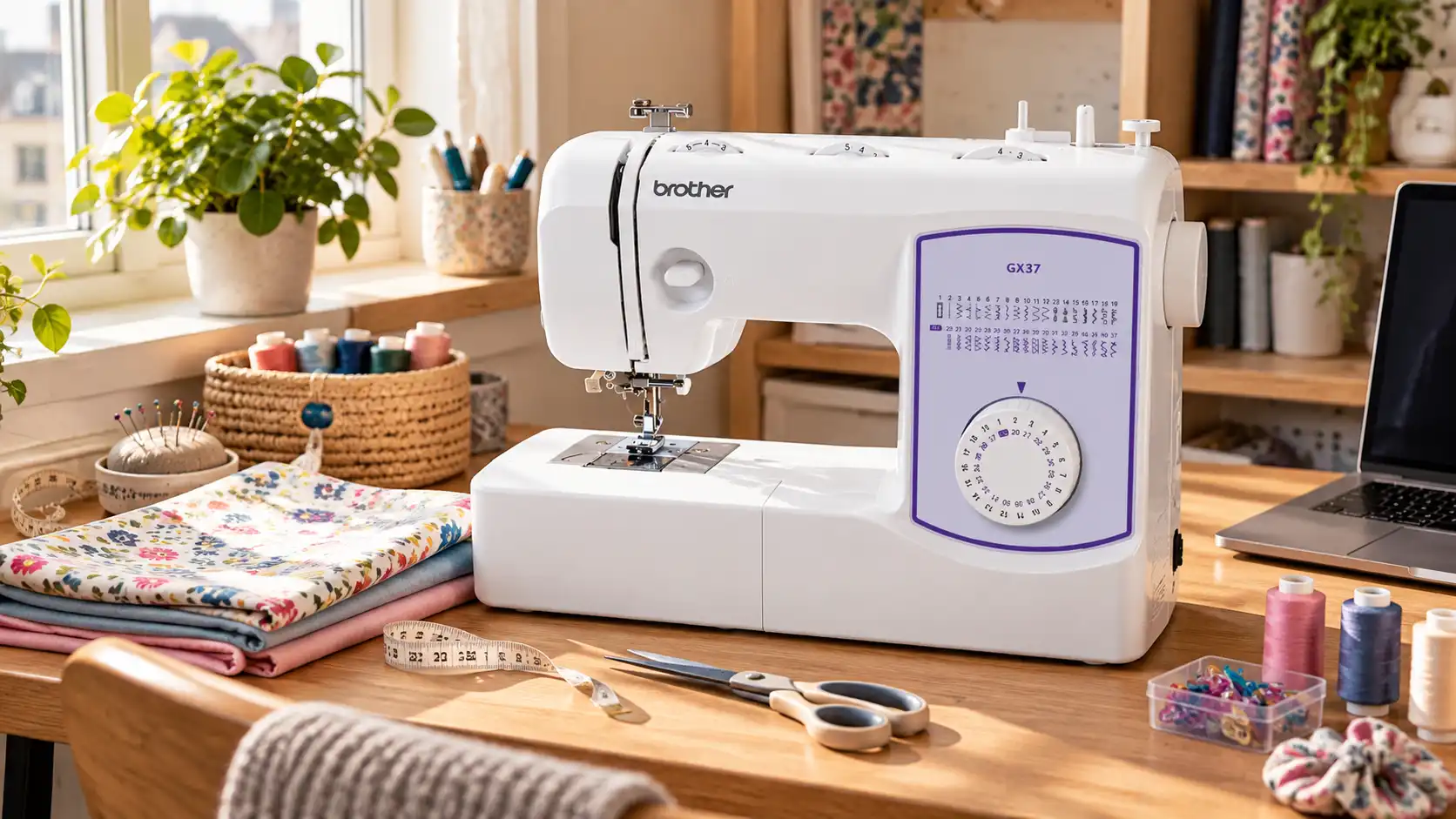
Not everyone has a dedicated sewing room.
For many people, the sewing machine lives in a closet, comes out onto the dining table when needed, and gets packed away again when the project is finished. In that situation, a machine that’s unnecessarily heavy or complicated can become a reason to sew less often.
That’s where the Brother GX37 makes sense.
We chose it as our Best Lightweight Sewing Machine because it focuses on the essentials while remaining easy to move, set up, and store.
Why We Picked the Brother GX37
The GX37 is a mechanical sewing machine with 37 built-in stitches, including utility, decorative, and stretch stitches. Brother also includes an automatic needle threader, a Quick-Set top-loading bobbin, a one-step automatic buttonhole, a free arm, and six presser feet. (brother-usa.com)
At around 10.14 pounds, it’s considerably easier to move than the heavier machines in our lineup. (brother-usa.com)
That makes it particularly appealing for someone who doesn’t want their sewing machine permanently occupying a desk or craft table.
And there’s another advantage: the GX37 doesn’t try to turn portability into an excuse for stripping the machine down to the absolute basics.
You still get a useful selection of stitches and practical features for everyday sewing.
What We Like
- 37 built-in stitches provide useful variety for everyday sewing.
- One-step automatic buttonhole is convenient for garments and home projects.
- Automatic needle threader makes threading easier.
- Quick-Set top-loading bobbin makes bobbin installation straightforward.
- Six included presser feet cover common sewing tasks.
What We Don't Like
The GX37 is lightweight partly because it isn’t built like a heavy-duty or premium machine.
That means you shouldn’t expect it to provide the same stability, workspace, or advanced controls as something like the Juki HZL-F600.
It also lacks some conveniences found on computerized machines, such as an LCD display, programmable stitch functions, and electronic speed control.
And although 37 stitches are plenty for basic sewing, it may feel limiting if you’re an experienced sewist who wants extensive stitch customization.
Skip This Machine If...
You regularly sew heavy denim, thick canvas, multiple layers, or large, bulky projects.
A lightweight machine is convenient precisely because it doesn’t carry the extra weight and structure of a heavy-duty or premium machine.
If your main projects involve demanding materials, look at the Singer Heavy Duty 4452 instead.
If you’re primarily quilting, the Juki TL-2010Q offers a much larger working area and features specifically designed around quilting.
Key Specifications
Feature | Brother GX37 |
Machine type | Mechanical |
Built-in stitches | 37 |
Buttonhole | 1-step automatic |
Bobbin | Quick-Set top-loading |
Needle threader | Automatic |
Presser feet | 6 |
Free arm | Yes |
Wide table | Included |
Maximum sewing speed | 850 stitches/minute |
Weight | Approximately 10.14 lb |
Specifications are based on Brother’s current product information. (brother-usa.com)
Who Should Buy the Brother GX37?
The GX37 is a good fit if you:
- Live in a small apartment or home
- Don’t have a permanent sewing room
- Need to store your machine after each project
- Sew occasionally
- Make basic garments
At roughly half the weight of a full-size machine, it’s easy to pull out for a quick hem and put away again without wrestling it out of a closet. Portability isn’t just about carrying a machine from one room to another, it’s about reducing the friction between wanting to sew and actually sitting down to sew.
Lightweight Doesn't Mean Mini
There’s an important distinction here.
The GX37 is lightweight, but it isn’t one of those tiny novelty machines designed primarily for occasional emergency repairs.
It has a conventional full-size sewing-machine layout, a useful stitch selection, a free arm, a proper bobbin system, and a selection of standard presser feet.
That’s why we prefer the term lightweight sewing machine rather than “mini sewing machine.”
You’re giving up some mass and advanced features, but you’re not giving up the basic functionality needed for normal home sewing.
Our Verdict
The Brother GX37 is our Best Lightweight Sewing Machine for people who want a practical full-featured machine without the bulk of heavier models.
It’s particularly appealing when storage space is limited or you know you’ll need to move the machine regularly.
Just remember that lightweight construction comes with trade-offs.
If your sewing involves thick materials, large quilts, or long hours of demanding work, a heavier machine may provide a more stable and capable platform.
But if your biggest problem is simply: “I want a real sewing machine that I can easily take out, use, and put away.”
The GX37 is a very sensible choice.
10. Brother SE2000 — Best Sewing & Embroidery Machine
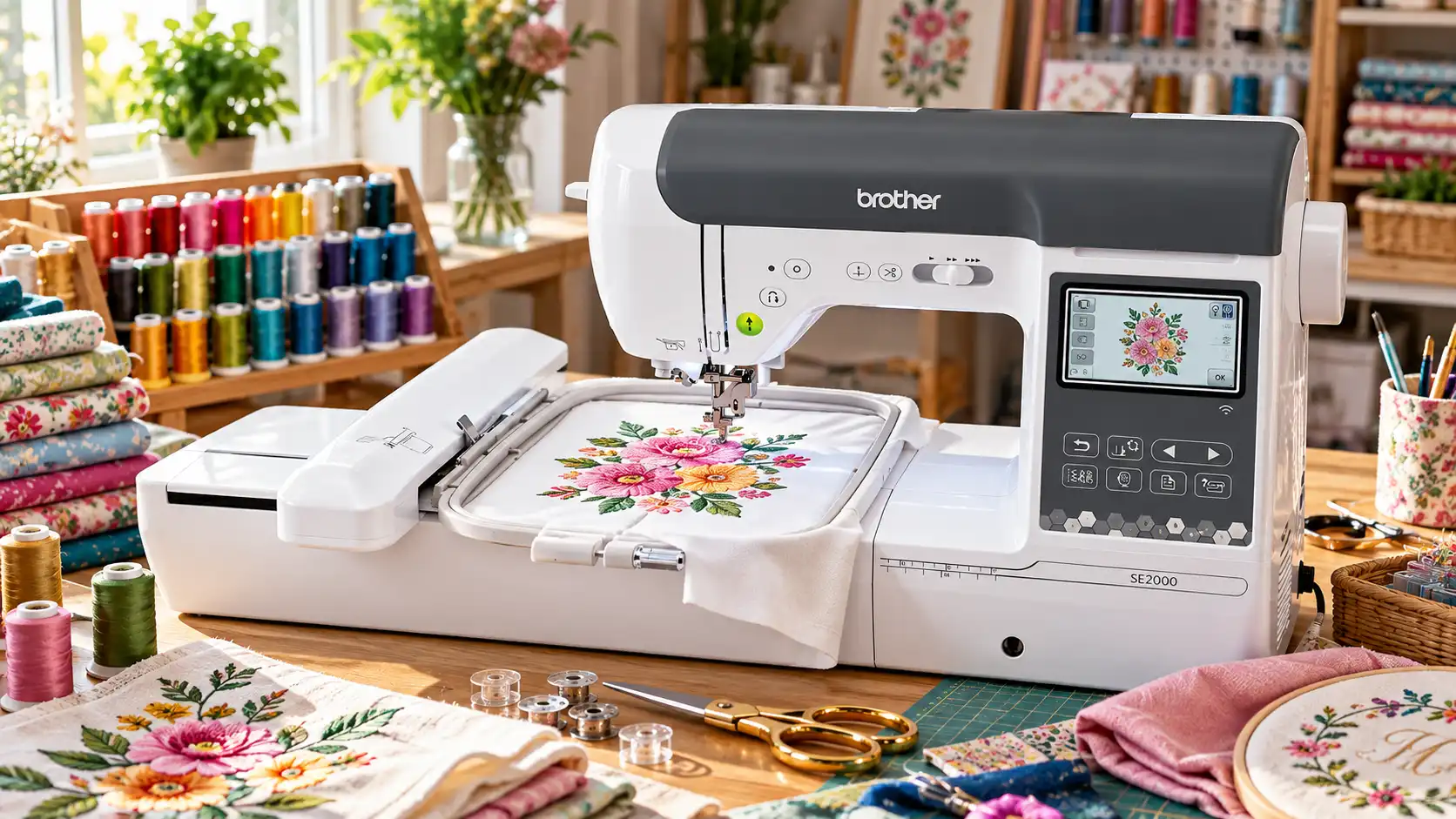
What if you want to sew clothes, make quilts, and also add embroidery to your projects?
Buying a regular sewing machine first and then adding an embroidery machine later can quickly become expensive, and it also means finding space for two machines.
That’s where the Brother SE2000 makes sense.
We chose it as our Best Sewing & Embroidery Machine because it combines a full computerized sewing machine with a dedicated embroidery system in one unit.
Why We Picked the Brother SE2000
The SE2000 is much more than a sewing machine with a few decorative stitches.
Brother lists 241 built-in sewing stitches, 193 built-in embroidery designs, 13 embroidery lettering fonts, and a 5 × 7-inch embroidery area. It also includes a 3.7-inch LCD touchscreen, wireless connectivity, automatic needle threading, a Quick-Set bobbin, and 10 one-step buttonhole styles. (brother-usa.com)
That combination gives you two very different capabilities.
You can use it as a conventional sewing machine for garments, repairs, crafts, and quilting. Then, when you want to personalize a project, you can switch to embroidery without moving to another machine.
Brother also includes wireless LAN capability, allowing compatible embroidery designs to be transferred wirelessly from supported devices and services. (brother-usa.com)
What We Like
- 241 built-in sewing stitches provide extensive sewing versatility.
- 193 built-in embroidery designs give you plenty of designs to start with.
- 5 × 7-inch embroidery area is large enough for many clothing, home décor, and personalization projects.
- 13 embroidery lettering fonts make names and monograms possible without purchasing additional lettering designs.
- 10 one-step buttonhole styles are useful for garment sewing.
What We Don't Like
The biggest drawback is obvious:
You’re paying for two capabilities, even if you only need one.
If you have no interest in embroidery, buying the SE2000 doesn’t make much sense. A dedicated sewing machine such as the Brother CS7000X can give you what you need for considerably less money.
The SE2000 also has a 5 × 7-inch maximum embroidery field. That’s large enough for many common projects, but it isn’t designed for very large embroidery designs without repositioning or additional equipment.
And like any computerized embroidery machine, there is more to learn than with a simple mechanical sewing machine.
Skip This Machine If...
You only want to sew and have no interest in embroidery.
You’re better off spending your money on a high-quality sewing machine rather than paying for embroidery hardware and software capabilities you’ll never use.
You should also consider a dedicated embroidery machine if your primary goal is large-format or high-volume embroidery.
Key Specifications
Feature | Brother SE2000 |
Machine type | Computerized sewing & embroidery |
Sewing stitches | 241 |
Embroidery designs | 193 |
Embroidery fonts | 13 |
Maximum embroidery area | 5 × 7 in. |
Buttonhole styles | 10 one-step |
LCD display | 3.7-inch color touchscreen |
Wireless connectivity | Yes |
Needle threader | Automatic |
Bobbin | Quick-Set top-loading |
Speed control | Yes |
Needle up/down | Yes |
Embroidery editing | Yes |
Maximum sewing speed | 850 stitches/minute |
Specifications are based on Brother’s current product information. (brother-usa.com)
Who Should Buy the Brother SE2000?
The SE2000 makes sense if you want to create projects such as:
- Personalized clothing
- Monogrammed shirts
- Embroidered gifts
- Quilts with embroidered designs
- Children’s clothing
It’s especially useful for someone who wants to start with sewing and gradually incorporate embroidery into their projects.
For example, imagine making a child’s jacket.
You could construct the garment using the sewing side of the machine, then add the child’s name or a decorative design using the embroidery function.
You don’t have to change machines.
Sewing + Embroidery: When Does a Combination Machine Make Sense?
A combination machine is attractive when space and versatility matter.
If you have a dedicated sewing room and already own a high-quality sewing machine, buying a separate embroidery machine may make more sense.
But if you’re building your sewing setup from scratch, the SE2000 gives you a way to cover both disciplines with one machine.
That’s also why we don’t call it simply the “Best Embroidery Machine.”
You already have a dedicated guide for people whose primary goal is embroidery. Here, we’re looking at the specific problem: “I want one machine that can sew and embroider.”
For that use case, the SE2000 is a much more relevant recommendation.
Our Verdict
The Brother SE2000 is our Best Sewing & Embroidery Machine because it combines substantial sewing capability with a dedicated computerized embroidery system.
Its 241 sewing stitches, 193 embroidery designs, 5 × 7-inch embroidery field, touchscreen controls, and wireless connectivity give you considerably more creative flexibility than a conventional sewing machine.
But don’t buy it simply because it does more.
If you’re only interested in sewing, choose a machine that concentrates your budget on sewing performance.
If you want to sew garments, quilts, crafts, and personalized embroidered projects with one machine, the SE2000 is one of the most versatile options in our lineup.
11. Is a Used or Vintage Sewing Machine Worth Buying?
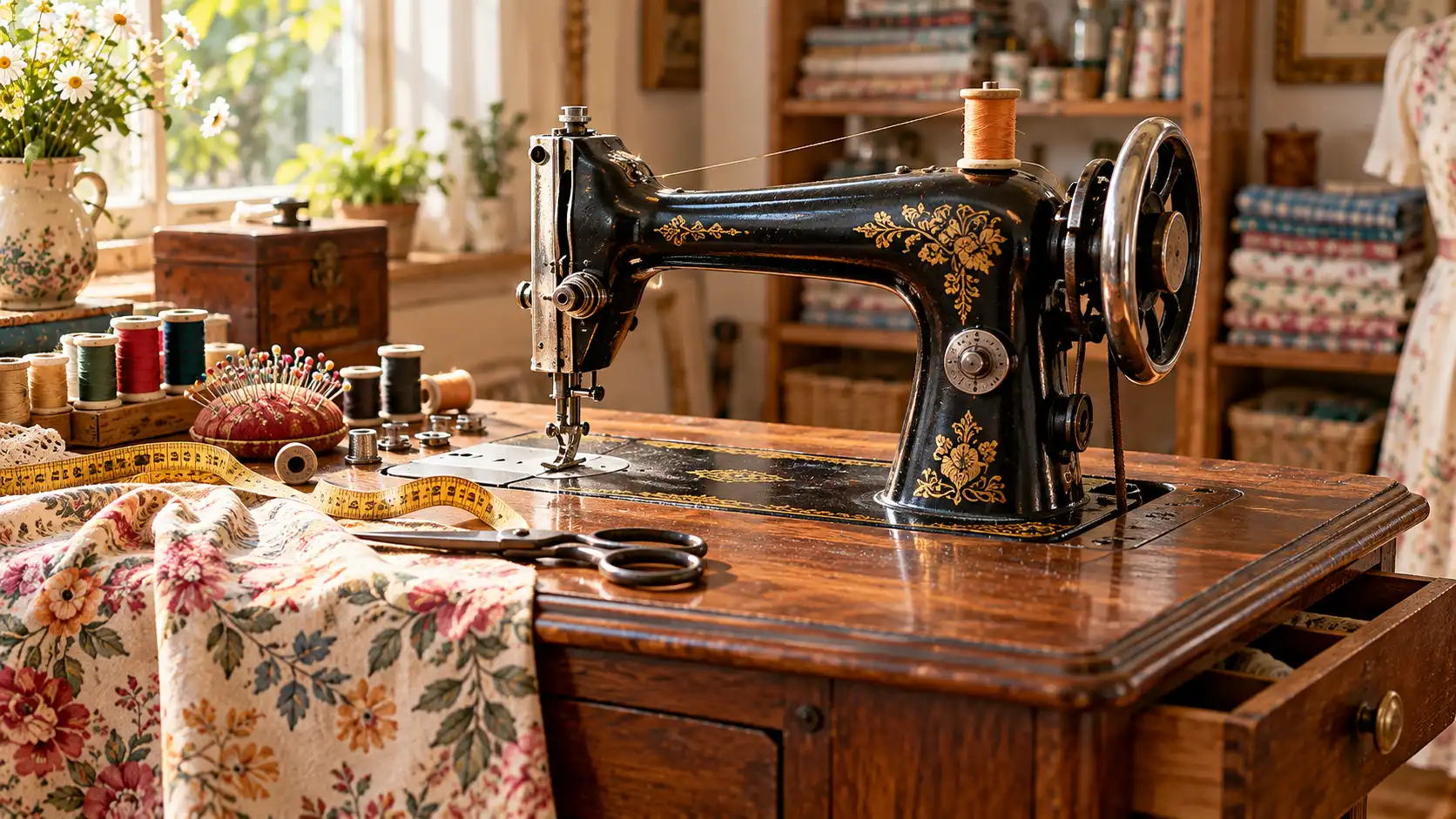
A brand-new sewing machine isn’t always the smartest choice.
If you’re working with a tight budget, you may find a well-maintained older mechanical machine that gives you excellent basic sewing performance for much less than a new computerized model. On the other hand, a cheap used machine with hidden problems can quickly turn into a frustrating repair project.
So, is a used or vintage sewing machine worth buying?
Yes, but only if you know what you’re looking at.
New vs. Used/Vintage: Which Makes More Sense?
| Feature | New Sewing Machine | Used/Vintage Sewing Machine |
|---|---|---|
| Warranty | Usually included | Usually limited or none |
| Condition | Predictable | Depends on previous owner |
| Electronics | Often modern | Older machines are often mechanical |
| Stitch selection | Usually more | Often fewer |
| Ease of finding parts | Usually straightforward | Depends heavily on model |
| Repairs | May require authorized service | Many mechanical models can be serviced independently |
| Price | Usually higher | Can be considerably lower |
| Learning curve | Depends on machine | Mechanical models can be straightforward |
| Best for | Convenience and modern features | Value and mechanical simplicity |
An older machine that has been cleaned, serviced, and properly adjusted can be an excellent purchase.
An older machine covered in rust with seized controls and missing parts is not a bargain just because the seller calls it vintage.
Why Consider a Vintage Sewing Machine?
Older mechanical machines can have real advantages: simpler construction that’s easier for a technician to diagnose and repair, decades of proven durability in some models (though condition matters far more than age), and a lower purchase price than a new machine of comparable build quality.
The Risks of Buying Used
Here’s where you need to be careful.
A used sewing machine may have:
- worn gears
- damaged wiring
- timing problems
- worn tension components
- seized mechanisms
- damaged feed dogs
- rust
- missing presser feet
- missing bobbin parts
- an unreliable motor
- neglected lubrication
- previous repairs that were done incorrectly
And some older machines can be difficult or expensive to service because replacement parts aren’t readily available.
That’s why condition and service history matter more than the machine’s age.
What to Check Before Buying a Used Sewing Machine
If possible, never buy a used machine without seeing it operate. Ask the seller to demonstrate:
- Straight stitch and zigzag look for excessive looping, skipped stitches, or uneven width
- Reverse, feed dogs, and needle movement — all should move smoothly and consistently
- Bobbin system — check for damage, excessive lint, rust, or improvised repairs
- Handwheel — should turn smoothly, not seized or rough
- Motor — run at different speeds and listen for grinding, rattling, or squealing
- Tension — test on scrap fabric; severe problems may indicate deeper issues
- Accessories — confirm the bobbin case, presser feet, foot controller, power cord, and needle plate are included; missing parts can turn a cheap purchase into an expensive one
Should You Buy Used or Vintage?
Don’t buy a vintage machine simply because it’s a well-known brand; research the specific model, since some are excellent straight-stitch workhorses while others won’t give you zigzag, stretch stitches, or modern buttonholes.
For most first-time sewists, we’d lean toward new unless you have someone knowledgeable helping you inspect a used machine. Your first machine is already a learning curve, and a new machine gives you predictable condition, documentation, and warranty coverage. You don’t want to spend your first month wondering whether a problem is you or the machine.
Used or vintage makes more sense when your budget is very limited, you prefer mechanical sewing over computerized features, you have access to a reputable repair technician, and you’re comfortable with basic maintenance.
If you’re buying used, prioritize condition, then serviceability, then parts availability, then actual sewing performance, not simply the year it was manufactured. A $50 machine that needs $300 of repairs isn’t cheaper than a $200 machine that works immediately. For beginners who want the least uncertainty, a new machine such as the Brother CS7000X or Brother ST371HD is the safer route. Whatever you choose, test it before you buy it whenever possible.
Mechanical vs. Computerized Sewing Machines
One of the first decisions you’ll face when shopping for a sewing machine is whether you want mechanical controls or computerized controls.
Neither type is automatically better.
The better choice depends on how you sew, how much control you want, and whether you prefer simplicity or convenience.
Mechanical Sewing Machines
Mechanical machines use physical dials, knobs, and levers to control the machine.
You select the stitch manually and adjust settings such as stitch length and width yourself.
The Janome 2212, Brother ST371HD, Singer Heavy Duty 4452, and Brother GX37 in our lineup are examples of machines built around this straightforward approach.
Why Choose a Mechanical Machine?
Mechanical machines can be appealing if you:
- Prefer simple controls
- Don’t want to navigate an LCD screen
- Want direct control over stitch settings
- Mainly use straight and zigzag stitches
- Prefer a traditional sewing-machine experience
- Want a machine that’s relatively straightforward to understand
There’s also something satisfying about turning a dial and immediately seeing the setting change.
You don’t have to navigate menus or remember which button controls which function.
Computerized Sewing Machines
Computerized machines use electronic controls, often combined with an LCD screen or touchscreen.
Instead of manually setting every parameter, you select a stitch and use the machine’s controls to adjust settings.
Our Brother CS7000X, Brother HC1850, Singer Quantum Stylist 9960, Juki HZL-F600, and Brother SE2000 are examples.
Why Choose a Computerized Machine?
Computerized machines become particularly useful when you want:
- More stitch options
- Automatic buttonholes
- Speed control
- Start/stop sewing
- Needle up/down
- Automatic thread trimming
- Stitch customization
- Memory or sequencing functions
- Sewing and embroidery capabilities
For example, the Singer Quantum Stylist 9960 offers extensive stitch customization and sequencing, while the Juki HZL-F600 adds features such as automatic thread trimming, automatic tension, and a knee lifter.
These features aren’t necessarily important when you’re learning to sew.
But once you sew regularly, small conveniences can add up.
Mechanical vs. Computerized: Quick Comparison
| Feature | Mechanical | Computerized |
|---|---|---|
| Controls | Dials and knobs | Buttons, LCD, or touchscreen |
| Learning curve | Usually straightforward | Can range from simple to complex |
| Stitch selection | Manual | Electronic |
| Stitch variety | Usually fewer | Often many more |
| Buttonholes | Often 4-step or simple 1-step | Usually automatic 1-step |
| Speed control | Usually foot pedal | Often foot pedal + electronic control |
| Start/stop button | Usually no | Often yes |
| Automatic thread cutter | Rare | Available on many models |
| Needle up/down | Model dependent | Common on higher-end models |
| Decorative stitches | Usually limited | Often extensive |
| Maintenance | Fewer electronic components | More electronic components |
| Best for | Simplicity and direct control | Convenience and versatility |
Which Is Better for You?
You don’t need a computerized machine just because you’re a beginner. The Brother ST371HD teaches fundamentals well through direct physical controls, while the Brother CS7000X’s automatic needle threading and speed control simply remove some of the fiddly work. The real question isn’t skill level; it’s whether you want simplicity or convenience.
Don’t judge a machine by how much technology it contains. The Singer Heavy Duty 4452 is mechanical but offers 110 stitch applications, a one-step buttonhole, and 1,100 stitches per minute; the Juki TL-2010Q is highly specialized for precision straight stitching despite a low stitch count. Judge a machine by how well it solves your actual sewing problems and by build quality and maintenance, not simply whether it has a computer inside, since neither type is inherently more reliable than the other.
As a rule of thumb: choose mechanical if you value simplicity and direct controls; choose computerized if you’ll actually use features like speed control, automatic thread trimming, needle up/down, and automatic buttonholes. If you mainly hem, repair, and make simple projects, mechanical is often enough. If you’re planning to make garments, quilt regularly, or grow into more advanced sewing, computerized gives you more room.
Essential Sewing Machine Features That Actually Matter
Sewing-machine specifications can get overwhelming quickly.
One model has 70 stitches. Another has 185. Another claims more than 1,000 stitch applications. Then you see terms such as automatic thread tension, needle up/down, free arm, drop feed, walking foot, presser-foot pressure, and thread cutter.
But here’s the thing:
You probably don’t need most of them.
The best sewing machine isn’t the one with the longest specification sheet. It’s the one with the features that make your sewing easier.
Here are the features I’d pay attention to before worrying about decorative stitches.
1. Stitch Quality
A consistent straight stitch and clean zigzag matter more than a large stitch library. Check tension and skipped-stitch performance before counting patterns.
2. Fabric Feeding
Fabric should move smoothly without you pulling or pushing it, especially on multiple layers, stretch fabric, denim, and quilts. The Juki HZL-F600’s feed system is built specifically for this.
3. Adjustable Sewing Speed
A speed limiter lets beginners slow down for curves, corners, and zippers instead of fighting the pedal at full speed. The CS7000X, HC1850, Singer 9960, and HZL-F600 all include it.
4. Automatic Needle Threader
A small convenience that saves real time if you sew often, not essential, but hard to give up once you’ve used it.
5. Bobbin System
Top-load (drop-in) bobbins are easier to see and load; front-load isn’t inferior, just more traditional. What matters most is whether replacement bobbins are easy to find.
6. One-Step Buttonhole
If you’re making clothing, a consistent one-step buttonhole matters. The ST371HD, CS7000X, HC1850, 4452, 9960, HZL-F600, and SE2000 all offer it, though quality varies by machine.
7. Needle Up/Down
Keeps the needle in the fabric when you stop sewing, so you can pivot corners and curves cleanly without the fabric shifting.
8. Free Arm
Makes sleeves, cuffs, pant hems, and children’s clothing much easier to sew, worth having if you make garments regularly.
9. Adjustable Presser-Foot Pressure
More useful for experienced sewists moving between lightweight and heavy fabrics. Premium machines like the HZL-F600 include this adjustment.
10. Automatic Thread Cutter
Sounds minor until you’re sewing dozens of seams in one project; then it eliminates a genuinely repetitive task hundreds of times over the machine’s life.
11. Extension Table
Gives large projects somewhere to rest instead of pulling against the needle. A machine with fewer stitches but a well-supported workspace can matter more for quilting than one with hundreds of decorative stitches and a cramped bed.
12. Walking Foot
Feeds multiple layers evenly, useful for quilting, matching plaids, and slippery fabrics. The Singer 4452 and Brother CS7000X both include walking-foot capability.
13. Drop Feed
Lets you lower the feed dogs for free-motion quilting or darning. Skip this as a deciding factor if you won’t do either.
14. Machine Weight and Stability
Heavier machines feel steadier on the table; lightweight ones like the GX37 are easier to carry and store. Neither is objectively better; it depends on your sewing space.
15. Presser Feet and Accessories
Six feet you’ll actually use beats fifteen you won’t. Look specifically for all-purpose, zipper, buttonhole, blind-hem, and walking feet.
16. Workspace
More bed space around the needle matters for quilts, jackets, and large garments; that’s why the Juki TL-2010Q and Brother GX37 sit at opposite ends of this list. Neither approach is inherently better.
17. Built-In Stitch Count
The most-advertised spec is the least reliable way to judge a machine. Straight, zigzag, stretch, blind hem, overcasting, and buttonhole cover most everyday sewing; more stitches mainly matter for decorative work or lettering.
Which Features Matter Most for Different Sewists
| Your priority | Features to prioritize |
|---|---|
| Beginner | Simple controls, automatic needle threader, easy bobbin, speed control |
| Garment sewing | Buttonholes, stretch stitches, free arm, speed control, needle up/down |
| Quilting | Large workspace, extension table, needle up/down, walking foot, drop feed |
| Heavy fabrics | Fabric feeding, motor performance, presser-foot clearance, sturdy construction |
| Advanced sewing | Stitch customization, thread cutter, speed control, presser-foot pressure, knee lift |
| Small space | Weight, size, free arm, easy storage |
| Embroidery | Embroidery field, designs, fonts, editing, connectivity |
| Occasional repairs | Simple controls, reliability, basic straight/zigzag stitches |
The Bottom Line
Don’t start with the question:
“Which sewing machine has the most features?”
Start with:
“Which features will I actually use?”
That’s the difference between buying a machine because its specification sheet looks impressive and buying one that genuinely makes sewing easier.
For most people, stitch quality, fabric feeding, ease of threading, useful buttonholes, speed control, and a comfortable workspace matter far more than an enormous decorative-stitch library.
How Much Should You Spend on a Sewing Machine?
One of the easiest ways to overspend on a sewing machine is to shop by features instead of needs.
You see a machine with hundreds of stitches, a touchscreen, automatic thread trimming, dozens of presser feet, and a long list of impressive-sounding features. It looks like a bargain until you realize you’ll probably use five stitches and a handful of those accessories.
On the other hand, buying the cheapest machine available can create a different problem: you save money today but end up replacing the machine after you’ve outgrown it.
So, how much should you actually spend on a sewing machine?
The answer depends on what you’re going to sew.
Under $150: Basic Sewing and Occasional Use
If your budget is around $150 or less, focus on the fundamentals.
You can find simple mechanical machines that are perfectly capable of handling:
- Clothing repairs
- Hemming
- Simple garments
- Crafts
The Brother GX37 is a good example of the type of machine to consider in this range. Its 37 stitches, automatic needle threader, one-step buttonhole, free arm, and lightweight design give you useful everyday functionality without a large investment.
The Janome 2212 is another option if you prefer traditional mechanical controls.
$150–$300: The Sweet Spot for Many Home Sewists
For many beginners and intermediate sewists, this is where things get interesting.
Spending a little more can get you:
- More stitches
- Automatic buttonholes
- Better convenience features
- Speed control
The Brother CS7000X is a good example.
It combines 70 built-in stitches, seven one-step buttonholes, speed control, automatic needle threading, a Quick-Set bobbin, a wide table, and 10 presser feet.
The Brother ST371HD also falls into the broader affordable category while taking a simpler mechanical approach.
$300–$600: More Capability for Serious Hobbyists
Once you move into this range, you’re no longer shopping only for a beginner machine.
You can start looking for machines with:
- More sophisticated computerized controls
- Better stitch customization
- More advanced buttonholes
- Greater workspace
This is where your specific projects should start driving the decision.
For example, someone making clothes may prioritize the Brother HC1850, while someone looking for advanced creative control may prefer a machine such as the Singer Quantum Stylist 9960.
Don’t automatically assume a $500 machine is better than a $250 machine.
It’s better for a different user.
$600–$1,000+: Advanced Sewing
At this level, you’re paying for more than basic functionality.
You’re looking at machines designed for people who sew frequently and want more control, convenience, or specialization.
Features may include:
- Advanced stitch customization
- Automatic thread cutting
- Sophisticated buttonholes
- Better fabric-feeding systems
This is where experienced sewists should start asking: “What problem is my current machine causing me?”
If you can’t name one, you probably don’t need to upgrade yet.
$1,000+: Premium and Specialized Machine
Once you’re spending four figures, you should have a clear reason.
The Juki HZL-F600 represents this end of our recommendations.
Its appeal isn’t simply that it costs more. It’s the combination of sophisticated fabric feeding, automatic thread trimming, automatic tension, advanced buttonholes, a large workspace, speed control, and other features designed to make frequent sewing more efficient.
Similarly, a combination machine such as the Brother SE2000 costs more because you’re getting both sewing and computerized embroidery capability.
Who Should Spend $1,000 or More?
Consider this range if:
- You sew frequently
- Sewing is a serious hobby
- You make garments regularly
- You quilt often
If you sew twice a month, you probably don’t need to spend this much.
What About Sewing for Income?
This is where the budget question changes.
If you’re sewing products for customers, making alterations for clients, or producing garments regularly, time becomes part of the machine’s value.
A $250 machine and a $1,000 machine can both sew a straight seam, but if the pricier one saves you several minutes per project through faster setup, better fabric control, and fewer interruptions, that time difference can eventually pay for itself.
But don’t make the mistake of assuming an expensive home machine is automatically the right choice for commercial production.
If you’re producing at high volume, you may eventually need specialized or industrial equipment rather than simply moving farther up the consumer-machine price ladder.
Don't Forget the Cost of Everything Around the Machine
Your sewing-machine budget shouldn’t necessarily equal your entire sewing budget.
Remember to account for:
- Quality needles
- Thread
- Bobbins
- Presser feet
- Cutting tools
- Seam ripper
A $300 machine plus $100 of useful accessories may serve you better than a $500 machine whose included features don’t match your projects.
A Simple Sewing Machine Budget Guide
| Budget | Best For | What to Expect |
|---|---|---|
| Under $150 | Occasional sewing, basic repairs | Simple mechanical machines |
| $150–$300 | Beginners and everyday sewing | Better features and more versatility |
| $300–$600 | Serious hobbyists | More automation and specialized capability |
| $600–$1,000 | Advanced sewists | Premium convenience and control |
| $1,000+ | Frequent/advanced sewing | Premium or combination machines |
These are general buying ranges, not hard price boundaries. Retail prices change, promotions can move models between categories, and some machines offer unusually strong value outside their typical price range.
The Bottom Line
If you’re buying your first machine, don’t feel pressured to spend $1,000.
For many people, a machine in the $150–$300 range provides more than enough capability to learn, complete real projects, and discover what kind of sewing they actually enjoy.
If you’ve already been sewing for years, the calculation changes.
At that point, you’re not really buying a machine to “learn sewing.”
You’re buying it to remove limitations.
And that’s when paying more can make sense, provided you can clearly identify what the extra money will solve.
How to Choose the Best Sewing Machine for Your Needs
At this point, you probably have a better idea of which machines stand out. But there’s still one question that matters more than any ranking:
Which one is actually right for you?
The answer starts with your sewing projects, not your budget, your skill level, or the number printed on the machine’s box.
For an even deeper walkthrough of this process, see our complete guide on how to choose a sewing machine.
This section covers the strategic decisions: what to sew, which machine type, and how much automation. For the specific mechanics behind bobbin systems, buttonholes, fabric feeding, and stitch counts, see Essential Sewing Machine Features That Actually Matter earlier in this guide.
1. Start With What You Plan to Sew
Before comparing machines, write down the projects you expect to make over the next year.
Are you planning to:
- Hem and repair clothes?
- Make dresses, shirts, or trousers?
- Sew quilts?
- Work with denim or canvas?
- Make bags and accessories?
- Sew children’s clothing?
- Add embroidery to your projects?
- Sew occasionally or several times a week?
Your answer immediately eliminates some machines.
For example, if quilting is your main hobby, the Juki TL-2010Q makes much more sense than a machine chosen simply because it has hundreds of decorative stitches.
If you’re making clothes, features such as useful buttonholes, stretch stitches, a free arm, speed control, and reliable fabric feeding become more important.
And if you’re mostly repairing clothes, you probably don’t need a premium machine at all.
2. Choose the Right Machine Type
Once you know what you’ll sew, decide whether you need a:
Mechanical sewing machine
Best when you want straightforward controls and basic sewing capability.
Computerized sewing machine
Best when you want more automation, stitch variety, speed control, and convenience.
Heavy-duty sewing machine
Best when thick fabrics and multiple layers are a regular part of your projects.
Quilting-focused machine
Best when quilting is your primary use.
Sewing and embroidery machine
Best when you want conventional sewing and computerized embroidery in one machine.
Don’t choose a machine type because it sounds more advanced.
Choose it because it matches your work.
3. Decide How Much Automation You Want
Think about how you prefer to work.
If you enjoy adjusting dials and having direct control over the machine, a mechanical model such as the Janome 2212 or Brother ST371HD may suit you.
If you’d rather press a button and let the machine handle certain settings, consider a computerized model such as the Brother CS7000X.
Experienced sewists may appreciate even more automation.
The Juki HZL-F600, for example, adds automatic thread trimming, automatic tension, speed control, a knee lifter, and other features designed to reduce repetitive work.
Neither approach is inherently better.
It’s about what makes you more comfortable and productive.
4. Consider How Often You'll Sew
Your sewing frequency should influence how much you spend.
Occasional sewist
If you sew a few times a year, prioritize:
- Ease of use
- Storage
- Reliability
- Basic stitches
- Reasonable price
Regular hobbyist
If you sew every week, consider:
- Speed control
- Better fabric handling
- More useful stitches
- Larger workspace
- Convenient threading
- Better accessories
Serious or advanced sewist
If you’re sewing several times a week, you may benefit from:
- Automatic thread cutting
- Knee lift
- Advanced buttonholes
- Adjustable presser-foot pressure
- Better feed systems
- Larger workspace
- More precise controls
At that point, the Juki HZL-F600 or Singer Quantum Stylist 9960 becomes much easier to justify.
5. Think About the Machine You Might Need Later
This doesn’t mean you should buy the most expensive machine you can afford.
Instead, ask: “What am I likely to be sewing six months from now?”
If you’re currently hemming clothes but already know you want to start making garments, choose a machine that won’t immediately become limiting.
If you’re learning to sew but aren’t sure whether you’ll continue, don’t spend thousands on a machine you may barely use.
The sweet spot is a machine that gives you some room to grow without making you pay for capabilities you don’t need yet.
The Biggest Buying Mistake to Avoid
Don’t buy a sewing machine because someone else says it’s the best.
Not even us.
The “best sewing machine” only makes sense when you add:
best for whom?
The perfect machine for a quilter may be frustrating for someone making clothes.
The perfect machine for a beginner may feel limiting to an experienced sewist.
And the perfect premium machine may be a complete waste of money if you only sew once every few months.
Start with your projects. Identify your problems. Then choose the machine that solves them.
That’s a much better way to shop than chasing specifications.
How to Maintain Your Sewing Machine
Buying the best sewing machine is only part of the equation.
Even a well-built machine can develop problems if lint, thread scraps, and dust are allowed to build up inside it. And when a machine starts making strange noises or producing poor stitches, many sewists immediately assume it’s time for a repair or even a replacement.
Often, the problem is much simpler.
A little regular maintenance can help keep your machine sewing smoothly and can also help you catch problems before they become expensive.
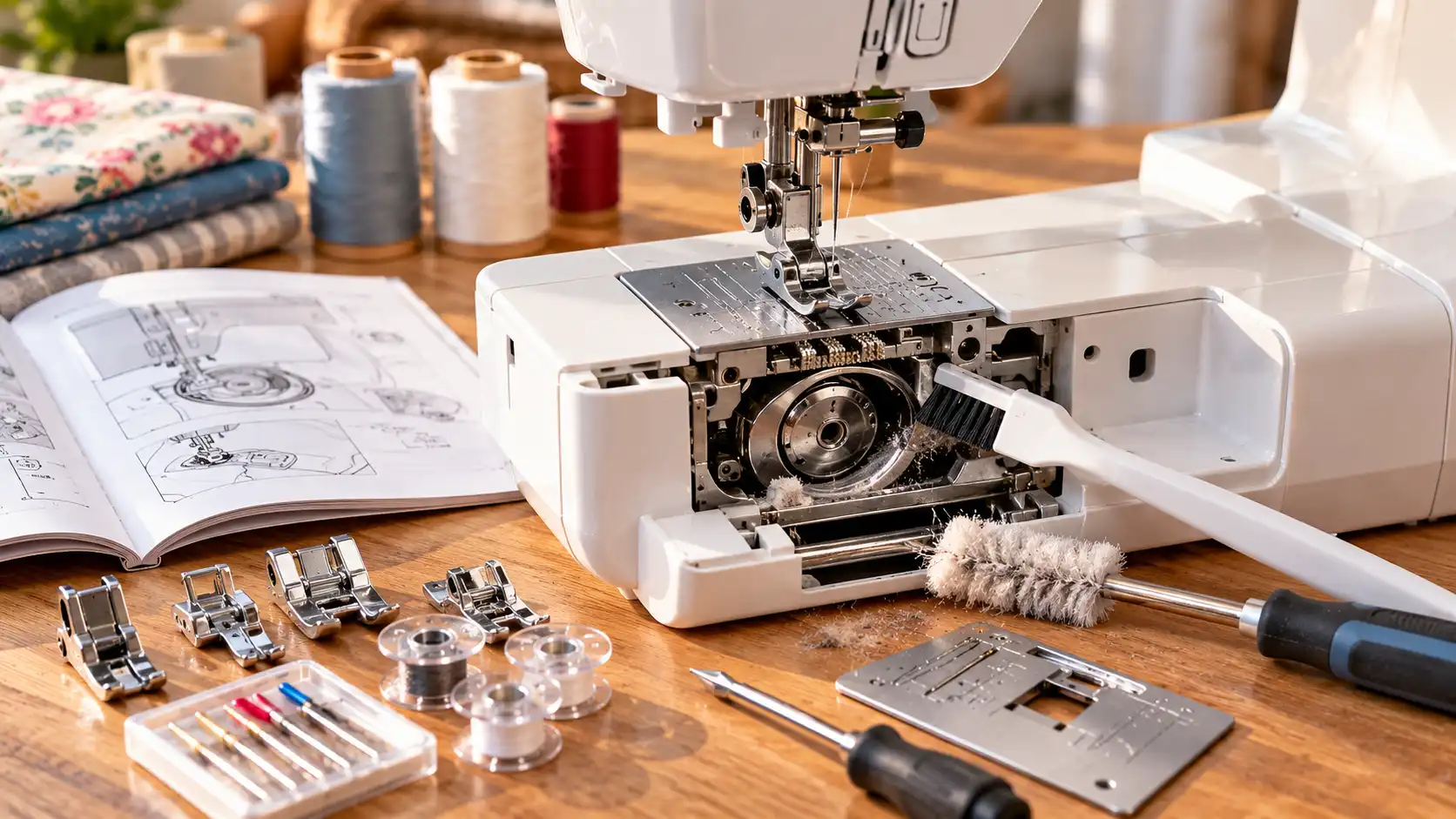
1. Clean the Machine Regularly
Lint from thread and fabric builds up around the bobbin area, feed dogs, and needle plate. Flannel, fleece, and brushed fabrics shed the most. Brush it out after each project rather than pushing it deeper, and avoid compressed air, which can force lint further inside.
2. Clean the Bobbin Area
Turn the machine off, remove the bobbin, open the bobbin area per your manual, and brush away lint and tangled thread before reassembling. If your machine has a removable needle plate, clean underneath it too.
3. Change Your Needle Regularly
A dull or bent needle causes skipped stitches, thread breakage, and uneven stitching. Replace it regularly, matching it to your fabric and thread; don’t try to fix every stitching problem by adjusting tension when the needle is the actual culprit.
4. Use the Correct Needle for the Fabri
Universal needles suit general wovens, ballpoint needles suit knits, stretch needles suit elastic fabrics, jeans/denim needles suit heavy denim, and microtex needles suit fine or tightly woven fabrics. Follow the needle manufacturer’s recommendation for your project.
5. Keep the Machine Covered
A cover reduces dust, pet hair, and fabric fibers when the machine isn’t in use, which is especially useful if it doesn’t live in a dedicated sewing space. The Brother CS7000X, for example, ships with a hard protective cover.
6. Don't Ignore the Thread
Poor-quality or improperly installed thread causes uneven tension, breakage, and excessive lint that can look like a machine problem. Use quality thread, store it clean and dry, and double-check that the spool is seated correctly; a surprising number of “machine problems” start here.
7. Re-Thread Before Adjusting Tension
If stitches suddenly look wrong, don’t reach for the tension dial first. Remove the upper thread, check the needle and bobbin, raise the presser foot, re-thread carefully, and test on scrap fabric. Many machines need the presser foot raised for the tension discs to open correctly. If you want a full walkthrough, see our step-by-step guide on how to thread a sewing machine. Only investigate tension if problems persist after re-threading.
8. Oil Only When the Manufacturer Says To
Not every modern machine should be oiled by its owner; many computerized models are serviced differently than older mechanical ones. Use only the lubrication procedure specified in your manual, and don’t start oiling just because a video recommends it. For model-specific guidance, see our full walkthrough on how to oil a sewing machine.
9. Listen for Changes
You know your machine’s normal sound, so grinding, squealing, knocking, or motor strain deserve investigation. A new noise doesn’t necessarily mean catastrophic failure, but stop sewing if something sounds seriously wrong; continuing can make the damage worse.
10. Check the Feed Dogs
If fabric stops feeding correctly, check that the feed dogs are raised (not set for free-motion sewing), clear lint from the area, verify the stitch length, and make sure the presser foot is lowered. A simple setting issue can look like a serious mechanical problem.
11. Clean Your Presser Feet
Presser feet collect lint, thread, and fabric residue. Wipe them occasionally, confirm they’re properly attached, and make sure you’re using the correct specialty foot for the selected stitch; the wrong foot can cause the needle to strike it.
12. Don't Pull the Fabric
Let the machine feed the fabric; your job is to guide it, especially on curves, multiple layers, delicate fabrics, and quilts. If the machine struggles to feed the fabric, investigate why rather than pulling harder.
13. Have the Machine Professionally Serviced
Regular cleaning isn’t a substitute for professional servicing. Follow the interval your manufacturer recommends; this matters especially for higher-investment machines like the Juki HZL-F600 or combination machines like the Brother SE2000, where a technician can access components outside normal user maintenance.
A Simple Maintenance Schedule
| Task | How Often |
|---|---|
| Remove lint and thread | After sewing sessions |
| Clean bobbin area | Regularly, depending on use |
| Check/change needle | Before demanding projects and whenever it becomes dull/damaged |
| Clean presser feet | As needed |
| Check threading | Whenever stitches suddenly change |
| Check feed dogs | When fabric stops feeding correctly |
| Oil machine | Only according to manufacturer instructions |
| Professional service | According to manufacturer/service recommendations |
The exact schedule depends on the machine and how frequently you use it.
A person sewing for several hours every day will naturally need more frequent cleaning than someone who uses a machine once a month.
Common Sewing Machine Problems You Can Often Troubleshoot
Skipped stitches: check the needle’s condition, type, and size, then verify threading and bobbin installation. Thread breaking: check the needle, thread quality, thread path, and tension. Fabric not feeding: check the feed dogs, presser foot, stitch length, and lint buildup around the feed mechanism. Uneven stitches: usually traces back to the same short list: needle, threading, bobbin, or tension.
If the machine suddenly sounds different, stop and investigate rather than continuing simply because it still technically works. A small problem is almost always cheaper to fix than a damaged one.
The Bottom Line
You don’t need to become a sewing-machine technician to take good care of your machine.
The basics are simple:
Keep it clean. Use the right needle. Thread it correctly. Don’t force the fabric. Follow the manufacturer’s maintenance instructions. And pay attention when something changes.
Good maintenance won’t make a poor machine great.
But it can help a good machine stay a good machine for much longer.
Sewing Machine FAQ
Choosing a sewing machine usually creates more questions than answers. You may know which model interests you, but then another question appears: Do I really need a computerized machine? What about bobbins? Can a beginner quilt? And when is a strange noise actually a problem?
Here are the questions we hear most often.
1. Do I need a computerized sewing machine as a beginner, or is mechanical fine?
A mechanical sewing machine is perfectly fine for a beginner.
In fact, a simple mechanical machine can be an excellent way to learn because you control the basic settings directly.
The Brother ST371HD and Janome 2212 are good examples of straightforward mechanical machines.
A computerized machine such as the Brother CS7000X can also be beginner-friendly because features such as automatic needle threading, speed control, and automatic buttonholes reduce some of the repetitive work.
So the decision comes down to preference:
- Choose mechanical for simplicity and direct control.
- Choose computerized for convenience and more features.
You don’t need a computerized machine simply because you’re new to sewing.
2. Can I learn to sew on a cheap sewing machine?
Yes.
You don’t need an expensive machine to learn the fundamentals of sewing.
A basic machine can teach you:
- Threading
- Bobbin loading
- Straight stitching
The important thing is to avoid buying an extremely poor-quality machine simply because it’s cheap.
A reasonably built entry-level machine such as the Janome 2212 can be a much better starting point than a very inexpensive machine that creates constant tension, feeding, or threading problems.
Once your machine arrives, our step-by-step guide on how to use a sewing machine walks through threading, bobbin winding, and your first seam.
3. Top-load vs. front-load bobbin: does it matter for beginners?
It can, but neither system is universally better.
A top-loading bobbin sits beneath a removable or transparent cover and is often easier for beginners to see and access.
A front-loading bobbin uses a separate bobbin case that loads into the front of the machine.
If you’re choosing your first machine, don’t reject a good machine simply because it uses a front-loading bobbin.
Instead, consider:
- How easy it is to load
- Whether replacement bobbins are easy to find
The Janome 2212, for example, uses a front-loading bobbin, while several Brother machines in our lineup use a top-loading Quick-Set system.
4. Do beginner sewing machines work for quilting?
Yes, but the type of quilting matters.
A beginner machine can handle basic quilt piecing, particularly when you’re working with standard quilting cotton.
The challenge comes when you start handling large quilt sandwiches, multiple layers, or extensive free-motion quilting.
For occasional quilting, the Brother CS7000X offers useful quilting accessories and a wide table.
If quilting becomes your primary hobby, however, a specialized machine such as the Juki TL-2010Q offers a much more quilting-focused setup, including a large work area, speed control, needle positioning, knee lifter, and quilting feet.
5. Is a serger the same thing as a sewing machine?
No.
A conventional sewing machine creates the primary seams used to construct garments and other projects.
A serger, also called an overlocker, is designed primarily to finish fabric edges and sew seams using multiple threads simultaneously.
A serger can:
- Finish raw edges
- Reduce fraying
But you don’t need a serger to start sewing.
A conventional sewing machine should generally be your first purchase. You can add a serger later if your projects justify one.
6. What is the best sewing machine for beginners
For this guide, our choice is the Brother ST371HD.
It combines straightforward mechanical controls with 37 stitches, an automatic needle threader, a one-step buttonhole, a Quick-Set bobbin, and useful presser feet.
However, the Brother CS7000X is our Best Overall and may be the better choice if you want more computerized features and room to experiment.
So:
Best beginner-focused choice: Brother ST371HD
Best beginner machine with more versatility: Brother CS7000X
For a full breakdown of beginner-friendly options, see our dedicated guide to the best sewing machines for beginners.
7. What is the best sewing machine for making clothes?
Our choice is the Brother HC1850.
Garment sewing benefits from features such as:
- Multiple useful stitches
- Stretch stitches
- One-step buttonholes
The HC1850 offers a broad range of stitches and garment-oriented features.
If you’re an advanced garment sewist who wants substantially more customization, the Singer Quantum Stylist 9960 is another machine worth considering.
8. What is the best sewing machine for quilting?
Our choice is the Juki TL-2010Q.
It is specifically designed around precision straight stitching and offers features that make quilting easier, including:
- Large working area
- Speed control
- Needle up/down
One important limitation is that it is a straight-stitch machine.
If you want one machine that handles quilting alongside garments, repairs, decorative stitches, and general sewing, a versatile computerized machine may be a better choice.
For more quilting-specific picks, see our full guide to the best sewing machines for quilting.
9. Can I sew denim on a regular sewing machine?
Yes, depending on the machine and the project.
A regular home sewing machine can sew some denim, particularly lighter-weight denim and seams involving fewer layers.
The problem is usually not the denim itself. It’s the number of layers and thickness at the seam.
For frequent heavy-denim or canvas work, a machine such as the Singer Heavy Duty 4452 is more appropriate.
Regardless of the machine, use an appropriate denim/jeans needle and suitable thread, and don’t force the fabric through the machine.
10. My sewing machine is making a grinding noise. Do I need a new one?
Not necessarily.
A strange noise doesn’t automatically mean the machine needs to be replaced.
First, stop sewing and check the simple possibilities:
- Is thread tangled around the bobbin area?
- Is the needle bent?
- Is the bobbin installed correctly?
If the noise continues after basic troubleshooting, have the machine inspected by a qualified technician.
Don’t keep running a machine that suddenly develops a serious grinding or knocking sound.
11. How often should I clean my sewing machine?
It depends on how frequently you sew and what fabrics you use.
If you’re sewing regularly, clean lint from the bobbin area and feed dogs frequently.
Fabrics such as fleece, flannel, felt, and other lint-producing materials may require more frequent cleaning.
At minimum, inspect the machine after sewing sessions and follow the cleaning instructions in your owner’s manual.
And remember: don’t oil a modern sewing machine unless the manufacturer specifically instructs you to.
12. How long should a sewing machine last?
There’s no single number that applies to every sewing machine.
Lifespan depends on:
- Build quality
- How frequently you sew
A machine used occasionally and maintained properly can last for many years.
A machine used heavily every day will naturally experience more wear.
Rather than asking:
“Will this machine last 20 years?”
ask:
“Is this machine appropriate for how I plan to use it, and can it be properly maintained and serviced?”
That’s a much more useful question.
13. Should I buy a sewing machine online or from a dealer?
Either can work, but compare more than the price.
Online retailers can offer:
- Convenient shopping
- Large selections
A local sewing-machine dealer may offer:
- Demonstrations
- Setup assistance
If you’re buying an expensive machine, dealer support can be particularly valuable.
For lower-cost machines, buying from a reputable retailer with a clear return policy may be perfectly reasonable.
14. Is an expensive sewing machine always better?
No.
A $1,000 machine isn’t automatically better for someone who only needs to hem clothes.
Likewise, a $200 machine may become frustrating for someone who sews garments every week.
Think of it this way:
The best sewing machine is the one whose capabilities match your needs.
That’s why our list includes everything from the budget-friendly Janome 2212 to the premium Juki HZL-F600.
15. Should I buy a used or vintage sewing machine?
It can be a great option, but inspect it carefully.
A well-maintained vintage mechanical machine can provide excellent basic sewing performance.
However, you should check:
- Stitch quality
- Motor operation
- Handwheel movement
If you’re a beginner and don’t have anyone who can inspect the machine with you, buying a new machine may be the safer option.
For more details, see our section on used and vintage sewing machines above.
Final FAQ Takeaway
If you’re still overwhelmed, don’t try to compare every specification.
Start with three questions:
What will I sew?
How often will I sew?
What problem do I want this machine to solve?
Once you answer those three questions, the list of suitable machines usually becomes much shorter.
And that’s ultimately what this guide is designed to do: help you choose the right sewing machine for your projects, not simply the machine with the longest feature list.
Conclusion: Choose the Machine That Fits Your Sewing
Choosing the best sewing machine isn’t really about finding the machine with the most stitches, the highest price, or the longest list of features.
It’s about finding the machine that makes your sewing easier.
The Best Sewing Machine Is the One You'll Actually Use
Here’s the part that’s easy to overlook.
A sewing machine can have an incredible specification sheet and still be the wrong machine for you.
If it’s too complicated, too heavy, too expensive, or simply doesn’t suit the fabrics and projects you enjoy, those impressive features won’t matter much.
We’ve all had purchases that looked perfect on paper but didn’t quite work in real life.
Don’t make your sewing machine another one.
Instead, start with your projects.
Think about the fabrics you’ll sew. Think about how often you’ll use the machine. Think about whether you’re learning, making clothes, quilting, repairing garments, or eventually sewing for income.
Then work backward to the machine.
That’s how you turn a long list of specifications into a decision you can actually feel confident about.
Why You Can Trust The Sewing Advisor
Learn more about our review process and team on our About page.
Our goal isn’t to tell you that every machine on this list is perfect.
It isn’t.
Every sewing machine has strengths, limitations, and a type of sewist it suits best.
That’s why this guide explains why we recommend each machine, what we like, what we don’t like, and when you should skip it.
We also consider manufacturer specifications alongside independent testing and real-world sewing experience rather than relying on a single source or a manufacturer’s marketing claims.
And because sewing machines, prices, and availability change, always check the current product listing and specifications before purchasing.
The right sewing machine isn’t necessarily the most expensive one. It’s the one that solves the problems you actually have and gives you enough room to enjoy where your sewing takes you next.
Ready to Choose?
If you’ve narrowed your choice down to two or three machines, don’t overthink it.
Go back to your projects.
Choose the machine that best matches what you actually want to sew.
That’s the machine most likely to stay on your table, and that’s ultimately what makes it the best sewing machine for you.
Allen Miller is the main author of The Sewing Advisor. He’s a whiz with a needle and thread. He spends his time reading, playing football, and writing. You can find more about him here.
You’ve been extremely helpful.
Hello There. I found your blog using msn. This is a very well written article.
I will be sure to bookmark it and return to read more of your useful info.
Thanks for the post. I’ll certainly return.
It is a great service with good value, I recommend
Very nice! I like the experience.
every one of these takes up the reason of rejecting less and less. with pain, that with pleasure, and one with wisdom. but in the softness of every unwilling mind, for the wise choice seeks pleasure
pete sampras today
I like the helpful information you provide in your articles.
I will bookmark your weblog and check again here frequently.
I am quite sure I’ll learn lots of new stuff right here!
Good luck for the next!