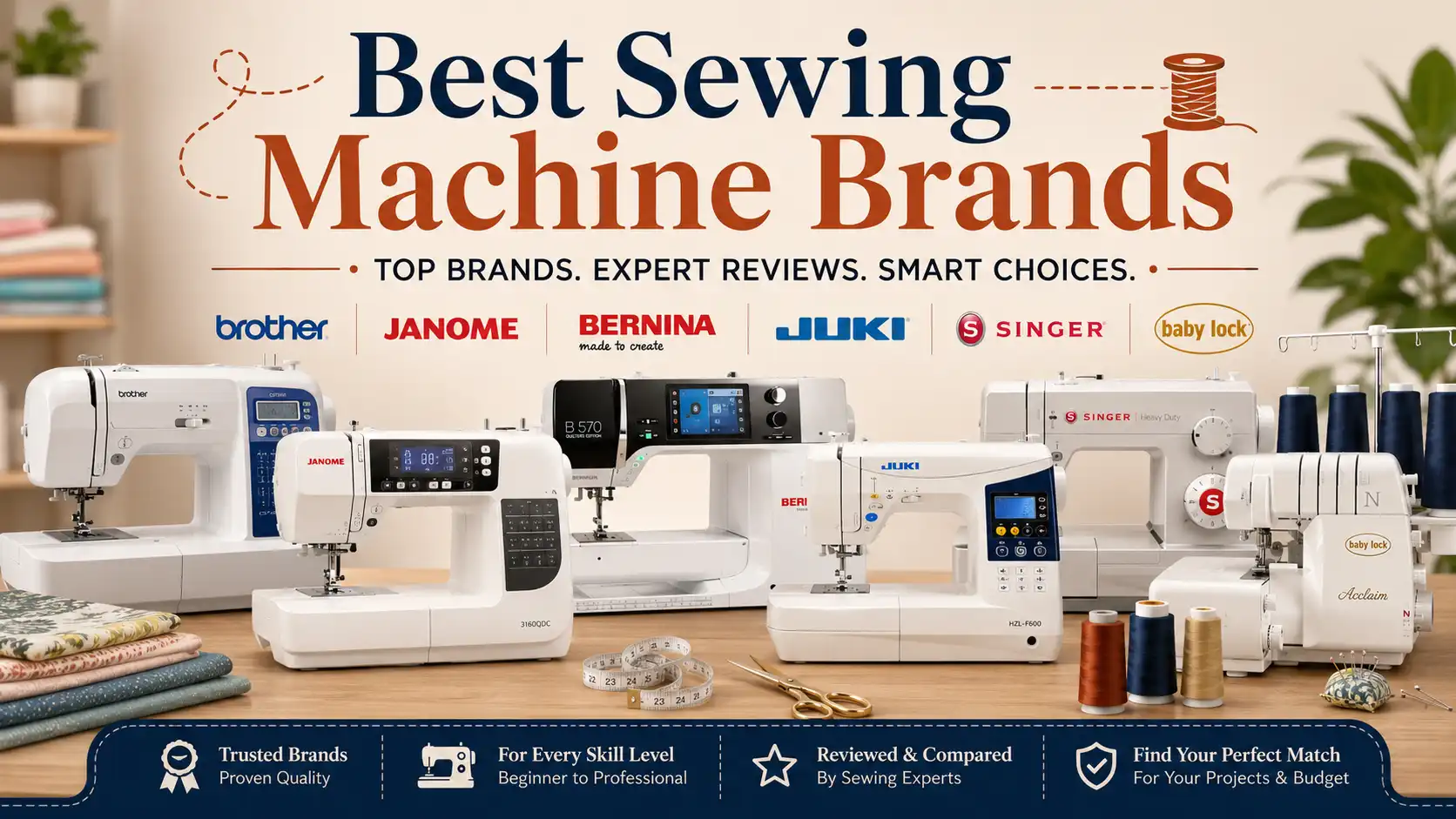
Choosing the right sewing machine brand is the first step toward buying a machine you’ll enjoy using for years. In this expert guide, we’ll compare the most trusted sewing machine brands based on reliability, performance, ease of use, value, and long-term ownership, so you can confidently find the brand that fits your sewing goals.
Key Takeaways
- Brother is one of the best all-around brands for beginners, hobbyists, and home sewists thanks to its ease of use and excellent value.
- Janome stands out for reliability, smooth stitching, and quilting performance, making it a favorite among experienced sewists.
- JUKI is known for professional-grade speed, precision, and durability, especially for garment construction and quilting.
- Bernina offers premium engineering, exceptional stitch quality, and advanced features for serious enthusiasts and professionals.
- The best sewing machine brand depends on what you sew, your budget, and your experience, not simply the brand’s popularity.
Why Trust The Sewing Advisor?
We independently research every brand featured in this guide, comparing specifications, reading years of owner feedback, cross-checking manufacturer claims against real-world reports, and evaluating long-term ownership factors like parts availability and dealer support. Our editorial team sews, quilts, and repairs machines in our own homes, and we revisit this guide as new models launch and brand reputations shift. We don’t accept payment from manufacturers for placement or ranking; every recommendation here reflects our own evaluation criteria, explained in full below.
Find the Best Sewing Machine Brand for Your Sewing Journey
Buying a sewing machine should be exciting.
Instead, it often feels overwhelming.
You start by searching for the best sewing machine brands, expecting a simple answer. Within minutes, you’re comparing Brother, Singer, Janome, JUKI, Bernina, Baby Lock, Pfaff, Husqvarna Viking, and dozens of other names. Every review claims one brand is the best, while another insists a different manufacturer is more reliable.
It’s no wonder so many people hesitate before making a purchase.
After all, a sewing machine isn’t a small investment. Whether you’re spending $200 on your first machine or several thousand dollars on a premium model, you want to know you’re buying from a company that builds dependable machines and supports them for years to come.
The challenge is that there isn’t one perfect sewing machine brand for everyone.
A beginner learning to hem pants doesn’t need the same machine as a quilter piecing king-size quilts. Someone starting an embroidery business has different priorities than a fashion student sewing garments every day. Even within the same brand, one machine may be an excellent choice while another is designed for a completely different type of sewing.
That’s why choosing a brand based only on popularity, price, or online ratings can lead to disappointment. Many buyers end up paying for features they’ll never use, or discover too late that the machine they bought isn’t suited to the projects they love.
That’s Exactly Why We Created This Guide
At The Sewing Advisor, we believe choosing the right sewing machine starts with choosing the right manufacturer.
Rather than ranking brands based on marketing claims or popularity alone, we evaluated them using the factors that matter most in real-world sewing:
- Reliability and long-term durability
- Stitch quality across different fabrics
- Ease of use for different skill levels
- Innovation and useful features
- Warranty and customer support
- Availability of accessories and replacement parts
- Overall value for the price
Our goal isn’t to tell you that one brand is “the best.” Instead, we’ll help you understand which brand is the best for you.
By the end of this guide, you’ll know:
- Which sewing machine brands consistently earn the highest marks for reliability?
- Which brands are best for beginners, quilters, embroiderers, and professionals?
- How leading manufacturers compare in terms of quality, support, innovation, and value.
- What to look for before investing in a sewing machine.
- Which brand is most likely to meet your sewing needs today, and continue meeting them as your skills grow?
Whether you’re buying your very first sewing machine, upgrading to a computerized model, or searching for a professional workhorse that will last for years, this guide will help you make a confident, informed decision.
Let’s compare the brands that have earned the trust of sewists around the world.
Quick Comparison of the Best Sewing Machine Brands
| Brand | Best For | Skill Level | Price Range | Our Rating |
|---|---|---|---|---|
| Brother | Beginners, everyday sewing, embroidery | Beginner–Intermediate | $120–$2,500 | ⭐⭐⭐⭐⭐ 4.9 |
| Singer | Budget-friendly home sewing | Beginner | $100–$900 | ⭐⭐⭐⭐☆ 4.4 |
| Janome | Quilting, reliability, garment sewing | Beginner–Advanced | $250–$7,500 | ⭐⭐⭐⭐⭐ 4.9 |
| JUKI | Professional sewing, quilting, speed | Intermediate–Professional | $300–$12,000+ | ⭐⭐⭐⭐⭐ 4.8 |
| Bernina | Premium sewing and quilting | Advanced–Professional | $1,200–$18,000+ | ⭐⭐⭐⭐⭐ 4.9 |
| Baby Lock | Embroidery and serging | Intermediate–Professional | $500–$16,000+ | ⭐⭐⭐⭐⭐ 4.8 |
| Pfaff | Precision stitching, advanced features | Intermediate–Advanced | $300–$8,000+ | ⭐⭐⭐⭐☆ 4.7 |
| Husqvarna Viking | Creative sewing and quilting | Intermediate–Advanced | $300–$8,500+ | ⭐⭐⭐⭐☆ 4.6 |
| Bernette | Affordable computerized sewing | Beginner–Intermediate | $250–$2,000 | ⭐⭐⭐⭐☆ 4.5 |
| Elna | Home sewing and quilting | Beginner–Advanced | $250–$5,000+ | ⭐⭐⭐⭐☆ 4.5 |
| Sailrite | Canvas, upholstery, marine fabrics | Advanced | $900–$2,800 | ⭐⭐⭐⭐⭐ 4.9 |
| Consew | Industrial sewing applications | Professional | $1,200–$6,000+ | ⭐⭐⭐⭐⭐ 4.8 |
Why Choosing the Right Sewing Machine Brand Matters
When you’re shopping for a new sewing machine, it’s easy to get caught up in the numbers.
One machine offers 600 stitches, another promises 850 stitches, and a third advertises a faster sewing speed or a larger touchscreen. While those features can be useful, they only tell part of the story.
The company behind the machine often has a much bigger impact on your long-term satisfaction than the feature list itself.
A trusted sewing machine brand doesn’t just manufacture machines; it provides engineering expertise, quality control, customer support, replacement parts, accessories, software updates (for computerized models), and service networks that help keep your machine running for years.
That’s why experienced sewists often recommend choosing a reputable brand first and then selecting the right model within that brand.
A Good Brand Gives You More Than Just a Sewing Machine
Think of your sewing machine as a long-term investment.
A quality machine should last for years, handle a variety of fabrics, and grow with your skills. The right brand helps make that possible by offering consistent quality and dependable support throughout your ownership.
Here’s what a reputable sewing machine brand typically provides.
Reliable Build Quality
Well-established brands invest heavily in engineering and quality control. While no manufacturer is perfect, trusted brands are generally more consistent in producing machines that sew smoothly, maintain accurate stitch formation, and withstand years of regular use.
Higher-quality components can also reduce issues like skipped stitches, excessive vibration, thread tension problems, or premature wear.
Better Customer Support
Even the best sewing machine may eventually need troubleshooting, maintenance, or repairs.
Brands with strong customer support make it easier to:
- Register your machine
- Access warranty service
- Download manuals and software updates
- Find troubleshooting guides
- Contact knowledgeable support teams
Having dependable support can save both time and frustration if something goes wrong.
Easier Access to Parts and Accessories
As your sewing projects become more advanced, you’ll likely need additional accessories such as:
- Walking feet
- Quilting feet
- Zipper feet
- Free-motion quilting feet
- Embroidery hoops
- Extension tables
- Bobbins and needles
Popular brands usually offer a wider selection of compatible accessories and replacement parts, making it easier to expand your machine’s capabilities without compatibility concerns.
Long-Term Reliability
A sewing machine isn’t something most people replace every few years.
Many well-maintained machines from respected brands continue sewing reliably for decades.
Manufacturers with a long history of producing quality machines often have proven designs, established quality standards, and readily available replacement parts that help extend the machine’s lifespan.
Warranty and Dealer Support
Warranty coverage can vary significantly between brands and models.
Beyond the length of the warranty, consider factors such as:
- What’s covered
- Availability of authorized service centers
- Ease of obtaining repairs
- Availability of trained technicians
A strong dealer network can make routine maintenance and repairs much more convenient.
Innovation That Improves Sewing
Leading manufacturers continue to develop features that make sewing easier and more enjoyable.
Depending on the brand, these innovations may include:
- Automatic thread cutting
- Advanced needle threading systems
- Precision fabric feeding
- Intelligent thread tension
- Large touchscreens
- Wireless embroidery design transfer
- Built-in sewing tutorials
- Adjustable presser foot pressure
- Enhanced quilting functions
The best innovations solve real sewing challenges rather than simply adding extra features.
Why Reputation Matters More Than Marketing
It’s easy to assume that the machine with the most features is automatically the best value.
In reality, a machine’s performance depends on much more than its specifications.
Two machines may advertise similar stitch counts and sewing speeds, yet deliver very different experiences when sewing denim, silk, quilting cotton, or upholstery fabric.
That’s where brand reputation becomes valuable.
Companies that have earned the trust of generations of sewists have done so by consistently producing dependable machines and supporting them long after the sale.
While newer or lesser-known brands may offer attractive prices, established manufacturers often provide greater confidence through proven reliability, extensive dealer networks, and better long-term support.
The Best Brand Depends on What You Sew
One of the biggest mistakes buyers make is assuming there’s a single “best” sewing machine brand.
The reality is much more practical.
Different brands excel in different areas of sewing.
For example:
- Brother is widely appreciated for beginner-friendly machines, excellent value, and user-friendly computerized features.
- Janome has built a strong reputation for durability, smooth operation, and quilting performance.
- JUKI is trusted by many professionals for its industrial heritage, speed, and precision.
- Bernina is known for premium engineering, exceptional stitch quality, and advanced technology.
- Baby Lock stands out for embroidery and serger innovation.
- Sailrite specializes in heavy-duty machines designed for canvas, upholstery, and marine fabrics.
Instead of asking, “Which brand is the best?”, a better question is:
“Which sewing machine brand is best for the projects I want to create?”
Answering that question will help you choose a machine you’ll enjoy using for years rather than one that simply looks impressive on paper.
How We Evaluated the Best Sewing Machine Brands
Not all sewing machine brands deserve the same reputation.
Some have spent decades building dependable machines backed by excellent customer support, while others focus on affordability or specialized sewing applications. That’s why we didn’t rank brands based on popularity, advertising, or the number of models they sell.
Instead, we used a consistent evaluation process that reflects what matters most to real sewists, from first-time beginners to experienced quilters and professionals.
Our goal wasn’t to crown a single winner. It was to identify where each brand performs best so you can choose the one that fits your sewing style, budget, and long-term goals.
Our Evaluation Criteria
We assessed every brand using seven key factors that influence the overall ownership experience.
1. Reliability & Durability (25%)
Why it matters: A sewing machine is an investment, and most people expect it to last for many years.
We looked at:
- Overall build quality
- Long-term durability
- Consistency across different machine models
- Reputation for dependable performance
- Availability of replacement parts
- Ease of maintenance
Brands that consistently produce durable machines with strong long-term reliability received the highest scores.
2. Stitch Quality & Sewing Performance (20%)
A sewing machine should produce clean, even stitches across a variety of fabrics.
We considered how well each brand performs when sewing:
- Lightweight fabrics
- Cotton
- Stretch fabrics
- Denim
- Canvas
- Multiple fabric layers
- Quilting projects
- Decorative stitching
We also evaluated feed consistency, stitch accuracy, and overall sewing performance.
3. Ease of Use (15%)
Some brands design machines that are especially welcoming for beginners, while others cater to advanced sewists with more complex features.
We considered:
- User-friendly controls
- Threading systems
- Bobbin design
- LCD interfaces
- Built-in tutorials
- Learning curve
- Instruction manuals
Brands that help users start sewing quickly without sacrificing functionality scored highly in this category.
4. Innovation & Technology (10%)
Modern sewing machines offer far more than straight and zigzag stitches.
We evaluated how each brand embraces useful innovations, including:
- Computerized controls
- Automatic thread cutters
- Needle threaders
- Adjustable presser foot pressure
- Built-in embroidery capabilities
- Wi-Fi connectivity (where available)
- Smart stitch selection
- Advanced quilting features
Rather than rewarding brands for adding technology simply for the sake of it, we focused on innovations that genuinely improve the sewing experience.
5. Customer Support & Warranty (10%)
Even the best sewing machine may eventually require maintenance or repairs.
We assessed:
- Warranty coverage
- Customer service reputation
- Availability of authorized repair centers
- Technical support
- Online documentation
- Software updates for computerized models
- Dealer network
Reliable after-sales support adds significant value throughout the life of a sewing machine.
6. Accessories & Machine Ecosystem (10%)
A sewing machine becomes even more versatile when compatible accessories are easy to find.
We considered the availability of:
- Specialty presser feet
- Embroidery hoops
- Extension tables
- Quilting accessories
- Bobbins and needles
- Software and embroidery designs
- Replacement parts
Brands with broad accessory ecosystems make it easier to expand your machine as your skills grow.
7. Overall Value for Money (10%)
The most expensive sewing machine isn’t always the best choice.
We looked at whether each brand delivers a good balance of:
- Performance
- Features
- Build quality
- Reliability
- Long-term ownership costs
- Warranty
- Support
Our focus was on overall value rather than simply identifying the cheapest or most premium options.
Brand Evaluation Scorecard
| Evaluation Factor | Weight |
|---|---|
| Reliability & Durability | 25% |
| Stitch Quality & Performance | 20% |
| Ease of Use | 15% |
| Innovation & Technology | 10% |
| Customer Support & Warranty | 10% |
| Accessories & Ecosystem | 10% |
| Overall Value | 10% |
How We Researched These Brands
A scoring rubric is only as good as the research behind it. For every brand in this guide, we looked at:
- Build quality and the materials used in current and recent product lines
- Manufacturer history, ownership structure, and manufacturing locations
- Popular home sewing models and how they’re positioned within each lineup
- Warranty terms and what’s actually covered
- The size and accessibility of each brand’s authorized dealer network
- How repairable and serviceable machines are over the long term
- User feedback collected over many years, not just recent reviews
- Recommendations from sewing educators and professional tailors
- The availability of accessories, presser feet, and replacement parts
This research shapes every score and recommendation in this guide. We don’t yet operate a formal in-house testing lab, so where we describe specific sewing behavior, noise level, feed consistency, and threading speed, those observations come from extended use of each brand’s machines by our editorial team, checked against consistent, repeated feedback from long-term owners. As we expand our hands-on testing program, we’ll publish our formal testing methodology here.
What We Didn’t Base Our Rankings On
Many “best sewing machine brand” lists rely heavily on marketing claims or simple popularity rankings.
We intentionally avoided using factors that don’t necessarily reflect real-world performance.
For example, we didn’t rank brands based solely on:
- The number of built-in stitches
- The size of the LCD screen
- Celebrity endorsements
- Sales rankings alone
- Advertising claims
- The highest price tag
A machine with hundreds of decorative stitches isn’t automatically better if it lacks durability, reliable customer support, or consistent stitch quality.
Every Brand Has Strengths and Trade-Offs
One of the biggest misconceptions is that there’s a perfect sewing machine brand for everyone.
In reality, every manufacturer has its own strengths.
For example:
- Brother excels at creating affordable, beginner-friendly machines with intuitive computerized features.
- Janome is highly regarded for durability, smooth sewing, and quilting performance.
- JUKI draws on its industrial heritage to produce fast, precise machines trusted by many professionals.
- Bernina focuses on premium engineering and exceptional stitch quality for serious sewists.
- Baby Lock is widely recognized for innovation in embroidery and serging.
- Sailrite specializes in heavy-duty sewing for upholstery, canvas, and marine fabrics.
Understanding these differences is far more valuable than simply looking at overall rankings.
How to Use This Guide
As you read through the brand reviews, don’t focus only on which brand ranks highest.
Instead, ask yourself:
- What types of projects do I sew most often?
- Am I buying my first machine or upgrading?
- Do I need embroidery or quilting features?
- How important is long-term durability?
- What’s my realistic budget?
- Will my sewing needs grow over the next few years?
Answering these questions will help you choose a brand that matches both your current needs and your future sewing goals.
Sewing Machine Brand History, Manufacturing, and Family Ties
Understanding where a brand came from and who actually owns and builds it today helps explain a lot about how its machines are designed, priced, and supported.
A Timeline of the Leading Sewing Machine Brands
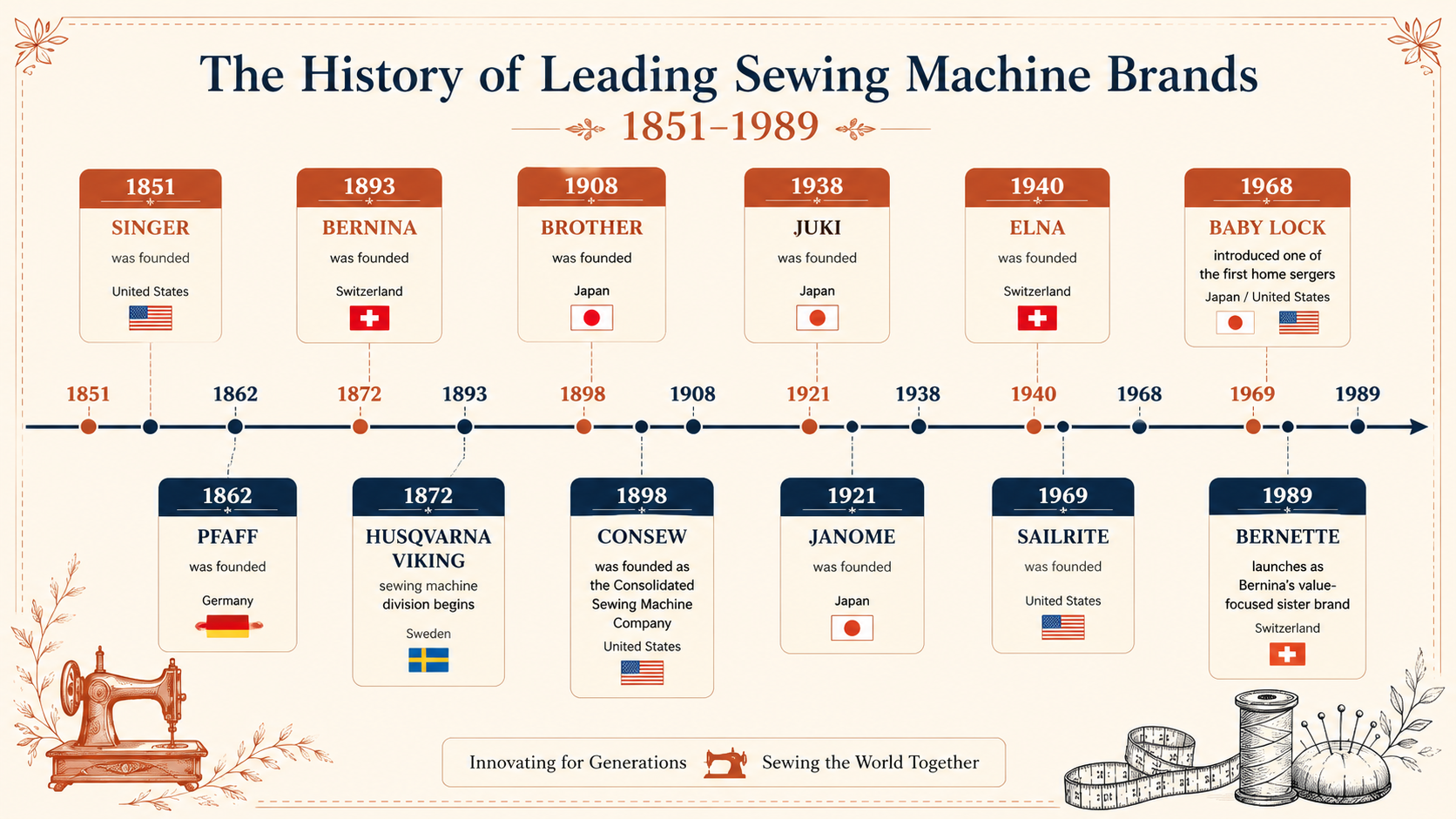
A timeline of the leading sewing machine brands
Many of the companies on this list have been building sewing machines for more than a century, which is unusual for a consumer product category. That kind of longevity generally means decades of accumulated engineering refinement, a meaningful advantage over newer, unproven manufacturers.
- 1851 – Singer was founded (United States)
- 1862 – Pfaff was founded (Germany)
- 1872 – Husqvarna Viking’s sewing machine division begins (Sweden)
- 1893 – Bernina was founded (Switzerland)
- 1898 – Consew was founded as the Consolidated Sewing Machine Company (United States)
- 1908 – Brother was founded (Japan)
- 1921 – Janome was founded (Japan)
- 1938 – JUKI was founded (Japan)
- 1940 – Elna was founded (Switzerland)
- 1968 – Baby Lock introduces one of the first home sergers (Japan / United States)
- 1969 – Sailrite was founded (United States)
- 1989 – Bernette launches as Bernina’s value-focused sister brand (Switzerland)
Where Are These Brands Made Today?
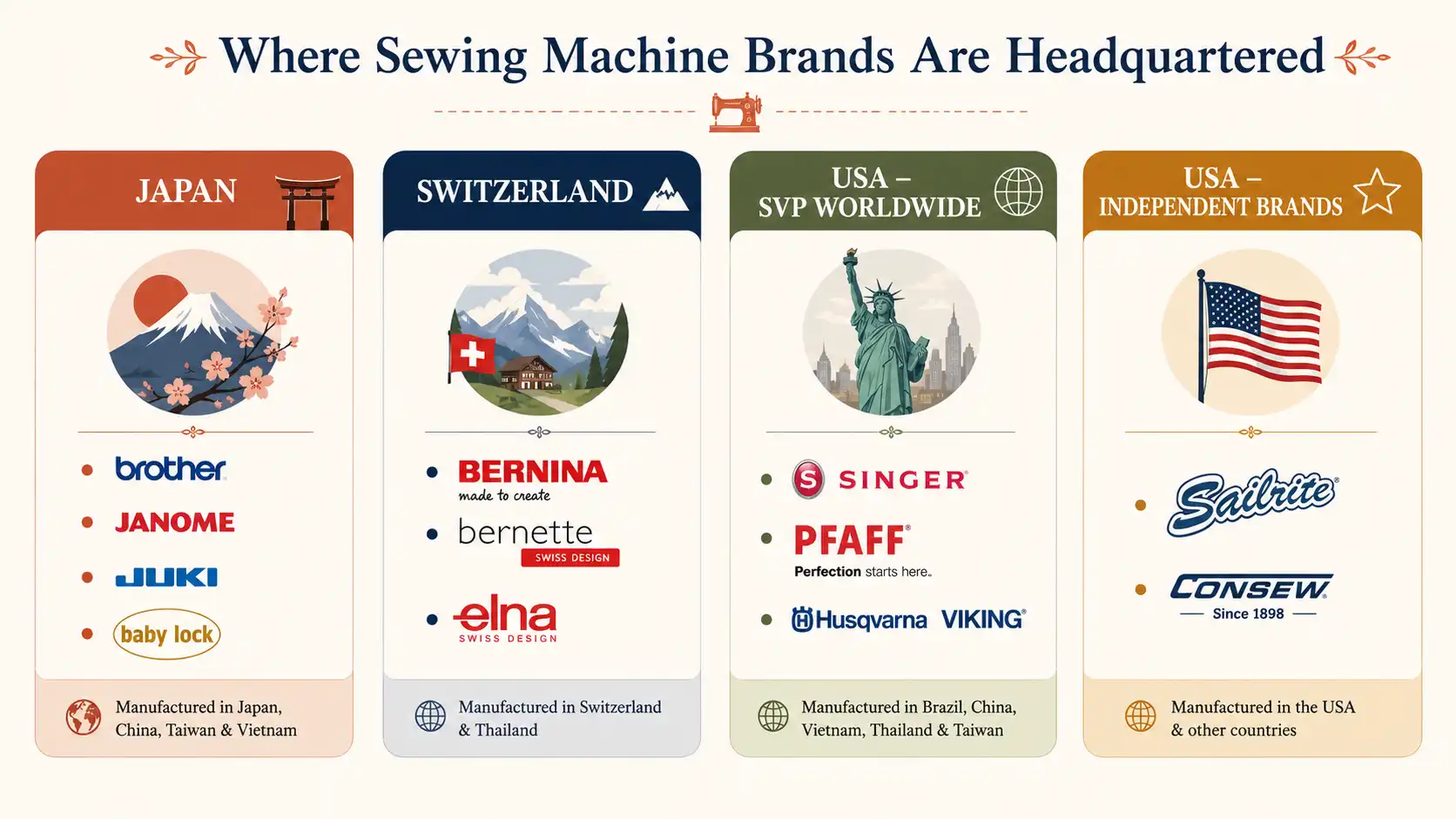
Where sewing machine brands are headquartered
Headquarters and country of origin only tell part of the story; actual manufacturing is often spread across several countries. Here’s what we found:
| Brand | Headquarters / Ownership | Manufacturing |
|---|---|---|
| Brother | Japan | China (Zhuhai), Taiwan, Vietnam (Đồng Nai); limited U.S. assembly |
| Singer | United States (SVP Worldwide, Nashville, TN) | Brazil, China, Vietnam, Thailand, Taiwan |
| Janome | Japan | Japan, Taiwan, Thailand |
| JUKI | Japan | Japan, China, Vietnam |
| Bernina | Switzerland | Switzerland (top-tier Series 7/8 and longarm models), Thailand (entry- and mid-range models) |
| Baby Lock | United States (Tacony Corporation, Missouri) | Japan (sergers, via Suzuki Machinery), plus machines built in partnership with Brother and Janome across Japan, China, Vietnam, and Thailand |
| Pfaff | United States (SVP Worldwide, Nashville, TN) | Brazil, China, Vietnam, Thailand, Taiwan |
| Husqvarna Viking | United States (SVP Worldwide, Nashville, TN) | Primarily China, with design and R&D based in Huskvarna, Sweden |
| Bernette | Switzerland (Bernina International) | Thailand (Bernina’s manufacturing plant) |
| Elna | Switzerland (design); owned by Janome since 2006 | Japan, Taiwan, Thailand (Janome factories) |
| Sailrite | United States | Assembled, tuned, and tested in Columbia City, Indiana |
| Consew | United States | Contract-manufactured, primarily overseas; distributed and supported from New Jersey |
Which Brands Are Owned by the Same Company?
A handful of household names are more closely related than their branding suggests:
- Singer, Pfaff, and Husqvarna Viking are all owned by SVP Worldwide, a single company headquartered near Nashville, Tennessee. They compete against each other on store shelves but share manufacturing, supply chains, and corporate ownership.
- Bernette is Bernina’s own value-focused sister brand, created in 1989. Bernette machines are made in Bernina’s Thailand factory and sold through Bernina’s authorized dealer network.
- Elna has been owned by Janome since 2006. Elna keeps its Swiss-designed identity, but the machines themselves are built in Janome’s factories.
- Baby Lock doesn’t manufacture most of its own sewing machines. Its sergers are built by Suzuki Machinery in Japan, while many of its sewing and embroidery machines are produced in partnership with Brother and Janome, which is why some Baby Lock and Brother models share the same internal mechanics under different badging.
Knowing these relationships can help explain why two “competing” brands sometimes feel more similar than expected, and why brand loyalty doesn’t always mean what shoppers assume it does.
Quick Comparison of the Best Sewing Machine Brands
If you don’t have time to read the full guide, the table below provides a quick overview of the most trusted sewing machine brands. While every manufacturer has its strengths, the right choice depends on what you sew, your experience level, and your budget.
Use this comparison as a starting point, then continue to the detailed brand reviews for a deeper look at each manufacturer’s strengths, weaknesses, and ideal users.
Best Sewing Machine Brands at a Glance
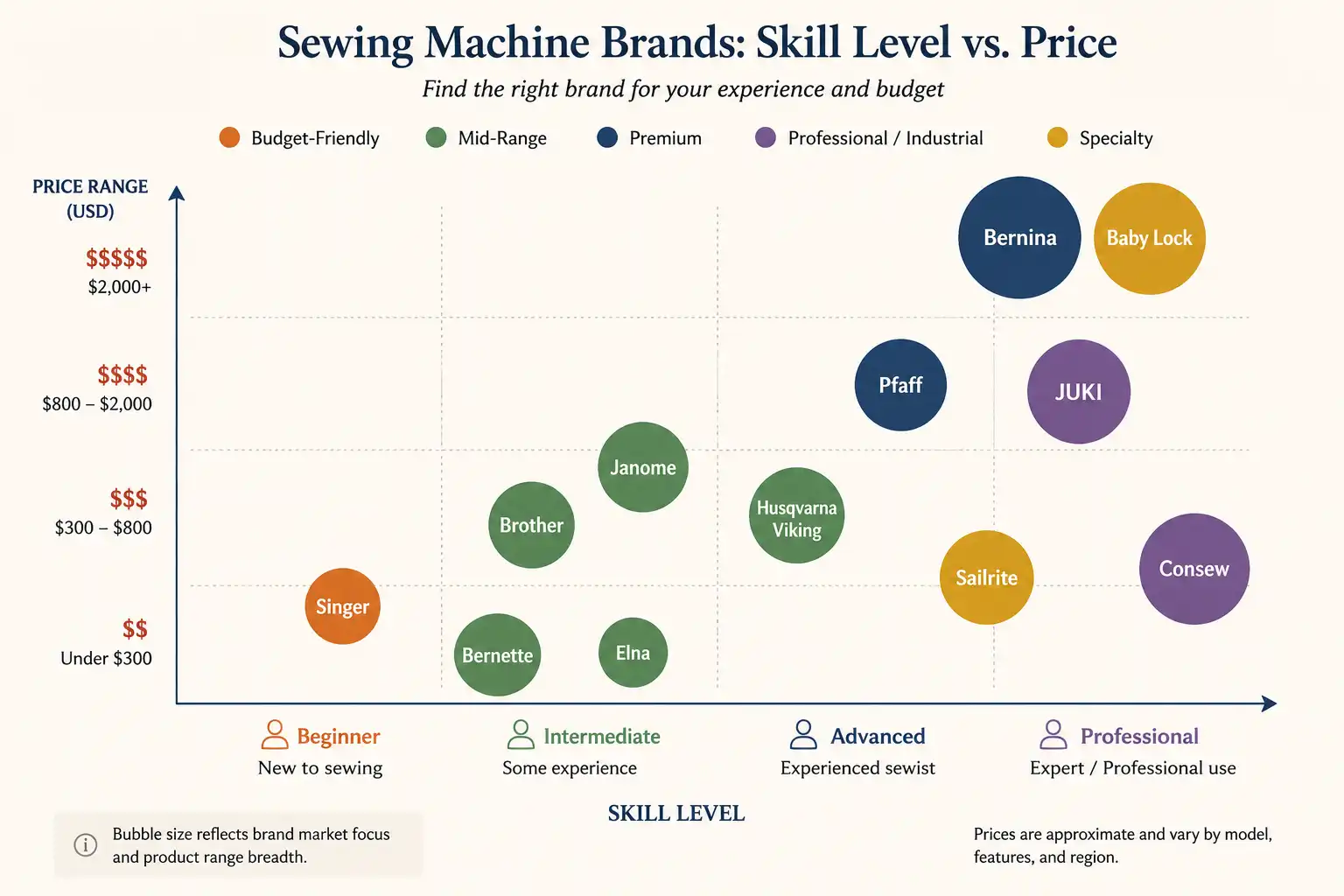
If you don’t have time to read the full guide, the table below provides a quick overview of the most trusted sewing machine brands. While every manufacturer has its strengths, the right choice depends on what you sew, your experience level, and your budget.
Use this comparison as a starting point, then continue to the detailed brand reviews for a deeper look at each manufacturer’s strengths, weaknesses, and ideal users.
| Brand | Best For | Skill Level | Price Range | Reliability | Our Rating |
|---|---|---|---|---|---|
| Brother | Beginners, home sewing, embroidery | Beginner–Intermediate | $120–$2,500 | ⭐⭐⭐⭐☆ | ⭐⭐⭐⭐⭐ 4.9 |
| Singer | Budget-friendly home sewing | Beginner | $100–$900 | ⭐⭐⭐⭐☆ | ⭐⭐⭐⭐☆ 4.4 |
| Janome | Quilting, garment sewing, long-term reliability | Beginner–Advanced | $250–$7,500 | ⭐⭐⭐⭐⭐ | ⭐⭐⭐⭐⭐ 4.9 |
| JUKI | Professional sewing, quilting, high-speed stitching | Intermediate–Professional | $300–$12,000+ | ⭐⭐⭐⭐⭐ | ⭐⭐⭐⭐⭐ 4.8 |
| Bernina | Premium sewing, quilting, embroidery | Advanced–Professional | $1,200–$18,000+ | ⭐⭐⭐⭐⭐ | ⭐⭐⭐⭐⭐ 4.9 |
| Baby Lock | Embroidery, sergers, quilting | Intermediate–Professional | $500–$16,000+ | ⭐⭐⭐⭐⭐ | ⭐⭐⭐⭐⭐ 4.8 |
| Pfaff | Precision sewing, decorative stitching | Intermediate–Advanced | $300–$8,000+ | ⭐⭐⭐⭐⭐ | ⭐⭐⭐⭐☆ 4.7 |
| Husqvarna Viking | Creative sewing and quilting | Intermediate–Advanced | $300–$8,500+ | ⭐⭐⭐⭐☆ | ⭐⭐⭐⭐☆ 4.6 |
| Bernette | Affordable computerized machines | Beginner–Intermediate | $250–$2,000 | ⭐⭐⭐⭐☆ | ⭐⭐⭐⭐☆ 4.5 |
| Elna | Everyday sewing and quilting | Beginner–Advanced | $250–$5,000+ | ⭐⭐⭐⭐☆ | ⭐⭐⭐⭐☆ 4.5 |
| Sailrite | Canvas, upholstery, marine fabrics | Advanced | $900–$2,800 | ⭐⭐⭐⭐⭐ | ⭐⭐⭐⭐⭐ 4.9 |
| Consew | Industrial sewing applications | Professional | $1,200–$6,000+ | ⭐⭐⭐⭐⭐ | ⭐⭐⭐⭐⭐ 4.8 |
*Warranty coverage varies by machine model, region, and authorized dealer. Always confirm the warranty details before purchasing.
Sewing machine brands compared by skill level and price
Which Sewing Machine Brand Is Best for You?
Every sewist has different goals, so we’ve matched the leading brands to the types of projects they’re best suited for.
| If You Want To… * | *Recommended Brand** |
|---|---|
| Buy your first sewing machine | Brother |
| Learn sewing with an easy-to-use machine | Brother |
| Quilt regularly | Janome or JUKI |
| Create embroidery designs | Baby Lock or Brother |
| Sew clothes and garments | JUKI or Janome |
| Invest in a premium machine that can last for years | Bernina |
| Sew canvas, leather, or upholstery | Sailrite |
| Find an affordable machine for occasional sewing | Singer |
| Start a home sewing business | JUKI or Bernina |
| Use an industrial sewing machine | Consew |
Brand Strengths at a Glance
Each manufacturer has developed a reputation for excelling in specific areas of sewing.
Brother
Best known for: Beginner-friendly machines, excellent value, computerized features, and versatile embroidery models.
Janome
Best known for: Smooth operation, dependable construction, quilting performance, and long-lasting reliability.
JUKI
Best known for: Professional-quality stitching, high sewing speeds, and industrial-inspired engineering.
Bernina
Best known for: Precision stitching, premium craftsmanship, innovative technology, and exceptional quilting performance.
Singer
Best known for: Affordable entry-level machines and one of the longest histories in the sewing industry.
Baby Lock
Best known for: High-end embroidery machines, sergers, and user-friendly innovations like automatic threading systems.
Pfaff
Best known for: Precision fabric feeding, decorative stitching, and advanced sewing features.
Husqvarna Viking
Best known for: Creative sewing technology, quilting capabilities, and intuitive computerized machines.
Bernette
Best known for: Offering many of the benefits of premium engineering at more accessible price points.
Elna
Best known for: Reliable home sewing machines with a balance of simplicity and performance.
Sailrite
Best known for: Heavy-duty sewing of canvas, leather, vinyl, upholstery, and marine fabrics.
Consew
Best known for: Industrial sewing machines built for demanding commercial environments.
Comparison by Sewing Style
Not sure where to start? Here’s a quick guide based on the type of sewing you do most often.
| Sewing Style | Best Brand |
|---|---|
| Everyday home sewing | Brother |
| Fashion design | JUKI |
| Dressmaking | Janome |
| Quilting | Janome |
| Free-motion quilting | Bernina |
| Machine embroidery | Baby Lock |
| Heavy-duty sewing | Sailrite |
| Leather projects | Sailrite |
| Upholstery | Sailrite |
| Industrial production | Consew |
| Small sewing business | JUKI |
| Professional tailoring | JUKI or Bernina |
Price Comparison
Your budget can quickly narrow down the best brands for your needs.
Budget-Friendly ($100–$300)
- Brother
- Singer
Ideal for beginners, basic alterations, and occasional sewing.
Mid-Range ($300–$1,000)
- Brother
- Janome
- Bernette
- Elna
Great for hobbyists, garment makers, and growing sewists who want additional features without moving into premium pricing.
Premium ($1,000–$3,000)
- JUKI
- Baby Lock
- Pfaff
- Husqvarna Viking
Designed for serious hobbyists, advanced sewists, and small business owners who want greater precision, speed, and specialized features.
Luxury ($3,000+)
- Bernina
- High-end Baby Lock models
- Select JUKI models
These machines are built for dedicated quilters, embroidery enthusiasts, professionals, and anyone seeking top-tier performance with advanced technology.
🏆 Sewing Machine Brand Awards
While the “best” brand depends on your goals, a few consistently rise to the top in specific categories.
🏆 Best Overall: Brother
🏆 Best for Beginners: Brother
🏆 Best Value: Janome
🏆 Best for Professionals: JUKI
🏆 Best Premium Brand: Bernina
🏆 Best for Embroidery: Baby Lock
🏆 Best Heavy-Duty Brand: Sailrite
🏆 Best Industrial Brand: Consew
These awards reflect each brand’s balance of performance, reliability, support, and long-term ownership, not price alone.
Which Sewing Machine Brand Is Right for You?
Finding the best sewing machine brand isn’t about choosing the company with the highest rating; it’s about choosing the one that matches how you sew today and where you want your skills to go tomorrow.
A beginner learning basic alterations has very different needs from someone quilting every weekend or running a small sewing business. That’s why the “best” brand changes depending on your experience, projects, and budget.
Before comparing individual brands, take a moment to identify which type of sewist you are.
If You’re Buying Your First Sewing Machine
Starting your sewing journey can feel overwhelming, but the right machine makes learning much easier.
Look for a brand that offers:
- Simple controls
- Automatic needle threading
- Easy bobbin loading
- Clear instruction manuals
- Reliable customer support
- Affordable replacement accessories
Our Recommendation
🥇 Brother
Brother has earned a reputation for producing beginner-friendly machines that are intuitive, dependable, and packed with practical features without becoming overwhelming.
Also consider:
- Singer
- Bernette
If You Love Quilting
Quilters often need features that go beyond standard sewing.
Look for brands that offer:
- Large throat space
- Excellent fabric feeding
- Consistent stitch quality
- Walking foot compatibility
- Extension tables
- Precision stitching
Our Recommendation
🥇 Janome
Janome has become one of the most respected quilting brands thanks to its smooth operation, durable construction, and wide range of quilting-focused machines.
Also consider:
- JUKI
- Bernina
- Baby Lock
If You Want to Sew Clothes
Garment sewing requires precision, versatility, and the ability to work with everything from lightweight cotton to stretch fabrics and denim.
Look for brands with:
- Adjustable presser foot pressure
- Accurate stitch formation
- Consistent fabric feeding
- Wide stitch selection
- Strong buttonhole performance
Our Recommendation
🥇 JUKI
JUKI combines industrial sewing expertise with home sewing convenience, making it a favorite among many dressmakers and fashion designers.
Also consider:
- Janome
- Brother
If Embroidery Is Your Passion
Embroidery machines require more than decorative stitches. Software compatibility, hoop options, editing features, and embroidery quality all matter.
Our Recommendation
🥇 Baby Lock
Baby Lock is recognized for advanced embroidery technology, user-friendly features, and high-quality embroidery systems.
Also consider:
- Brother
- Bernina
If You Frequently Sew Heavy Fabrics
Projects involving denim, canvas, leather, upholstery, or outdoor fabrics demand a machine with strong penetration power and durable construction.
Look for:
- Powerful motors
- Metal frames
- High-pressure foot lift
- Strong feed systems
- Heavy-duty needles
Our Recommendation
🥇 Sailrite
Sailrite specializes in machines designed specifically for demanding materials and long-lasting performance.
Also consider:
- JUKI
- Consew
If You’re a Professional or Run a Sewing Business
Professionals need machines that can handle long hours, maintain stitch quality, and minimize downtime.
Important factors include:
- High sewing speed
- Durable construction
- Reliable dealer support
- Readily available replacement parts
- Low maintenance requirements
Our Recommendation
🥇 JUKI
JUKI’s industrial heritage makes it one of the most trusted brands among professionals worldwide.
Also consider:
- Bernina
- Consew
- Baby Lock
If You’re Shopping on a Budget
A limited budget doesn’t mean you have to settle for poor quality.
Several brands offer dependable machines with enough features for everyday sewing while keeping costs reasonable.
Our Recommendation
🥇 Brother
Brother consistently delivers excellent value with machines that are easy to use, reliable, and widely available.
Also consider:
- Singer
- Bernette
If You Want a Machine That Can Last for Decades
For many sewists, a sewing machine is a long-term investment rather than a short-term purchase.
Brands known for durability often share several characteristics:
- Strong internal construction
- High-quality engineering
- Reliable motors
- Long-term parts availability
- Excellent service networks
Our Top Choices
- Janome
- Bernina
- JUKI
With proper maintenance, machines from these manufacturers can provide dependable performance for many years.
Quick Brand Recommendation Matrix
| Your Priority | Best Brand |
|---|---|
| First sewing machine | Brother |
| Best overall value | Brother |
| Everyday home sewing | Brother |
| Quilting | Janome |
| Garment making | JUKI |
| Machine embroidery | Baby Lock |
| Premium sewing experience | Bernina |
| Heavy-duty projects | Sailrite |
| Industrial sewing | Consew |
| Professional tailoring | JUKI |
| Long-term durability | Janome |
| Advanced quilting | Bernina |
1. Brother: Best Overall Sewing Machine Brand for Beginners and Everyday Sewing
The Sewing Advisor Rating: ⭐⭐⭐⭐⭐ (4.9/5)
| Best For | Beginners, everyday sewing, and entry-level embroidery |
| Skill Level | Beginner to Intermediate |
| Price Range | $120–$2,500 |
| Founded | 1908 |
| Country of Origin | Japan |
| Warranty | Varies by model and region |
| Our Verdict | The easiest brand to recommend to a first-time sewist, with plenty of room to grow into. |
If you’re looking for a sewing machine that’s easy to learn, reliable, and packed with useful features without breaking the bank, it’s hard to go wrong with Brother.
For decades, Brother has been one of the most recognizable names in the sewing industry, earning the trust of millions of home sewists, quilters, crafters, and embroidery enthusiasts around the world. Whether you’re hemming jeans, making quilts, sewing clothes, or exploring machine embroidery, Brother offers a wide selection of machines designed to grow with your skills.
What makes Brother stand out isn’t just its affordable pricing; it’s the brand’s ability to combine user-friendly technology with dependable performance. From automatic needle threaders and quick-set bobbins to intuitive LCD screens and built-in stitch libraries, Brother consistently designs machines that help beginners feel confident while still offering enough functionality for experienced hobbyists.
For many people, Brother is the brand that makes learning to sew enjoyable rather than intimidating.
About Brother
Founded in 1908 in Japan, Brother began as a company specializing in sewing machine repairs before expanding into manufacturing. Over the decades, it has grown into a global technology company known not only for sewing and embroidery machines but also for printers, scanners, and business equipment.
Brother’s long history of engineering and innovation has helped it build a reputation for producing dependable home sewing machines that strike an excellent balance between quality, features, and affordability.
Today, Brother machines are sold in more than 100 countries and remain one of the first brands recommended to new sewists.
Why We Recommend Brother
Brother excels in one area that many manufacturers struggle with:
Making advanced features simple to use.
Instead of overwhelming beginners with complicated menus and controls, Brother focuses on creating an intuitive sewing experience.
Many of its computerized models include features such as:
- Automatic needle threading
- Quick-set drop-in bobbins
- Built-in stitch libraries
- Speed control sliders
- One-step buttonholes
- LCD stitch selection
- Start/stop buttons for sewing without a foot pedal
- Automatic thread cutters on select models
These features reduce setup time and help new sewists spend more time creating and less time troubleshooting.
Brother also offers one of the widest selections of sewing and embroidery combination machines, making it a great choice for anyone who wants to explore creative projects without purchasing separate machines.
Our Experience: Across the entry-level and mid-range Brother machines we’ve spent the most time with, the automatic needle threader is the feature that wins over skeptical beginners fastest; it works on the first or second try, which isn’t true of every “automatic” threader on the market. The quick-set bobbin is the second thing new sewists usually mention: drop it in, close the cover, and you’re sewing within seconds of unboxing.
Best For
Brother is an excellent choice for:
- Beginners learning to sew
- Home sewists
- Everyday garment sewing
- Alterations and repairs
- DIY home décor
- Hobby quilting
- Craft projects
- Entry-level embroidery
- Budget-conscious buyers
Because Brother offers machines across multiple price points, many sewists stay with the brand as their skills improve.
Where Brother Excels
Beginner-Friendly Design
One of Brother’s biggest strengths is accessibility.
Many models are designed so that someone with no previous sewing experience can start sewing within minutes.
Helpful features include:
- Clearly labeled controls
- Easy threading guides
- Automatic bobbin winding
- Built-in sewing tutorials on some computerized models
- User-friendly instruction manuals
This shorter learning curve makes Brother one of the easiest brands to recommend to first-time buyers.
Excellent Value for Money
Brother consistently delivers more features at a given price point than many competitors.
Even entry-level machines often include:
- Dozens of built-in stitches
- Automatic buttonholes
- Free arm capability
- LED lighting
- Adjustable stitch length and width
That combination of functionality and affordability makes Brother one of the strongest values in the sewing industry.
Strong Embroidery Lineup
Brother isn’t just known for sewing machines.
The company also produces some of the most popular home embroidery machines available.
Many sewing and embroidery combination models allow users to:
- Create personalized gifts
- Monogram clothing
- Embroider quilts
- Import embroidery designs
- Expand creative possibilities without purchasing a second machine
For hobby embroiderers, Brother provides an approachable entry point into machine embroidery.
Wide Availability
Because Brother machines are sold through many retailers and sewing dealers, it’s generally easy to find:
- Replacement needles
- Bobbins
- Presser feet
- Embroidery hoops
- Accessories
- Spare parts
This broad ecosystem makes owning a Brother machine convenient over the long term.
Expert Tip: If it’s your first Brother machine, resist the urge to buy the model with the highest stitch count. Most sewists settle into using six to ten stitches on a regular basis, no matter how many hundreds are built in. Put the savings toward a wider table extension or a walking foot instead; you’ll notice the difference more.
Things to Consider
No sewing machine brand is perfect, and Brother has a few limitations worth considering.
Some entry-level models use lightweight internal components that are best suited for occasional or moderate home sewing rather than continuous heavy-duty use.
If you regularly sew thick leather, multiple layers of canvas, or industrial materials, you’ll likely be better served by brands such as JUKI, Sailrite, or Consew, which are designed for more demanding applications.
Additionally, while Brother offers excellent value, its premium machines don’t quite match the precision engineering and luxury feel of high-end Bernina models.
Who Should Skip Brother?
Brother may not be the right fit if:
- You sew leather, upholstery, or multiple layers of canvas on a regular basis – Sailrite or Consew are built for that kind of work.
- You want the precision engineering and resale value of a luxury machine – Bernina will serve you better over the long run.
- You’re a professional sewing eight-hour days – JUKI’s industrial-grade construction is designed for that pace.
Popular Brother Sewing Machines
Some of Brother’s most highly regarded models include:
- Brother CS7000X – A versatile computerized sewing and quilting machine that’s ideal for beginners and intermediate sewists.
- Brother XR9550 – Known for its wide selection of stitches, quilting features, and beginner-friendly design.
- Brother HC1850 – A lightweight computerized machine suitable for garment sewing, quilting, and everyday projects.
- Brother SE700 – A sewing and embroidery combination machine offering wireless embroidery design transfer and creative flexibility.
- Brother PQ1500SL – A high-speed straight-stitch machine favored by many quilters.
Each of these models serves a different type of sewist, demonstrating the breadth of Brother’s product lineup.
Price Range
Brother offers machines across several price categories:
- Entry-Level: Approximately $150–$300
- Mid-Range: Approximately $300–$800
- Advanced Sewing & Embroidery: Approximately $800–$2,500+
This wide pricing structure allows beginners to start with an affordable machine while providing room to upgrade within the same brand.
Warranty and Customer Support
Brother provides warranty coverage that varies by model and region, with many machines backed by limited warranties covering different components for different lengths of time.
The company also offers:
- Extensive online manuals
- Video tutorials
- Customer support resources
- Authorized service centers
- A broad dealer network
These resources make it relatively easy to maintain and troubleshoot Brother machines throughout their lifespan.
Pros and Cons
Pros
- Beginner-friendly and easy to learn
- Excellent value for money
- A wide range of sewing and embroidery machines
- Intuitive computerized features
- Strong accessory ecosystem
- Reliable customer support
- Great availability of replacement parts
Cons
- Entry-level models aren’t intended for heavy-duty sewing
- Premium models face strong competition from high-end brands like Bernina
- Some lightweight machines may vibrate more at higher speeds
Our Verdict
Brother earns its place as one of the best sewing machine brands because it consistently delivers what most home sewists need: reliability, ease of use, practical features, and excellent value.
It’s a brand that removes much of the intimidation from learning to sew while offering enough variety to support users as their skills develop. Whether you’re buying your very first machine, exploring quilting, or stepping into machine embroidery, Brother has a model that can meet your needs.
Overall Rating: ⭐⭐⭐⭐⭐ (4.9/5)
Best For: Beginners, home sewing, everyday projects, quilting, and entry-level embroidery.
2. Singer: Best Budget-Friendly Sewing Machine Brand with a Legacy of Innovation
The Sewing Advisor Rating: ⭐⭐⭐⭐☆ (4.4/5)
| Best For | Beginners, home sewing, DIY projects, and budget-conscious buyers |
| Skill Level | Beginner to Intermediate |
| Price Range | $100–$900 |
| Founded | 1851 |
| Country of Origin | United States (brand), owned by SVP Worldwide today |
| Warranty | Varies by model and region |
| Our Verdict | A legendary sewing machine brand that continues to offer affordable and beginner-friendly machines for everyday sewing. |
For many people, Singer is the first name that comes to mind when they think about sewing machines.
That’s not surprising.
Singer has been part of the sewing world for more than 170 years, helping transform sewing from a time-consuming household chore into something faster, more accessible, and more enjoyable.
Generations of sewists learned on a Singer machine, and many vintage Singer models are still sewing today.
Today’s Singer lineup focuses primarily on affordable home sewing machines that appeal to beginners, hobbyists, and DIY enthusiasts. While the company has evolved over the years, its mission remains the same: making sewing accessible to as many people as possible.
If you’re looking for a dependable machine for everyday projects without spending a fortune, Singer remains one of the strongest brands to consider.
About Singer
Founded in 1851 by Isaac Merritt Singer, the Singer Manufacturing Company played a major role in popularizing the modern sewing machine.
Singer introduced innovations that helped make sewing machines practical for everyday households and businesses, including improvements to machine design, manufacturing, and installment purchasing that allowed more families to own a sewing machine.
Over time, Singer became one of the world’s most recognizable sewing brands.
Although the company has changed ownership several times throughout its history, the Singer name remains one of the most established brands in the industry.
Today, Singer produces a wide variety of mechanical, computerized, heavy-duty, and quilting machines for home users.
Why We Recommend Singer
Singer continues to earn its place among the best sewing machine brands because it delivers a combination of:
- Affordable pricing
- Wide availability
- Easy-to-use machines
- Familiar operation
- Broad model selection
Many beginners choose Singer because the machines are straightforward, accessible, and available through major retailers.
The brand also offers one of the largest selections of mechanical sewing machines, making it attractive to sewists who prefer simple controls over computerized interfaces.
Our Experience: The Singer machine many people remember from a grandmother’s sewing room is a mechanical model, and that “it just keeps running” reputation still holds up on the current Heavy Duty line. What’s changed is quality control; it varies more between individual Singer models than it does at Janome or Bernina, so the specific model matters here more than the brand name alone.
Best For
Singer is an excellent choice for:
- First-time sewing machine owners
- Budget-conscious buyers
- Everyday home sewing
- Clothing alterations
- DIY home décor
- Basic quilting
- Hobby sewing
- Occasional heavy-duty sewing (with appropriate models)
Where Singer Excels
Excellent Value for Beginners
Singer has long specialized in making sewing accessible.
Many of its entry-level machines include practical features such as:
- Automatic buttonholes
- Adjustable stitch length
- Built-in stitches
- Free-arm sewing
- Drop-in or front-loading bobbins, depending on the model
- LED lighting
These features are often enough for beginners to complete a wide range of everyday sewing projects.
Wide Variety of Machines
One of Singer’s biggest strengths is the diversity of its product lineup.
Whether you’re looking for:
- A simple mechanical machine
- A computerized sewing machine
- A heavy-duty model
- A quilting machine
- A portable sewing machine
Singer likely has a model that fits your needs and budget.
Strong Heavy-Duty Line
While many people associate Singer with beginner machines, its Heavy Duty Series has become particularly popular among home sewists who frequently work with denim, canvas, upholstery fabrics, and multiple fabric layers.
Models such as the Singer Heavy Duty 4452 and Singer Heavy Duty 4432 are well known for their powerful motors, faster sewing speeds, and ability to handle thicker materials.
Although they’re not industrial machines, they offer a practical solution for many demanding home projects.
Expert Tip: If you’re torn between the Singer Heavy Duty 4423 and 4452, the 4452 adds a wider table and a few more stitches for a modest price jump, worth it if you’re sewing denim or canvas regularly, skippable if you’re mostly doing occasional repairs.
Easy to Find Parts and Accessories
Because Singer has such a large global presence, owners can usually find:
- Needles
- Bobbins
- Presser feet
- Replacement parts
- Carrying cases
- Maintenance accessories
This extensive ecosystem makes maintaining a Singer machine relatively convenient.
Things to Consider
Singer remains a trusted brand, but not every machine in its lineup performs at the same level.
Entry-level models are designed primarily for occasional home sewing and may not offer the same refinement, quiet operation, or long-term durability as higher-end machines from brands like Janome, JUKI, or Bernina.
Quality can also vary more between different Singer models than it does with some premium manufacturers.
For that reason, it’s important to choose a Singer machine based on your specific sewing needs rather than the brand name alone.
Who Should Skip Singer?
Singer may not be the right fit if:
- You want consistent build quality across every model in the lineup – quality varies more here than at brands like Janome or JUKI.
- You need a machine for daily, all-day sewing – the Heavy Duty line handles occasional thick fabrics well, but isn’t built for continuous commercial use.
- You’re chasing premium stitch quality and are willing to pay for it – Bernina or JUKI will get you there faster.
Popular Singer Sewing Machines
Some of Singer’s most popular models include:
- Singer M1500 – A lightweight mechanical machine for beginners.
- Singer 4423 Heavy Duty – One of the brand’s best-selling heavy-duty sewing machines.
- Singer 4452 Heavy Duty – A favorite for thicker fabrics and frequent home sewing.
- Singer Quantum Stylist 9960 – A feature-rich computerized machine with an extensive stitch library.
- Singer MX231 – A practical mechanical machine for everyday sewing.
These machines demonstrate Singer’s ability to serve everyone from beginners to experienced hobbyists.
Price Range
Singer offers one of the broadest pricing ranges in the industry.
Typical pricing includes:
- Entry-Level Mechanical Machines: $120–$250
- Computerized Machines: $250–$700
- Heavy-Duty Models: $250–$600
- Advanced Models: $700–$1,500+
This affordability makes Singer one of the easiest brands for new sewists to access.
Warranty and Customer Support
Singer provides customer support through authorized service centers and online resources.
Depending on your location and model, you’ll typically find:
- Instruction manuals
- Online troubleshooting guides
- Replacement parts
- Customer service
- Warranty coverage
- Authorized repair providers
As always, warranty terms vary by country and specific machine.
Pros and Cons
Pros
- Affordable pricing
- Excellent for beginners
- A wide range of sewing machine models
- Popular heavy-duty machines
- Easy to find accessories and replacement parts
- Available through many retailers
Cons
- Quality varies between different models
- Entry-level machines are not designed for intensive daily use
- Fewer premium features than brands like Bernina or Baby Lock
- Some advanced sewists may outgrow entry-level models over time
Our Verdict
Singer has earned its place in sewing history by making sewing more accessible to millions of people around the world.
While it may no longer dominate every category, it remains one of the best choices for beginners, casual sewists, and anyone looking for an affordable machine backed by a well-known brand.
The key is choosing the right Singer model for your sewing goals. A beginner making simple repairs has very different needs from someone quilting every weekend or sewing heavy canvas.
If you’re looking for a dependable, budget-friendly sewing machine from one of the industry’s most recognizable manufacturers, Singer continues to be a smart place to start.
Overall Rating: ⭐⭐⭐⭐☆ (4.4/5)
Best For: Beginners, home sewing, DIY projects, clothing alterations, and budget-conscious buyers.
3. Janome: Best Sewing Machine Brand for Reliability, Quilting, and Long-Term Value
The Sewing Advisor Rating: ⭐⭐⭐⭐⭐ (4.9/5)
| Best For | Quilting, garment sewing, serious hobbyists, and long-term reliability |
| Skill Level | Beginner to Advanced |
| Price Range | $250–$7,500 |
| Founded | 1921 |
| Country of Origin | Japan |
| Warranty | Varies by model and region |
| Our Verdict | One of the most reliable sewing machine brands for home sewists and quilters. |
When sewists talk about machines that simply keep working year after year, one name comes up again and again: Janome.
Unlike some manufacturers that focus on adding as many features as possible, Janome has built its reputation on something even more valuable: consistent quality.
Whether you’re sewing everyday clothing, piecing intricate quilts, or tackling large creative projects, Janome machines are known for smooth operation, dependable stitch quality, and thoughtful engineering that makes sewing feel effortless.
While beginners appreciate their intuitive design, experienced sewists often remain loyal to the brand because of its durability and precision. Many Janome owners use the same machine for well over a decade with nothing more than routine cleaning and maintenance.
If you’re looking for a sewing machine that’s built to grow with your skills, Janome is one of the safest investments you can make.
About Janome
Janome’s story began in Japan in 1921, and today it’s one of the most respected sewing machine manufacturers in the world.
Interestingly, the company’s name comes from the Japanese word “Janome,” meaning “snake’s eye.” It refers to the round bobbin system that became one of the company’s early innovations.
Over the past century, Janome has introduced numerous advancements in home sewing technology, including computerized sewing machines, advanced quilting systems, and embroidery models designed for serious hobbyists.
Today, Janome machines are trusted in homes, sewing classrooms, quilting studios, and small businesses across the globe.
Why We Recommend Janome
Janome excels where it matters most:
Building machines that inspire confidence every time you sit down to sew.
Instead of chasing flashy features, Janome focuses on creating machines that are smooth, dependable, and comfortable to use over long sewing sessions.
Many users immediately notice:
- Exceptionally quiet operation
- Smooth fabric feeding
- Excellent stitch consistency
- Durable internal construction
- Comfortable ergonomics
- Reliable tension systems
These qualities become especially important as your sewing projects become more complex.
Our Experience: The first thing most sewists notice when they move from an entry-level machine to a Janome is how much quieter it runs, especially at higher speeds during long quilting sessions. That smoother feeding becomes noticeable after a few hours at the machine — less vibration, less fatigue, and fewer stops to re-square fabric.
Best For
Janome is an excellent choice for:
- Quilters
- Dressmakers
- Home sewists
- Intermediate sewists
- Experienced hobbyists
- Sewing teachers
- Long-term machine owners
- Anyone wanting premium reliability without luxury-brand pricing
Where Janome Excels
Outstanding Reliability
If there’s one reason Janome has earned such a loyal following, it’s reliability.
Many Janome machines remain in regular use for ten, fifteen, or even twenty years with proper maintenance.
Their reputation comes from:
- High-quality internal components
- Consistent manufacturing standards
- Excellent quality control
- Durable drive systems
- Dependable motors
For sewists who value long-term ownership, this reputation is difficult to ignore.
Exceptional Quilting Performance
Janome has become one of the most respected names in quilting.
Many of its quilting-focused machines include features such as:
- Large workspaces
- Extension tables
- Superior fabric feeding
- Adjustable presser foot pressure
- Precision stitch control
- Needle up/down functionality
- Automatic thread cutting on many models
These features help quilters achieve accurate seams and smooth stitching across everything from quilt blocks to full-size quilts.
Expert Tip: If quilting is your main reason for considering Janome, don’t skip the extension table; it’s an inexpensive add-on that makes a bigger difference to large-quilt handling than almost any other accessory in the Janome ecosystem.
Smooth, Quiet Sewing
One of the first things many people notice when switching to a Janome machine is how refined it feels.
The machine feeds fabric smoothly, handles long seams with confidence, and produces consistent stitches without excessive vibration.
This makes extended sewing sessions more enjoyable and less fatiguing.
Built to Grow With You
Janome’s product lineup spans nearly every stage of a sewing journey.
Whether you’re buying your first computerized machine or upgrading to an advanced quilting model, you’ll find options that build on familiar controls rather than forcing you to learn an entirely new system.
That continuity encourages many sewists to stay with the brand for years.
Things to Consider
Although Janome is one of the most dependable sewing machine brands available, there are a few factors to keep in mind.
Compared with Brother, entry-level Janome machines often cost a little more. The higher price generally reflects stronger construction and long-term durability rather than additional decorative features.
Janome also tends to focus on practical performance instead of packing machines with hundreds of decorative stitches or entertainment-style features.
If your priority is maximizing features on a tight budget, Brother may offer better value.
Who Should Skip Janome?
Janome may not be the right fit if:
- Your budget is tight, and you want the most decorative stitches and features per dollar – Brother will stretch your money further.
- You want hundreds of built-in decorative and entertainment-style stitches – Janome prioritizes practical performance over stitch-count marketing.
- Embroidery is your main focus – Baby Lock and Brother both offer a deeper embroidery lineup.
Popular Janome Sewing Machines
Some of Janome’s most respected models include:
- Janome HD3000 – A durable mechanical machine that handles everyday sewing and heavier fabrics with ease.
- Janome 4120QDC – A versatile computerized model popular with garment makers and quilters.
- Janome 3160QDC – A lightweight computerized sewing machine packed with practical features.
- Janome Memory Craft 6650P – A professional-grade machine designed for serious quilting and advanced sewing.
- Janome Skyline S7 – A premium computerized machine with advanced customization and quilting capabilities.
Each model reflects Janome’s emphasis on precision, reliability, and ease of use.
Price Range
Janome offers machines across several categories:
- Entry-Level: $250–$500
- Mid-Range: $500–$1,200
- Advanced Quilting Models: $1,200–$3,000+
- Premium Machines: $3,000+
While Janome machines may cost more than some entry-level competitors, many sewists consider the investment worthwhile because of their durability and long service life.
Warranty and Customer Support
Janome supports its machines through an extensive network of authorized dealers and service centers.
Owners also benefit from:
- Comprehensive instruction manuals
- Educational resources
- Access to replacement parts
- Quilting accessories
- Software support for compatible models
- Reliable dealer servicing
This support network helps protect your investment for years after purchase.
Pros and Cons
Pros
- Outstanding long-term reliability
- Excellent stitch quality
- Smooth and quiet operation
- One of the best brands for quilting
- Strong dealer and service network
- Durable construction
- Excellent resale value
Cons
- Higher starting prices than many beginner brands
- Fewer decorative features on entry-level models
- Embroidery lineup isn’t as extensive as Brother or Baby Lock
Our Verdict
Janome has earned its reputation through decades of dependable performance rather than marketing hype.
If your priority is owning a sewing machine that delivers consistent stitch quality, handles a wide variety of fabrics, and remains reliable for years, Janome is one of the strongest choices available.
While it may require a slightly larger upfront investment than some beginner-focused brands, that investment is often rewarded with a smoother sewing experience and a machine that continues to perform as your skills advance.
For quilters, dressmakers, and sewists who value quality over gimmicks, Janome remains one of the best sewing machine brands on the market.
Overall Rating: ⭐⭐⭐⭐⭐ (4.9/5)
Best For: Quilting, garment sewing, long-term ownership, and serious hobbyists.
4. JUKI: Best Sewing Machine Brand for Professional Performance and Precision Stitching
The Sewing Advisor Rating: ⭐⭐⭐⭐⭐ (4.8/5)
| Best For | Professional sewing, garment making, quilting, and serious hobbyists |
| Skill Level | Intermediate to Professional |
| Price Range | $300–$12,000+ |
| Founded | 1938 |
| Country of Origin | Japan |
| Warranty | Varies by model and region |
| Our Verdict | A top choice for sewists who prioritize speed, precision, and long-term durability. |
If you’ve ever visited a professional tailoring shop, fashion studio, or garment factory, chances are you’ve seen a JUKI machine.
For decades, JUKI has been recognized as one of the world’s leading sewing machine manufacturers, building both industrial and home sewing machines that are known for their speed, precision, and exceptional stitch quality.
While many people associate JUKI exclusively with industrial equipment, the company also produces outstanding home sewing and quilting machines that bring professional-level performance into home sewing rooms.
If your goal is to create beautifully constructed garments, quilt with precision, or invest in a machine that can keep up with demanding projects, JUKI is one of the strongest brands available.
About JUKI
Founded in 1938 in Japan, JUKI began as a manufacturer focused on industrial sewing technology.
Its reputation quickly grew among clothing manufacturers thanks to machines that could operate at high speeds while maintaining exceptional stitch consistency.
That same engineering philosophy eventually influenced JUKI’s home sewing machines.
Today, many of the technologies developed for industrial production can be found in JUKI’s domestic models, giving home sewists access to professional-quality performance in a more compact package.
Because of this heritage, JUKI remains one of the most respected names among professional tailors, fashion designers, quilting enthusiasts, and sewing educators.
Why We Recommend JUKI
JUKI isn’t designed to impress with flashy features.
Instead, it focuses on delivering something far more valuable:
A smooth, accurate, and dependable sewing experience.
Many sewists notice the difference the moment they begin stitching.
Fabric feeds evenly.
Stitches remain consistent.
The machine feels stable even at higher speeds.
Rather than constantly adjusting tension or fighting difficult fabrics, you can focus on the creative side of sewing.
That’s one reason experienced sewists often upgrade to JUKI after outgrowing entry-level machines.
Our Experience: The difference is most obvious in the fabric feed. On a JUKI, dense multi-layer seams, the kind you hit at the intersection of quilt blocks or a folded denim hem, go through without the hesitation or thread bunching you sometimes get on lighter home machines. It’s a small thing until you’re a few hours into a project and realize you haven’t stopped to fight the fabric once.
Best For
JUKI is an excellent choice for:
- Dressmakers
- Fashion designers
- Tailors
- Advanced home sewists
- Quilters
- Small sewing businesses
- Professionals
- Sewists who regularly work with a wide variety of fabrics
Where JUKI Excels
Professional-Level Stitch Quality
JUKI’s greatest strength is the quality of its stitching.
Whether you’re sewing lightweight cotton, linen, wool, denim, or layered quilting fabrics, JUKI machines are known for producing clean, consistent stitches with minimal adjustments.
Many users describe the stitching as smooth and balanced, even during long sewing sessions.
For anyone who values precision, this is one of JUKI’s biggest advantages.
Industrial Engineering
Unlike many home sewing brands, JUKI draws directly from decades of industrial manufacturing experience.
This heritage influences features such as:
- Superior fabric feeding
- Stable sewing at higher speeds
- Durable internal mechanisms
- Reliable motors
- Reduced vibration
- Excellent stitch consistency
These qualities contribute to the brand’s reputation for long-term reliability.
Expert Tip: New JUKI owners coming from a Brother or Singer often reach for the speed control slider out of habit. On most JUKI models, you can leave it higher than you’re used to; the machine stays stable and accurate even at speeds that would make a lighter machine walk across the table.
Outstanding Garment Construction
If your primary focus is sewing clothing, JUKI deserves serious consideration.
Many garment makers appreciate features such as:
- Accurate seam construction
- Excellent straight stitching
- Consistent fabric handling
- Precise stitch formation
- Smooth feeding through curves and seams
These characteristics help produce garments with a polished, professional appearance.
Excellent Quilting Machines
Although Janome and Bernina are often the first brands associated with quilting, JUKI has earned an excellent reputation among quilters as well.
Popular quilting models often include:
- Large throat space
- Adjustable speed control
- Needle up/down
- Automatic thread trimming
- Knee lift functionality
- Excellent straight-stitch performance
Many serious quilters choose JUKI specifically for its precision and speed.
Built for Long Sewing Sessions
One area where JUKI truly shines is endurance.
If you regularly spend several hours at your sewing machine, you’ll appreciate features that reduce fatigue and maintain consistent performance throughout extended projects.
This makes JUKI especially popular with professionals and dedicated hobbyists.
Things to Consider
JUKI machines aren’t always the best starting point for absolute beginners.
Compared with brands like Brother, some models have a steeper learning curve and place greater emphasis on sewing performance rather than beginner tutorials or decorative features.
Additionally, JUKI machines often cost more than entry-level competitors.
However, many owners view the higher price as an investment in professional-level quality and durability.
If you’re mainly interested in decorative stitches or embroidery, Brother or Baby Lock may offer more suitable options.
Who Should Skip JUKI?
JUKI may not be the right fit if:
- You’re an absolute beginner who wants a gentle learning curve and built-in tutorials – Brother is the friendlier starting point.
- Decorative stitches and embroidery are your priority – Brother and Baby Lock offer far deeper libraries.
- You need the lowest possible up-front cost – entry-level JUKI computerized models start higher than comparable Brother or Singer machines.
Popular JUKI Sewing Machines
Some of JUKI’s most respected home sewing machines include:
- JUKI TL-2010Q – A high-speed straight-stitch machine beloved by quilters and professionals.
- JUKI TL-18QVP – Designed for precision quilting and garment construction.
- JUKI HZL-F600 – A feature-rich computerized sewing machine for advanced home sewing.
- JUKI HZL-DX7 – A premium computerized model offering exceptional stitch quality and customization.
- JUKI HZL-G220 – A versatile machine suitable for experienced hobbyists and garment makers.
Each model reflects JUKI’s focus on engineering, precision, and dependable performance.
Price Range
JUKI machines generally fall into the following price categories:
- Entry-Level Computerized Models: $600–$900
- Mid-Range Machines: $900–$1,500
- Advanced Quilting and Professional Models: $1,500–$3,000+
- Industrial Machines: Varies significantly depending on the application
While the initial investment is higher than that of many beginner brands, JUKI machines are designed to provide years of dependable service.
Warranty and Customer Support
JUKI supports its machines through authorized dealers and service centers in many regions.
Owners typically have access to:
- Instruction manuals
- Technical documentation
- Replacement parts
- Specialized accessories
- Dealer servicing
- Educational resources
Because JUKI has a strong presence in both the industrial and domestic sewing markets, replacement parts and servicing are generally available for many models.
Pros and Cons
Pros
- Exceptional stitch quality
- Professional-level sewing performance
- Excellent fabric feeding
- Durable construction
- Outstanding for garment making
- Highly regarded quilting machines
- Built for long-term use
Cons
- Higher price point than many beginner brands
- Some models have a steeper learning curve
- Decorative stitch selection may be smaller than that of competing computerized machines
- Not as embroidery-focused as Brother or Baby Lock
Our Verdict
JUKI has earned its reputation by focusing on what matters most: performance, precision, and reliability.
Instead of competing on flashy features, the brand invests in engineering that produces smooth stitches, dependable fabric feeding, and machines capable of handling years of demanding sewing.
For sewists who are ready to move beyond entry-level machines, or professionals who expect consistent results day after day, JUKI is one of the best investments you can make.
If you value stitch quality more than decorative extras, it’s difficult to find a brand that consistently performs at JUKI’s level.
Overall Rating: ⭐⭐⭐⭐⭐ (4.8/5)
Best For: Professional sewing, garment construction, quilting, and experienced sewists seeking precision and long-term reliability.
5. Bernina: Best Premium Sewing Machine Brand for Precision, Innovation, and Lifetime Value
The Sewing Advisor Rating: ⭐⭐⭐⭐⭐ (4.9/5)
| Best For | Advanced sewing, quilting, embroidery, and professionals |
| Skill Level | Advanced to Professional |
| Price Range | $1,200–$18,000+ |
| Founded | 1893 |
| Country of Origin | Switzerland |
| Warranty | Varies by model and region |
| Our Verdict | One of the finest sewing machine brands in the world, offering exceptional precision, durability, and innovation for serious sewists. |
When people talk about premium sewing machines, one name almost always enters the conversation:
Bernina.
For more than a century, Bernina has earned a reputation for engineering some of the most refined sewing machines available. While many brands compete on price or the number of built-in features, Bernina focuses on something that experienced sewists appreciate even more: precision, craftsmanship, and long-term performance.
Buying a Bernina isn’t just purchasing another sewing machine. For many owners, it’s an investment in a machine they expect to use for decades.
Whether you’re quilting heirloom projects, creating couture garments, or running a sewing business, Bernina machines are designed to deliver consistent, professional-quality results with remarkable attention to detail.
About Bernina
Founded in 1893 in Switzerland by Karl Friedrich Gegauf, Bernina is one of the oldest sewing machine manufacturers still producing machines today.
The company takes its name from Piz Bernina, the highest mountain in the Eastern Alps, symbolizing strength, precision, and reliability.
Unlike many manufacturers, Bernina has remained family-owned for generations, allowing it to maintain a strong focus on engineering quality and innovation.
Over the years, Bernina has introduced numerous industry advancements, including sophisticated stitch regulation systems, advanced embroidery technology, and quilting innovations that have influenced modern sewing machine design.
Today, Bernina machines are trusted by professional designers, educators, quilt artists, and experienced sewists around the world.
Why We Recommend Bernina
Bernina isn’t designed to be the cheapest option, or even the easiest option for beginners.
Instead, it’s built for sewists who demand outstanding accuracy, exceptional build quality, and features that improve every stage of the sewing process.
From the moment you begin sewing, you’ll notice details that set Bernina apart:
- Smooth, balanced stitching
- Excellent fabric control
- Powerful needle penetration
- Precise thread tension
- Quiet operation
- Thoughtful ergonomics
- Premium materials and construction
These qualities become increasingly valuable as your projects become more complex.
Our Experience: The Bernina Stitch Regulator is the feature that tends to convert skeptics. Free-motion quilting without it takes practice to keep stitch lengths even; with the BSR engaged, stitch length stays consistent almost regardless of how quickly you move the fabric. It’s the closest thing to a shortcut we’ve found for a skill that normally takes years to develop by feel.
Best For
Bernina is an excellent choice for:
- Advanced home sewists
- Professional tailors
- Fashion designers
- Dedicated quilters
- Machine embroidery enthusiasts
- Sewing educators
- Small sewing businesses
- Anyone seeking a long-term premium investment
Where Bernina Excels
Exceptional Stitch Quality
One of Bernina’s defining characteristics is stitch consistency.
Whether you’re sewing delicate silk, lightweight cotton, thick denim, layered quilts, or decorative embroidery, Bernina machines are engineered to produce beautifully balanced stitches with minimal adjustments.
This level of precision helps achieve professional-looking results across a wide range of sewing projects.
Premium Engineering
Bernina machines are built with durability in mind.
Many models feature:
- Robust internal construction
- Precision-engineered components
- Powerful motors
- Stable sewing at high speeds
- Smooth fabric feeding
- Excellent needle control
This attention to engineering contributes to the brand’s long-standing reputation for reliability.
Expert Tip: Don’t buy the flagship model as your first Bernina unless you already know you’ll use everything it offers. A mid-tier model like the 570 QE gives you the core stitch quality and BSR compatibility most sewists actually use, at a meaningfully lower price than the 790 PRO.
Outstanding Quilting Features
Bernina has become one of the most respected brands among serious quilters.
Depending on the model, quilting-focused features may include:
- Large workspaces
- Adjustable presser foot pressure
- Automatic thread cutting
- Precision stitch control
- Knee lift systems
- Built-in quilting stitches
- Compatibility with the Bernina Stitch Regulator (BSR)
The Bernina Stitch Regulator is especially popular because it helps maintain consistent stitch lengths during free-motion quilting, making intricate quilting designs easier to execute.
Advanced Embroidery Technology
Bernina also offers sophisticated embroidery machines that appeal to sewists looking for creative flexibility.
Features on select models include:
- Large embroidery areas
- Design editing
- Multi-hoop support
- USB connectivity
- Precision placement tools
- Extensive embroidery customization
These capabilities make Bernina a strong option for embroidery enthusiasts and creative professionals.
Built for Decades of Sewing
Many Bernina owners view their machines as lifetime investments.
With proper maintenance, it’s not uncommon for Bernina machines to remain in regular use for many years.
This longevity is supported by:
- High-quality components
- Precision manufacturing
- Long-term parts availability
- Authorized dealer servicing
- Strong resale value
Things to Consider
Bernina’s biggest obstacle for many buyers is price.
Compared with entry-level or mid-range brands, Bernina machines require a significantly larger investment.
They’re also designed with experienced users in mind, meaning beginners may not immediately benefit from every advanced feature.
If you’re just learning to sew or have a limited budget, brands like Brother or Janome may offer a better balance of affordability and functionality.
However, for dedicated sewists who spend many hours at the machine, Bernina’s premium engineering often justifies the higher price over the long term.
Who Should Skip Bernina?
Bernina may not be the right fit if:
- You’re new to sewing and unsure how much you’ll use the machine – Brother or Janome lets you learn without the premium price tag.
- Your budget tops out under $1,500 – even entry-level Bernina models sit above that.
- You mainly need decorative stitches and embroidery on a budget – Brother offers far more embroidery machines for the money.
Popular Bernina Sewing Machines
Some of Bernina’s most respected models include:
- Bernina 335 – A compact premium machine ideal for garment sewing and everyday projects.
- Bernina 475 QE – Designed with quilters in mind, offering precision stitching and quilting features.
- Bernina 570 QE – A versatile sewing, quilting, and embroidery-capable machine.
- Bernina 770 QE PLUS – A high-end model known for advanced quilting, embroidery, and customization.
- Bernina 790 PRO – One of the brand’s flagship machines, combining professional sewing, quilting, and embroidery capabilities.
Each machine reflects Bernina’s commitment to precision, innovation, and long-term performance.
Price Range
Bernina primarily serves the premium market.
Typical pricing includes:
- Entry-Level Premium Models: $1,500–$2,500
- Mid-Range Models: $2,500–$5,000
- High-End Sewing & Embroidery Machines: $5,000–$10,000+
- Flagship Professional Models: $10,000 and above
While these prices place Bernina beyond the reach of some buyers, many owners consider the investment worthwhile because of the machines’ performance, longevity, and resale value.
Warranty and Customer Support
Bernina supports its products through a network of authorized dealers who provide:
- Product demonstrations
- Training
- Machine servicing
- Software assistance
- Genuine replacement parts
- Accessory recommendations
This dealer-based approach gives many owners ongoing support throughout the life of their machine.
Pros and Cons
Pros
- Exceptional stitch quality
- Premium engineering and construction
- Outstanding quilting performance
- Advanced embroidery capabilities
- Excellent long-term durability
- Strong dealer support
- High resale value
Cons
- Premium price
- More features than many beginners need
- Learning curve for advanced functions
- Accessories can be more expensive than those of some competitors
Our Verdict
Bernina has earned its reputation by delivering uncompromising quality rather than chasing the lowest price.
Every aspect of the sewing experience, from stitch formation and fabric control to ergonomics and durability, reflects decades of Swiss engineering and innovation.
Although the initial investment is substantial, Bernina machines are built for sewists who view sewing as a long-term passion or profession. If precision, reliability, and advanced capabilities matter more than cost, Bernina remains one of the finest sewing machine brands available today.
Overall Rating: ⭐⭐⭐⭐⭐ (4.9/5)
Best For: Advanced sewists, professional tailors, dedicated quilters, embroidery enthusiasts, and anyone seeking a premium machine built for years of dependable performance.
6. Baby Lock: Best Sewing Machine Brand for Embroidery, Serging, and Creative Sewing
The Sewing Advisor Rating: ⭐⭐⭐⭐⭐ (4.8/5)
| Best For | Embroidery, serging, quilting, and advanced creative sewing |
| Skill Level | Intermediate to Professional |
| Price Range | $500–$16,000+ |
| Founded | 1968 |
| Country of Origin | United States (Tacony Corporation); engineered and built in partnership with Japanese manufacturers |
| Warranty | Varies by model and region |
| Our Verdict | One of the most innovative sewing machine brands, especially for embroidery enthusiasts and serger users. |
If your sewing journey extends beyond straight stitches and garment construction, Baby Lock is a brand you’ll quickly encounter.
Known for its innovative approach to sewing, quilting, embroidery, and serging, Baby Lock has built a loyal following among sewists who want machines that simplify complex tasks without compromising on quality.
Unlike brands that try to compete in every price category, Baby Lock focuses primarily on premium machines designed to make creative sewing more enjoyable. Whether you’re stitching intricate embroidery designs, finishing seams with a serger, or quilting large projects, the brand is recognized for combining advanced technology with a surprisingly user-friendly experience.
For sewists who enjoy exploring new techniques and expanding their creative possibilities, Baby Lock is one of the most compelling brands available today.
About Baby Lock
Baby Lock was founded in 1968 and is widely credited with introducing one of the first home sergers to the consumer market.
Until then, sergers were primarily used in commercial garment factories. Baby Lock helped bring this technology into home sewing rooms, making professional-looking seam finishes accessible to everyday sewists.
Over the years, the company expanded into computerized sewing machines, embroidery systems, and quilting machines while continuing to lead the industry with innovations that simplify setup and improve ease of use.
Today, Baby Lock remains one of the most respected names among quilting enthusiasts, embroidery artists, sewing educators, and professionals.
Why We Recommend Baby Lock
Baby Lock stands out because it focuses on solving the small frustrations that many sewists experience every day.
Instead of requiring constant adjustments, many Baby Lock machines are designed to automate tasks that traditionally demand patience and precision.
Depending on the model, these innovations may include:
- Automatic thread delivery systems
- Air threading for sergers
- Advanced embroidery positioning
- Automatic tension adjustments
- Precision fabric feeding
- Large touchscreens
- Built-in tutorials
- Intelligent stitch optimization
These features help users spend less time troubleshooting and more time creating.
Our Experience: Jet-Air Threading is one of those features that sounds like a gimmick until you’ve re-threaded a serger by hand at 1 a.m. On the Baby Lock sergers we’ve used, threading that would normally take several frustrating minutes, especially through the tensioners, drops to seconds. It’s the single biggest reason we point nervous first-time serger buyers toward this brand.
Best For
Baby Lock is an excellent choice for:
- Machine embroidery
- Serging (overlocking)
- Quilting
- Advanced home sewing
- Creative hobbyists
- Small embroidery businesses
- Sewing educators
- Experienced sewists looking for premium technology
Where Baby Lock Excels
Industry-Leading Sergers
Baby Lock has long been considered one of the leaders in home serger technology.
Many of its sergers include features that significantly reduce setup time, such as:
- Jet-Air Threading™ systems
- Automatic thread delivery
- Easy differential feed adjustment
- Professional-quality seam finishes
- Smooth operation at high speeds
These innovations make serging more approachable, even for sewists who have never used an overlock machine before.
Outstanding Embroidery Performance
Baby Lock also offers a strong lineup of embroidery and combination sewing/embroidery machines.
Many models feature:
- Large embroidery fields
- On-screen design editing
- USB and wireless design transfer
- Built-in embroidery fonts
- Precision placement tools
- Advanced color management
These capabilities allow users to personalize garments, quilts, gifts, and home décor projects with professional-looking embroidery.
Expert Tip: If you’re deciding between a Baby Lock combination machine and buying a dedicated serger separately, think about how often you actually finish seams. Frequent garment sewists usually get more long-term value from a dedicated serger like the Victory than from folding serging into a machine that’s primarily built for embroidery.
Quilting-Friendly Features
Quilters appreciate Baby Lock machines for their smooth feeding systems and thoughtful design.
Common quilting features include:
- Large throat space
- Knee lift functionality
- Automatic thread cutting
- Needle up/down control
- Speed adjustment
- Free-motion quilting support
These features make long quilting sessions more comfortable and precise.
Ease of Use Despite Advanced Features
Although Baby Lock machines are packed with technology, they’re designed to remain approachable.
Many users appreciate:
- Intuitive touchscreen interfaces
- Clear on-screen guidance
- Simplified threading
- Automatic settings
- Helpful built-in tutorials
This balance between innovation and usability is one of Baby Lock’s greatest strengths.
Premium Build Quality
Baby Lock machines are built with durability in mind.
The combination of quality components, precise engineering, and thoughtful ergonomics contributes to their reputation for dependable long-term performance.
Things to Consider
Baby Lock primarily serves the premium end of the market.
As a result, its machines generally cost more than comparable entry-level models from Brother or Singer.
If you’re only interested in basic repairs or occasional sewing, many of Baby Lock’s advanced features may be unnecessary.
However, for sewists who frequently embroider, quilt, or use a serger, the convenience and time-saving technology can easily justify the higher investment.
Who Should Skip Baby Lock?
Baby Lock may not be the right fit if:
- You only need basic straight and zigzag stitching – most of the brand’s technology is wasted on occasional repairs.
- You’re working with a tight budget – Baby Lock’s entry point is higher than Brother’s or Singer’s.
- You prefer shopping through general retailers rather than authorized dealers – Baby Lock’s selection is strongest through its dealer network.
Popular Baby Lock Sewing Machines
Some of Baby Lock’s most respected machines include:
- Baby Lock Jubilant – A computerized sewing machine that’s easy to use while offering room to grow.
- Baby Lock Presto II – Designed for garment sewing, quilting, and everyday creativity.
- Baby Lock Altair 2 – A premium sewing and embroidery machine packed with advanced technology.
- Baby Lock Solaris Vision – One of the brand’s flagship sewing, quilting, and embroidery machines.
- Baby Lock Victory Serger – A highly regarded serger featuring Jet-Air Threading™ technology.
These models showcase Baby Lock’s commitment to combining innovation with practical usability.
Price Range
Baby Lock focuses on premium machines.
Typical pricing includes:
- Entry-Level Sewing Machines: $600–$1,000
- Computerized Sewing Machines: $1,000–$3,000
- Embroidery Machines: $2,000–$8,000+
- Flagship Sewing & Embroidery Systems: $8,000–$15,000+
While these prices represent a significant investment, many owners value the advanced technology and time-saving features they receive in return.
Warranty and Customer Support
Baby Lock products are typically sold through authorized dealers, providing buyers with access to:
- Product demonstrations
- Hands-on training
- Machine servicing
- Software assistance
- Genuine accessories
- Educational classes
- Technical support
This dealer-focused approach helps many owners get the most from their machines.
Pros and Cons
Pros
- Outstanding embroidery technology
- Industry-leading sergers
- Innovative time-saving features
- Excellent quilting performance
- User-friendly despite advanced capabilities
- Premium build quality
- Strong dealer support
Cons
- Premium pricing
- Fewer entry-level machines than some competitors
- Many advanced features may exceed the needs of casual sewists
- The best selection is often available through authorized dealers rather than general retailers
Our Verdict
Baby Lock has built its reputation by making advanced sewing technologies easier to use.
From air-threading sergers to sophisticated embroidery systems and quilting machines, the brand consistently develops features that solve real sewing challenges instead of adding complexity.
If your passion lies in embroidery, quilting, or creating professionally finished garments, Baby Lock is one of the best sewing machine brands you can choose.
Although the investment is higher than that of many mainstream brands, the combination of innovation, reliability, and user-friendly design makes Baby Lock a favorite among serious hobbyists and creative professionals alike.
Overall Rating: ⭐⭐⭐⭐⭐ (4.8/5)
Best For: Embroidery enthusiasts, serger users, quilters, advanced home sewists, and creative professionals.
7. Pfaff: Best Sewing Machine Brand for Precision Fabric Feeding and Decorative Stitching
The Sewing Advisor Rating: ⭐⭐⭐⭐⭐ (4.7/5)
| Best For | Garment sewing, quilting, precision stitching, and advanced techniques |
| Skill Level | Intermediate to Advanced |
| Price Range | $300–$8,000+ |
| Founded | 1862 |
| Country of Origin | Germany (brand), owned by SVP Worldwide today |
| Warranty | Varies by model and region |
| Our Verdict | An excellent choice for sewists who value precision, fabric control, and advanced decorative stitching. |
When precision matters, Pfaff is one of the first brands experienced sewists recommend.
Founded in Germany in 1862, Pfaff has built a long-standing reputation for producing machines that combine engineering excellence with innovative sewing technology. One of the brand’s most recognized innovations is the Integrated Dual Feed (IDT™) system, which helps feed both the top and bottom layers of fabric evenly.
This technology is especially useful when working with quilts, slippery fabrics, stripes, plaids, or multiple fabric layers where accurate alignment is essential.
Why Choose Pfaff?
Pfaff machines are designed for sewists who want greater control over their work.
They’re particularly well suited for:
- Garment construction
- Quilting
- Decorative stitching
- Precision topstitching
- Home décor projects
- Fashion sewing
Many advanced users appreciate the smooth feeding system, customizable stitch settings, and excellent stitch consistency.
Strengths
- Renowned Integrated Dual Feed (IDT™) system
- Excellent stitch quality
- Smooth handling of difficult fabrics
- Beautiful decorative stitches
- Durable construction
- User-friendly computerized interfaces on many models
Our Experience: The Integrated Dual Feed system is easiest to appreciate on fabrics that usually cause headaches, directional prints, stripes, and slippery synthetics. Where a standard feed system can let layers creep out of alignment over a long seam, the IDT foot keeps top and bottom fabric moving together, so plaids and stripes that need to match up actually do.
Things to Consider
Pfaff machines generally cost more than beginner-focused brands, making them better suited for sewists who already have some experience and want premium features.
Who Should Skip Pfaff?
Pfaff may not be the right fit if:
- You’re a beginner on a tight budget – Brother or Singer will get you sewing for less.
- You don’t work with directional prints, stripes, or slippery fabrics – the IDT system’s biggest advantage may go unused.
- You need a large dealer network nearby – Pfaff’s authorized dealer coverage is thinner than Brother’s or Singer’s in some regions.
Popular Pfaff Models
- Pfaff Passport 3.0
- Pfaff Ambition 620
- Pfaff Quilt Expression 720
- Pfaff Creative Icon 2
Pros
- Outstanding fabric feeding
- Excellent for quilting and garment sewing
- Premium engineering
- Beautiful stitch quality
Cons
- Higher price point
- Smaller dealer network in some regions
- More advanced than many beginners require
Our Verdict
If precise fabric handling is your top priority, Pfaff is one of the strongest brands on the market. Its IDT™ system alone makes it worth considering for quilters, garment makers, and anyone who frequently works with challenging fabrics.
8. Husqvarna Viking: Best Sewing Machine Brand for Creative Sewing and Quilting
The Sewing Advisor Rating: ⭐⭐⭐⭐☆ (4.6/5)
| Best For | Creative sewing, quilting, embroidery, and computerized sewing |
| Skill Level | Intermediate to Advanced |
| Price Range | $300–$8,500+ |
| Founded | 1872 |
| Country of Origin | Sweden (design and heritage), owned by SVP Worldwide today |
| Warranty | Varies by model and region |
| Our Verdict | A strong pick for sewists who enjoy combining creativity with technology. |
With roots dating back to 1872, Husqvarna Viking has a long history of innovation and craftsmanship.
The brand is particularly popular among sewists who enjoy decorative sewing, quilting, and embroidery. Many of its computerized machines include intuitive touchscreens, automatic settings, and creative stitch options that make complex projects easier to complete.
Best For
- Quilting
- Decorative sewing
- Embroidery
- Fashion design
- Creative hobbyists
Strengths
- Innovative computerized features
- Excellent stitch quality
- Large embroidery capabilities
- User-friendly interface
- Strong quilting performance
Our Experience: The touchscreen interface on newer Husqvarna Viking machines is genuinely fast to navigate compared with menu-diving on other computerized machines; stitch selection and width/length adjustments happen in fewer taps, which matters most when you’re deep into a complex embroidery or quilting project and don’t want to break concentration.
Popular Models
- Husqvarna Viking Jade 20
- Husqvarna Viking Opal 690Q
- Husqvarna Viking Designer Epic 3
Who Should Skip Husqvarna Viking?
Husqvarna Viking may not be the right fit if:
- You want the widest possible dealer and parts network in the U.S. – Brother, Singer, and Janome all have deeper coverage.
- You’re a beginner unsure you’ll stick with sewing – the mid-to-advanced feature set is wasted on occasional use.
- You need industrial-level speed and durability – JUKI or Consew are the better fit.
Top Husqvarna Viking Picks by Budget
- Best Mid-Range Model: Husqvarna Viking Opal 690Q – Read our full review
- Best Premium Model: Husqvarna Viking Designer Epic 3 – Read our full review
Our Verdict
Husqvarna Viking is an excellent choice for sewists who enjoy combining creativity with technology and want a machine capable of handling a wide variety of sewing projects.
9. Bernette: Best Mid-Range Sewing Machine Brand for Growing Sewists
The Sewing Advisor Rating: ⭐⭐⭐⭐☆ (4.5/5)
| Best For | Beginners upgrading to computerized sewing |
| Skill Level | Beginner to Intermediate |
| Price Range | $250–$2,000 |
| Founded | 1989 |
| Country of Origin | Switzerland (a Bernina International sister brand) |
| Warranty | Varies by model and region |
| Our Verdict | An attractive balance of affordability and performance for sewists ready to move beyond entry-level machines. |
Bernette is a sister brand of Bernina, created to offer many of the company’s design principles at a more affordable price.
Its machines provide an excellent stepping stone for sewists who have outgrown entry-level models but aren’t ready to invest in premium Bernina machines.
Best For
- Beginner upgrades
- Everyday sewing
- Garment making
- Hobby quilting
Our Experience: Sewists moving up from a basic Brother or Singer often describe the jump to a Bernette as feeling like a “grown-up” machine without the intimidation of a full-price Bernina; the stitch quality and build feel noticeably more refined, even though the control layout stays approachable.
Popular Models
- Bernette b35
- Bernette b38
- Bernette b77
Who Should Skip Bernette?
Bernette may not be the right fit if:
- You want the widest possible model lineup to choose from – Brother, Singer, and Janome all offer more options.
- You’re set on eventually owning a flagship Bernina – buying Bernette first doesn’t carry over any credit or trade-in value.
- You need heavy-duty capability for thick fabrics – Bernette is built for everyday and quilting use, not denim or canvas in volume.
Pros
- Good value
- Easy to use
- Modern computerized features
Cons
- Smaller product lineup
- Less refined than premium Bernina models
Our Verdict
Bernette offers an attractive balance of affordability and performance, making it a smart choice for intermediate sewists.
10. Elna: Best Sewing Machine Brand for Everyday Home Sewing
The Sewing Advisor Rating: ⭐⭐⭐⭐☆ (4.5/5)
| Best For | Home sewing, dressmaking, and quilting |
| Skill Level | Beginner to Advanced |
| Price Range | $250–$5,000+ |
| Founded | 1940 |
| Country of Origin | Switzerland (design); owned by Janome since 2006 |
| Warranty | Varies by model and region |
| Our Verdict | A dependable, Janome-engineered alternative for sewists who want European design heritage. |
Elna has been producing sewing machines since 1940 and is known for dependable home sewing machines with clean, practical designs.
Today, Elna shares engineering resources with Janome, and many modern Elna machines benefit from that relationship.
Our Experience: Since Janome took over Elna’s manufacturing, the two brands share more internal engineering than their separate branding suggests. If you’ve sewn on a Janome and liked the feel, an Elna in the same price tier will likely feel familiar, sometimes at a slightly lower price for a comparable machine.
Best For
- Home sewing
- Dressmaking
- Quilting
- Everyday projects
Strengths
- Reliable performance
- Smooth stitching
- Comfortable operation
- Good long-term value
Popular Models
- Elna eXplore 220S
- Elna eXcellence 580+
Who Should Skip Elna?
Elna may not be the right fit if:
- You want the widest possible selection of models and accessories – Janome’s own lineup, sold under its own name, is larger.
- You need heavy-duty performance for thick fabrics – Elna is built for everyday home sewing, not denim or canvas in volume.
- Local dealer support matters most to you – Elna’s dealer network is smaller than Janome’s, Brother’s, or Singer’s in many regions.
Our Verdict
Elna is an excellent alternative for sewists seeking Janome-like reliability in a slightly different product lineup.
11. Sailrite: Best Sewing Machine Brand for Heavy-Duty Fabrics
The Sewing Advisor Rating: ⭐⭐⭐⭐⭐ (4.9/5)
| Best For | Canvas, upholstery, leather, and marine fabrics |
| Skill Level | Advanced |
| Price Range | $900–$2,800 |
| Founded | 1969 |
| Country of Origin | United States |
| Warranty | Varies by model |
| Our Verdict | The most specialized brand in this guide is built almost entirely around heavy-duty, walking-foot performance. |
When your projects involve canvas, upholstery, leather, vinyl, or marine fabrics, few brands are as specialized as Sailrite.
Unlike general-purpose sewing machine manufacturers, Sailrite focuses almost exclusively on heavy-duty applications.
Our Experience: The Ultrafeed’s walking foot mechanism is noticeably more aggressive than the walking feet sold as accessories for home machines; it’s built to pull multiple layers of vinyl or canvas through evenly rather than just assist a standard feed dog. That difference is most obvious the first time you sew a seam with four or more layers of upholstery fabric.
Best For
- Upholstery
- Canvas
- Leather
- Marine projects
- Outdoor gear
- Heavy fabrics
Popular Models
- Sailrite Ultrafeed LSZ-1
- Sailrite Ultrafeed LS-1
Who Should Skip Sailrite?
Sailrite may not be the right fit if:
- Most of your sewing is lightweight garments, quilting cottons, or everyday repairs – a general-purpose brand will be far more versatile.
- You want a large built-in stitch library or embroidery capability – Sailrite machines are intentionally focused on straight and zigzag utility stitching.
- You’re new to sewing altogether – the learning curve is steeper than on a beginner-focused home machine.
Pros
- Extremely durable
- Powerful fabric feeding
- Built specifically for thick materials
Cons
- Not intended for delicate everyday sewing
- Higher learning curve
Our Verdict
If heavy-duty sewing is your priority, Sailrite is one of the best investments you can make.
12. Consew: Best Sewing Machine Brand for Industrial Sewing
The Sewing Advisor Rating: ⭐⭐⭐⭐⭐ (4.8/5)
| Best For | Industrial and commercial sewing production |
| Skill Level | Professional |
| Price Range | $1,200–$6,000+ |
| Founded | 1898 |
| Country of Origin | United States |
| Warranty | Varies by model |
| Our Verdict | A trusted industrial name for sewists and businesses that have outgrown home machines entirely. |
Consew specializes in industrial sewing machines designed for commercial production rather than home sewing.
Its machines are commonly found in:
- Tailoring shops
- Upholstery businesses
- Leather workshops
- Manufacturing facilities
Our Experience: Consew machines are built around a single job: running for hours without a break in a small production shop, which shows up less as any one flashy feature and more as an absence of problems: consistent tension, stable speed, and motors that don’t struggle under continuous use the way a home machine eventually would.
Best For
- Industrial sewing
- Commercial production
- Leather goods
- Upholstery
- High-volume garment manufacturing
Popular Models
- Consew 206RB-5
- Consew CP206RL
Who Should Skip Consew?
Consew may not be the right fit if:
- You sew at home for personal projects – an industrial machine is overkill for occasional use and isn’t designed to be portable.
- You don’t have a dedicated workspace – these machines are heavy, bulky, and typically mounted on a table.
- You want a wide variety of decorative stitches – Consew machines are built for straight-line production speed, not stitch variety.
Pros
- Commercial-grade durability
- High sewing speeds
- Powerful motors
- Built for continuous daily use
Cons
- Not portable
- Requires a dedicated workspace
- Overkill for most home sewists
Our Verdict
If you operate a sewing business or need a true industrial machine, Consew is one of the most trusted names in commercial sewing equipment.
Best Sewing Machine Brands by Use Case
Choosing the best sewing machine brand isn’t just about buying the highest-rated manufacturer; it’s about finding the one that fits the way you sew.
A quilter has very different priorities than someone hemming jeans on the weekend. Likewise, a fashion designer, embroidery enthusiast, or upholstery professional needs features that a beginner may never use.
To help you narrow your options, we’ve matched the top sewing machine brands to the sewing styles they’re best known for.
Best Sewing Machine Brand for Beginners
🥇 Winner: Brother
Learning to sew is much easier when your machine works with you instead of against you.
Brother consistently earns our top recommendation for beginners because its machines combine straightforward controls with practical features that reduce frustration.
Many entry-level Brother machines include automatic needle threaders, quick-set bobbins, one-step buttonholes, and intuitive LCD screens, allowing new sewists to spend more time creating and less time troubleshooting.
Why Brother Stands Out
- Easy to learn
- Excellent value
- Beginner-friendly computerized models
- A wide range of affordable machines
- Great instructional resources
Runner-Up: Singer
Best Sewing Machine Brand for Quilting
🥇 Winner: Janome
Quilters demand smooth fabric feeding, consistent stitch quality, and machines capable of handling large projects.
Janome has earned a loyal following in the quilting community thanks to its dependable construction, spacious work areas, and precision stitching.
Many quilting models also include extension tables, automatic thread cutters, adjustable presser foot pressure, and excellent stitch control.
Also Consider
- JUKI
- Bernina
- Baby Lock
Best Sewing Machine Brand for Garment Making
🥇 Winner: JUKI
Garment construction requires precision.
JUKI’s industrial heritage translates into exceptionally accurate straight stitches, smooth fabric feeding, and reliable performance across lightweight fabrics, denim, and everything in between.
Fashion designers and professional tailors often choose JUKI because it delivers consistent results throughout long sewing sessions.
Also Consider
- Janome
- Pfaff
Best Sewing Machine Brand for Embroidery
🥇 Winner: Baby Lock
Embroidery requires more than attractive designs.
You need accurate placement, dependable stitching, user-friendly software, and machines capable of producing professional-quality results.
Baby Lock excels in all of these areas while making advanced embroidery surprisingly approachable.
Also Consider
- Brother
- Bernina
Best Sewing Machine Brand for Heavy-Duty Sewing
🥇 Winner: Sailrite
Heavy fabrics place tremendous demands on a sewing machine.
Canvas, leather, upholstery, marine vinyl, and multiple fabric layers require machines specifically engineered for these materials.
Sailrite focuses almost entirely on heavy-duty applications, making it one of the strongest choices for demanding projects.
Also Consider
- Consew
- JUKI
- Singer Heavy Duty Series
Best Sewing Machine Brand for Leather
🥇 Winner: Sailrite
Leather requires powerful needle penetration, steady feeding, and durable construction.
While industrial machines remain the best choice for commercial leatherwork, Sailrite provides excellent heavy-duty solutions for home users working with leather bags, wallets, belts, and upholstery.
Also Consider
- Consew
- JUKI
Best Sewing Machine Brand for Upholstery
🥇 Winner: Sailrite
When repairing furniture or creating custom cushions, fabric thickness becomes a major challenge.
Sailrite machines are specifically designed to sew through upholstery fabrics, canvas, vinyl, and multiple heavy layers without sacrificing stitch quality.
Best Sewing Machine Brand for Home Sewing
🥇 Winner: Brother
Most home sewists don’t need industrial power or luxury features.
Instead, they need a dependable machine capable of handling everyday repairs, clothing alterations, crafts, and occasional quilting.
Brother offers one of the best combinations of affordability, ease of use, and versatility for these everyday projects.
Also Consider
- Singer
- Janome
Best Sewing Machine Brand for Professional Tailors
🥇 Winner: JUKI
Professional sewing requires speed, consistency, and reliability.
JUKI’s industrial roots make it one of the most trusted names among professional tailors, alterations specialists, and garment manufacturers.
Its machines are designed for extended use without compromising stitch quality.
Also Consider
- Bernina
- Consew
Best Sewing Machine Brand for Fashion Designers
🥇 Winner: JUKI
Fashion designers often work with a wide variety of fabrics, from delicate silks to structured denim.
JUKI’s precise stitch formation, excellent fabric control, and professional-level performance make it a favorite in design studios around the world.
Best Sewing Machine Brand for Small Businesses
🥇 Winner: JUKI
If you sew products for Etsy, local markets, or your own clothing brand, you’ll likely need a machine capable of handling frequent use.
JUKI machines offer the durability and performance that many growing businesses require without immediately investing in full industrial equipment.
Also Consider
- Bernina
- Baby Lock
Best Sewing Machine Brand for Budget Buyers
🥇 Winner: Brother
A limited budget doesn’t mean you have to compromise on quality.
Brother consistently delivers excellent value with reliable machines packed with practical features at competitive prices.
Also Consider
- Singer
- Bernette
Best Premium Sewing Machine Brand
🥇 Winner: Bernina
For sewists seeking the very best, Bernina remains one of the industry’s benchmark brands.
Its combination of Swiss engineering, precision stitching, advanced technology, and exceptional durability makes it a favorite among professionals and passionate hobbyists.
Also Consider
- Baby Lock
- JUKI
Best Sewing Machine Brand for Long-Term Reliability
🥇 Winner: Janome
If your priority is owning a machine that continues performing year after year, Janome deserves serious consideration.
The brand has built its reputation on dependable engineering, durable construction, and consistent quality control.
Many well-maintained Janome machines remain in active use for decades.
Also Consider
- JUKI
- Bernina
Best Sewing Machine Brands by Category
| Sewing Need | Best Brand | Runner-Up |
|---|---|---|
| Beginners | Brother | Singer |
| Home Sewing | Brother | Janome |
| Quilting | Janome | JUKI |
| Garment Making | JUKI | Janome |
| Fashion Design | JUKI | Pfaff |
| Embroidery | Baby Lock | Brother |
| Heavy-Duty Sewing | Sailrite | JUKI |
| Leather | Sailrite | Consew |
| Upholstery | Sailrite | Consew |
| Professional Sewing | JUKI | Bernina |
| Small Business | JUKI | Baby Lock |
| Budget Buyers | Brother | Singer |
| Premium Machines | Bernina | Baby Lock |
| Long-Term Reliability | Janome | JUKI |
The Bottom Line
The best sewing machine brand isn’t necessarily the one with the highest price or the longest list of features; it’s the one that aligns with the projects you enjoy, your current skill level, and your future sewing goals.
- If you’re just getting started, Brother offers the easiest path into sewing.
- If you love quilting, Janome combines reliability with features designed for large projects.
- If you want professional-level performance, JUKI delivers exceptional precision and durability.
- If you’re looking for premium craftsmanship, Bernina remains one of the finest investments available.
- If embroidery is your passion, Baby Lock leads with innovative technology.
- And if your work involves canvas, leather, or upholstery, Sailrite is purpose-built for heavy-duty sewing.
Choosing a brand that matches your sewing style today will help ensure your machine continues to support your creativity as your skills grow.
Sewing Machine Brand Comparisons: Which Brand Should You Choose?
Choosing between two trusted sewing machine brands can be more difficult than deciding whether to buy a sewing machine at all.
Many manufacturers build excellent machines, but they often target different types of sewists. One brand may focus on beginner-friendly features, while another emphasizes durability, quilting performance, or professional-level precision.
The comparisons below highlight the biggest differences between the industry’s leading brands so you can quickly narrow your options.
Brother vs Singer
Best for: Beginners deciding between the two most popular brands.
| Category | Brother | Singer |
|---|---|---|
| Beginner Friendly | ⭐⭐⭐⭐⭐ | ⭐⭐⭐⭐☆ |
| Ease of Use | ⭐⭐⭐⭐⭐ | ⭐⭐⭐⭐☆ |
| Computerized Models | Excellent | Good |
| Mechanical Models | Good | Excellent |
| Embroidery Options | Excellent | Limited |
| Budget Models | Excellent | Excellent |
| Heavy-Duty Machines | Good | Very Good |
| Overall Value | ⭐⭐⭐⭐⭐ | ⭐⭐⭐⭐☆ |
Choose Brother If…
- You’re buying your first sewing machine.
- You want easy-to-use computerized features.
- You’re interested in embroidery later.
- You value intuitive controls and simple setup.
Choose Singer If…
- You prefer a mechanical machine.
- You want an affordable machine for basic sewing.
- You’re interested in one of the Heavy Duty models.
- You mainly sew clothing repairs and household projects.
Our Recommendation
For most beginners, Brother offers a smoother learning experience thanks to its user-friendly design and excellent computerized machines.
However, Singer remains a strong choice for budget-conscious buyers who prefer mechanical simplicity or need a capable heavy-duty home machine.
Brother vs Janome
Best for: Home sewists choosing between affordability and long-term reliability.
| Category | Brother | Janome |
|---|---|---|
| Beginner Friendly | ⭐⭐⭐⭐⭐ | ⭐⭐⭐⭐☆ |
| Durability | ⭐⭐⭐⭐☆ | ⭐⭐⭐⭐⭐ |
| Quilting | ⭐⭐⭐⭐☆ | ⭐⭐⭐⭐⭐ |
| Ease of Use | ⭐⭐⭐⭐⭐ | ⭐⭐⭐⭐☆ |
| Value | ⭐⭐⭐⭐⭐ | ⭐⭐⭐⭐☆ |
| Long-Term Investment | ⭐⭐⭐⭐☆ | ⭐⭐⭐⭐⭐ |
Choose Brother If…
- You’re new to sewing.
- You want more features for your budget.
- You enjoy computerized convenience.
- You plan to explore embroidery.
Choose Janome If…
- You quilt regularly.
- You prioritize durability.
- You sew frequently.
- You want a machine that can grow with your skills.
Our Recommendation
Both brands are excellent.
If you’re looking for the easiest entry into sewing, Brother is difficult to beat.
If your goal is owning a machine that performs reliably for years while handling increasingly complex projects, Janome is often the better long-term investment.
Janome vs JUKI
Best for: Experienced sewists deciding between two premium Japanese manufacturers.
| Category | Janome | JUKI |
|---|---|---|
| Reliability | ⭐⭐⭐⭐⭐ | ⭐⭐⭐⭐⭐ |
| Quilting | ⭐⭐⭐⭐⭐ | ⭐⭐⭐⭐☆ |
| Garment Sewing | ⭐⭐⭐⭐☆ | ⭐⭐⭐⭐⭐ |
| Sewing Speed | ⭐⭐⭐⭐☆ | ⭐⭐⭐⭐⭐ |
| Precision Stitching | ⭐⭐⭐⭐☆ | ⭐⭐⭐⭐⭐ |
| Ease of Learning | ⭐⭐⭐⭐⭐ | ⭐⭐⭐⭐☆ |
Choose Janome If…
- Quilting is your primary hobby.
- You prefer smooth, quiet operation.
- You value long-term ownership.
- You want an intuitive sewing experience.
Choose JUKI If…
- You sew garments professionally.
- Speed matters.
- You appreciate industrial-inspired engineering.
- You frequently work with a wide range of fabrics.
Our Recommendation
You really can’t go wrong with either brand.
Choose Janome if quilting and everyday sewing are your priorities.
Choose JUKI if you want professional-level speed, precision, and garment construction performance.
Bernina vs Baby Lock
Best for: Buyers investing in a premium sewing machine.
| Category | Bernina | Baby Lock |
|---|---|---|
| Stitch Quality | ⭐⭐⭐⭐⭐ | ⭐⭐⭐⭐⭐ |
| Quilting | ⭐⭐⭐⭐⭐ | ⭐⭐⭐⭐⭐ |
| Embroidery | ⭐⭐⭐⭐☆ | ⭐⭐⭐⭐⭐ |
| Sergers | Good | Excellent |
| Innovation | ⭐⭐⭐⭐⭐ | ⭐⭐⭐⭐⭐ |
| Ease of Use | ⭐⭐⭐⭐☆ | ⭐⭐⭐⭐⭐ |
Choose Bernina If…
- Precision sewing is your highest priority.
- You enjoy quilting.
- You want premium Swiss engineering.
- You’re looking for a long-term investment.
Choose Baby Lock If…
- Embroidery is your main focus.
- You frequently use a serger.
- You want advanced technology that’s easy to operate.
- You enjoy creative sewing projects.
Our Recommendation
Both brands belong among the very best.
For quilting and precision sewing, Bernina has a slight edge.
For embroidery, serging, and user-friendly innovation, Baby Lock is difficult to beat.
Brother vs JUKI
This comparison often comes down to skill level.
Brother focuses on making sewing approachable, while JUKI focuses on delivering professional-level performance.
Choose Brother If…
- You’re a beginner.
- You want the best value.
- Ease of use matters most.
Choose JUKI If…
- You sew regularly.
- You value precision.
- You’re upgrading from an entry-level machine.
Singer vs Janome
Singer and Janome appeal to very different buyers.
Singer emphasizes affordability and accessibility, while Janome focuses on refined performance and long-term reliability.
Choose Singer If…
- Budget is your biggest concern.
- You sew occasionally.
- You’re learning basic sewing skills.
Choose Janome If…
- You sew every week.
- You quilt.
- You want premium reliability.
Quick Comparison Table
| If You Want… * | *Choose…** |
|---|---|
| Best beginner machine | Brother |
| Best budget machine | Singer |
| Best long-term reliability | Janome |
| Best professional performance | JUKI |
| Best premium machine | Bernina |
| Best embroidery machine | Baby Lock |
| Best heavy-duty sewing | Sailrite |
| Best industrial sewing | Consew |
Which Brand Wins Overall?
There isn’t a single winner because each brand excels in different areas.
Here’s our overall summary:
🥇 Best Overall for Most People: Brother
🥇 Best for Reliability: Janome
🥇 Best for Professional Sewing: JUKI
🥇 Best Premium Brand: Bernina
🥇 Best for Embroidery: Baby Lock
🥇 Best Budget Brand: Singer
🥇 Best for Heavy-Duty Projects: Sailrite
🥇 Best Industrial Brand: Consew
The best choice ultimately depends on the projects you sew, your experience level, and the features you’ll actually use—not simply the brand’s reputation.
Which Sewing Machine Brands Are the Most Reliable?
One of the most common questions we hear is:
“Which sewing machine brand lasts the longest?”
The answer isn’t as simple as naming a single manufacturer.
A sewing machine’s reliability depends on several factors, including build quality, engineering, maintenance, how often it’s used, and whether it’s designed for occasional home sewing or daily professional work.
That said, some brands have earned stronger reputations than others for producing machines that continue performing well for years or even decades with proper care.
If long-term durability is your top priority, these are the brands we trust the most.
What Makes a Sewing Machine Reliable?
Reliability isn’t just about how long a machine lasts. It’s also about how consistently it performs over time.
A reliable sewing machine should:
- Produce consistent stitches across different fabric types
- Handle regular use without frequent mechanical issues
- Be easy to maintain and service
- Have replacement parts readily available
- Offer dependable customer support
- Continue performing well after years of ownership
Even the best machine will require occasional maintenance, but a reliable brand minimizes unexpected problems and costly repairs.
Our Reliability Rankings
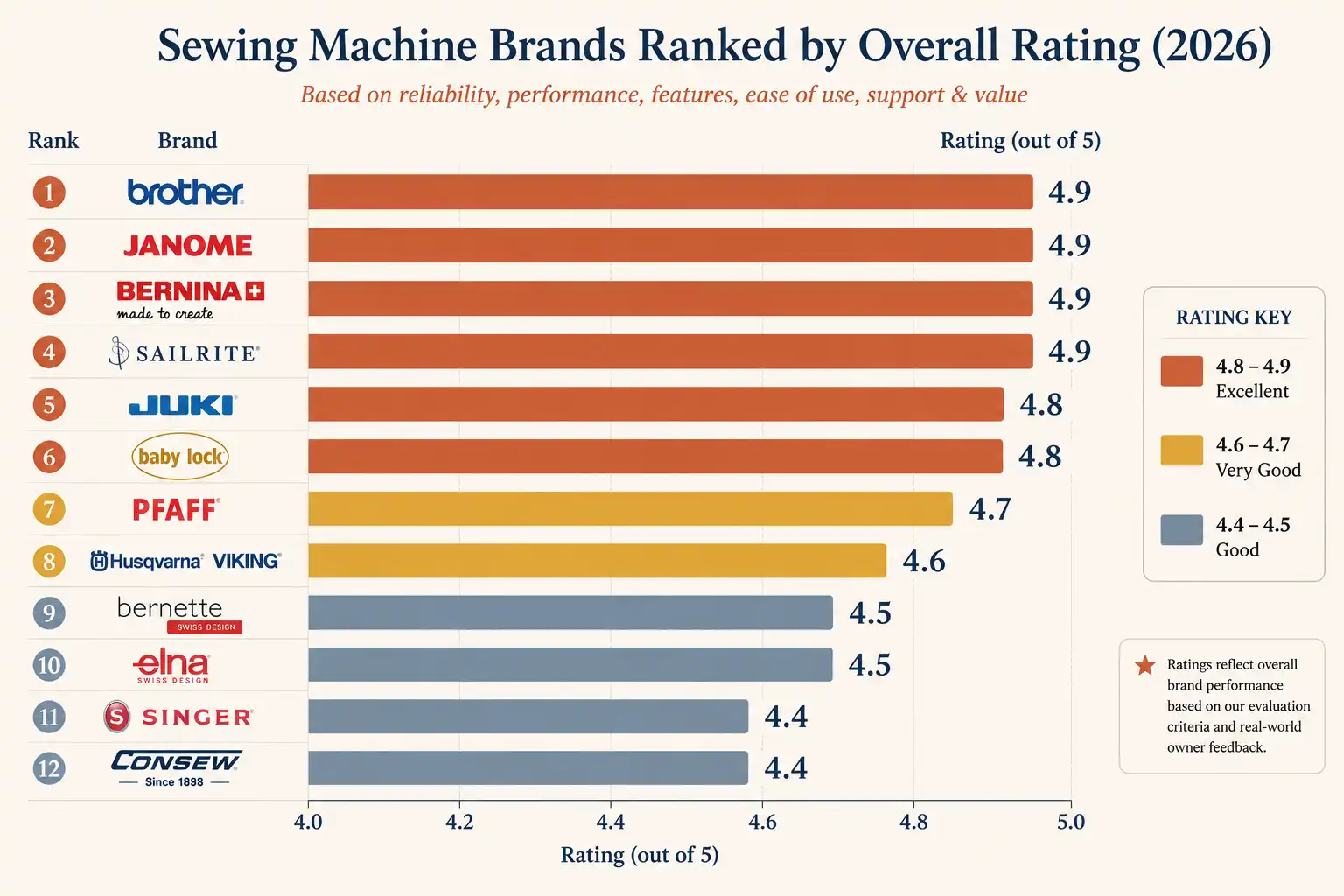
Sewing machine brand reliability ratings
| Brand | Reliability Rating | Why It Stands Out |
|---|---|---|
| Janome | ⭐⭐⭐⭐⭐ | Exceptional build quality and long service life |
| JUKI | ⭐⭐⭐⭐⭐ | Industrial engineering and durable construction |
| Bernina | ⭐⭐⭐⭐⭐ | Premium materials and precision manufacturing |
| Baby Lock | ⭐⭐⭐⭐☆ | Innovative technology backed by quality engineering |
| Pfaff | ⭐⭐⭐⭐☆ | Excellent mechanical performance and fabric handling |
| Brother | ⭐⭐⭐⭐☆ | Reliable home machines with good long-term value |
| Singer | ⭐⭐⭐⭐☆ | Strong reliability in many models, though quality varies across the lineup |
| Husqvarna Viking | ⭐⭐⭐⭐☆ | Well-built computerized machines with a good reputation |
| Bernette | ⭐⭐⭐⭐☆ | Solid mid-range reliability for growing sewists |
| Elna | ⭐⭐⭐⭐☆ | Dependable machines with Janome-backed engineering |
| Sailrite | ⭐⭐⭐⭐⭐ | Built specifically for demanding heavy-duty work |
| Consew | ⭐⭐⭐⭐⭐ | Designed for continuous industrial use |
Janome: A Benchmark for Long-Term Reliability
If we had to recommend one brand based solely on durability, Janome would be near the top of the list.
Janome machines are known for:
- Smooth operation
- Consistent stitch quality
- Durable internal components
- Dependable performance over many years
Many sewists report using well-maintained Janome machines for decades without major mechanical problems.
This reputation makes Janome especially popular among quilters, educators, and hobbyists who sew regularly.
JUKI: Industrial DNA That Shows
JUKI’s experience manufacturing industrial sewing equipment is reflected in its home machines.
Even consumer models often feature:
- Robust internal construction
- Powerful motors
- Excellent fabric feeding
- High sewing speeds
- Reliable stitch formation
For sewists who spend hours at their machine each week, JUKI is one of the safest long-term investments.
Bernina: Premium Engineering Built to Last
Bernina machines are designed with longevity in mind.
Although they’re among the most expensive brands, many owners consider them lifetime investments thanks to their:
- Precision engineering
- High-quality materials
- Excellent serviceability
- Consistent performance
With proper maintenance, a Bernina machine can remain productive for decades.
Brother: Reliable for Everyday Home Sewing
Brother has earned a strong reputation for producing dependable home sewing machines.
While many of its entry-level models are built with affordability in mind, they still provide excellent reliability for:
- Clothing repairs
- Home décor
- Crafts
- Quilting
- Everyday sewing
For most home users, a Brother machine offers years of dependable performance when properly maintained.
Singer: Reliability Depends on the Model
Singer’s reputation spans more than 170 years, but it’s important to recognize that reliability varies across its product range.
Many vintage Singer machines are famous for their durability, while modern models differ depending on their intended use and price point.
The Heavy Duty series, for example, has become a popular option for sewists working with thicker fabrics, while entry-level models are best suited for light to moderate home sewing.
Choosing the right Singer machine is more important than choosing the Singer name alone.
Heavy-Duty Specialists
Brands like Sailrite and Consew are engineered for demanding environments where machines operate for long hours and sew through thick materials.
If your work involves canvas, leather, upholstery, or commercial production, these brands are among the most durable choices available.
Their machines are designed for durability first, often sacrificing portability and convenience in exchange for long-term performance.
Reliability vs. Maintenance
Even the best sewing machine won’t stay reliable without regular care.
Simple maintenance habits can dramatically extend the life of your machine, including:
- Cleaning lint after each project
- Replacing needles regularly
- Using a quality thread
- Oiling the machine when recommended by the manufacturer
- Keeping the machine covered when not in use
- Having it professionally serviced when necessary
Routine maintenance is one of the easiest ways to avoid skipped stitches, tension problems, and premature wear.
Signs of a Well-Built Sewing Machine
When comparing brands, look beyond marketing claims and consider features that contribute to long-term durability, such as:
- Metal internal frames
- High-quality feed dogs
- Smooth motor performance
- Consistent stitch formation
- Stable construction with minimal vibration
- Readily available replacement parts
- Strong warranty and dealer support
These characteristics often have a greater impact on reliability than the number of built-in stitches or decorative features.
Which Brand Is the Most Reliable?
If reliability is your primary concern, here’s our overall ranking:
🥇 Janome – Best overall for long-term durability and consistent performance
🥈 JUKI – Exceptional engineering inspired by industrial machines
🥉 Bernina – Premium craftsmanship built for decades of use
Also Excellent:
- Baby Lock
- Pfaff
- Brother
- Sailrite
- Consew
Each of these brands has earned a strong reputation for producing dependable machines when matched to the right type of sewing and maintained properly.
Final Thoughts
The most reliable sewing machine isn’t always the most expensive; it’s the one that’s well-built, suited to your projects, and cared for over time.
For occasional home sewing, a dependable Brother or Singer may be all you ever need. For frequent quilting, garment construction, or professional work, investing in a Janome, JUKI, Bernina, or Baby Lock can provide years of confidence and consistent results.
Choosing a trusted brand is the first step. Maintaining your machine is what ensures it continues performing at its best for many years.
How to Choose the Right Sewing Machine Brand
With so many reputable sewing machine brands available, it’s easy to feel overwhelmed. Brother, Janome, JUKI, Bernina, Singer, Baby Lock, and Pfaff each have their strengths, and each appeals to a different type of sewist.
The good news is that you don’t need the “best” brand; you need the best brand for your sewing goals.
Before making your decision, consider the following factors.
1. Start With Your Sewing Experience
The right machine for a beginner is often very different from the right machine for an experienced quilter or professional tailor.
Ask yourself:
- Is this your first sewing machine?
- Have you used mechanical or computerized machines before?
- Do you want a machine that’s easy to learn or one you’ll grow into over time?
Our Recommendations
| Your Experience | Best Brands |
|---|---|
| Beginner | Brother, Singer |
| Beginner Ready to Grow | Janome, Bernette |
| Intermediate | Janome, Pfaff, Baby Lock |
| Advanced | JUKI, Bernina, Baby Lock |
| Professional | JUKI, Bernina, Consew |
Tip: If you’re just starting, avoid paying for advanced features you may not use for several years.
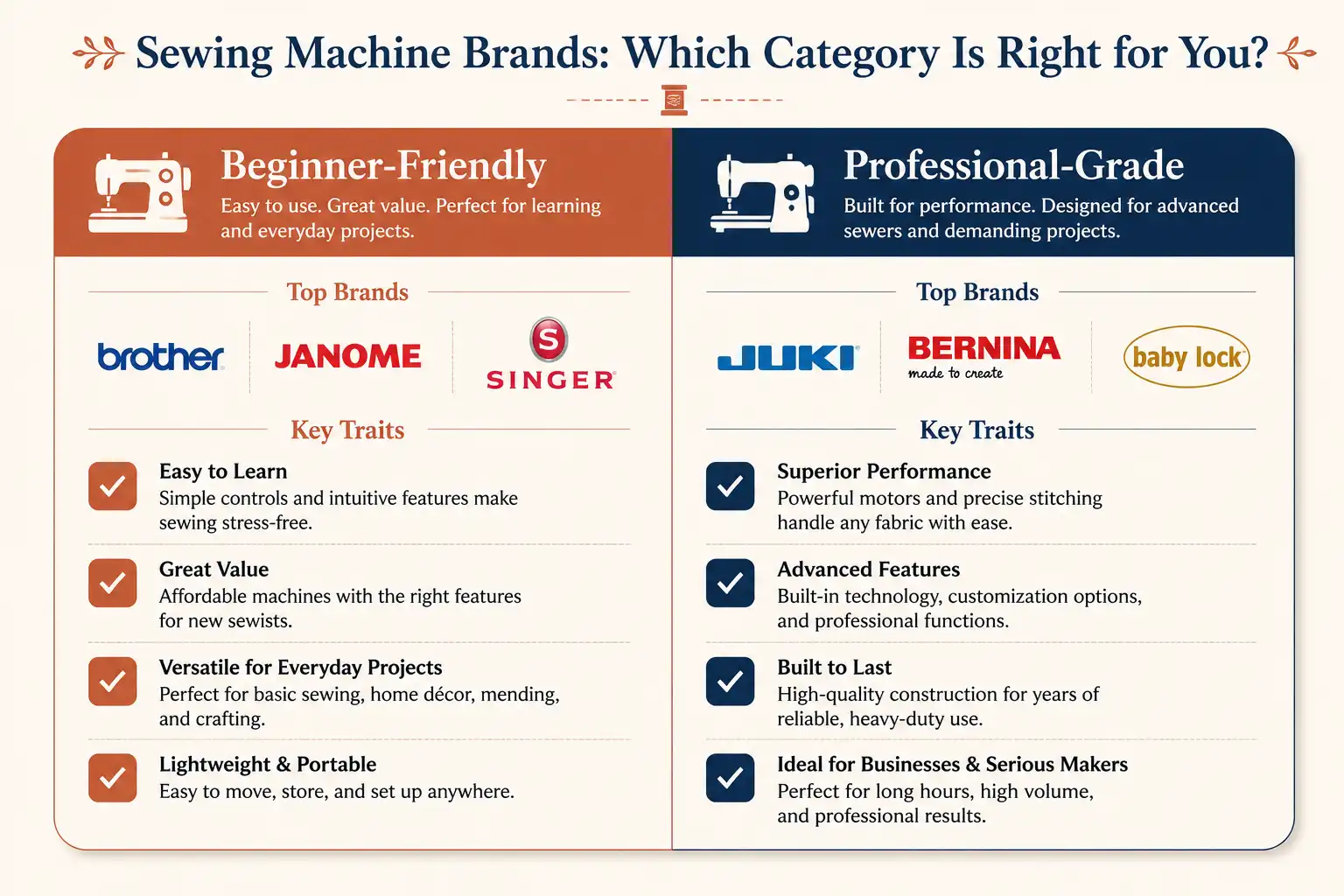
Beginner-friendly vs. professional-grade sewing machine brands
2. Think About What You’ll Actually Sew
Your projects should influence your decision more than brand popularity.
Someone making quilts needs different features than someone sewing children’s clothes or repairing jeans.
Match the Brand to Your Projects
| Project Type | Recommended Brands |
|---|---|
| Everyday Clothing Repairs | Brother, Singer |
| Dressmaking & Fashion | JUKI, Pfaff |
| Quilting | Janome, Bernina, Baby Lock |
| Embroidery | Baby Lock, Brother |
| Crafts & Home Décor | Brother, Janome |
| Leather & Canvas | Sailrite, Consew |
| Upholstery | Sailrite |
| Small Business Production | JUKI, Consew |
Choosing a brand that specializes in your type of sewing often leads to better results and a more enjoyable experience.
3. Set a Realistic Budget
Sewing machines range from under $150 to well over $10,000, so it’s important to decide how much you’re comfortable investing.
While premium machines offer advanced technology and exceptional build quality, many home sewists can complete years of projects with a mid-range machine.
General Budget Guide
| Budget | What to Expect | Recommended Brands |
|---|---|---|
| Under $300 | Basic mechanical and entry-level computerized machines | Brother, Singer |
| $300–$800 | More features, improved durability, and better stitch quality | Brother, Janome, Bernette |
| $800–$2,000 | Advanced computerized machines with premium features | Janome, JUKI, Pfaff |
| $2,000+ | Professional-level quilting, embroidery, and sewing systems | Bernina, Baby Lock |
Instead of stretching your budget for features you won’t use, invest in a machine that fits your current needs while leaving room to grow.
4. Consider Mechanical vs. Computerized Machines
Many buyers focus on brands when they should first decide what type of machine they prefer.
Mechanical Machines
Best for:
- Beginners who want simplicity
- Occasional sewing
- Easy maintenance
- Budget-conscious buyers
Popular brands include:
- Singer
- Brother
- Janome
Computerized Machines
Best for:
- Frequent sewing
- Decorative stitches
- Quilting
- Embroidery
- Precision sewing
Popular brands include:
- Brother
- Janome
- Baby Lock
- Bernina
- Pfaff
Choose the type of machine that matches how you enjoy sewing rather than assuming computerized models are always the better option.
5. Look Beyond the Number of Stitches
One of the biggest marketing tactics in the sewing industry is advertising hundreds of built-in stitches.
In reality, most sewists use only a handful on a regular basis.
Instead of focusing on stitch count, prioritize features that genuinely improve your sewing experience, such as:
- Automatic needle threader
- Adjustable presser foot pressure
- Quality feed system
- Strong motor
- Easy bobbin loading
- Automatic thread cutter
- Speed control
- Free arm
- Good lighting
- Extension table (if quilting)
These features will have a much greater impact on everyday sewing than dozens of decorative stitches.
6. Think About Long-Term Support
A sewing machine is a long-term investment, and support matters.
Before buying, check whether the brand offers:
- Readily available replacement parts
- Authorized service centers
- Helpful online resources
- Good warranty coverage
- Easy access to accessories and presser feet
Brands with strong dealer and service networks can make ownership much easier over the life of the machine.
7. Consider Future Growth
Many people outgrow their first sewing machine within a few years.
If you expect your skills to improve, buying a machine with a little extra capability now may save you from upgrading too soon.
For example:
- A beginner interested in quilting may appreciate a machine with a larger workspace.
- Someone curious about embroidery might choose a brand with upgrade paths and compatible embroidery models.
- A hobbyist planning to sell handmade products should prioritize durability and speed.
Thinking ahead can help you choose a machine that continues to meet your needs as your projects become more ambitious.
Common Mistakes to Avoid
Many sewing machine buyers regret their purchase not because the machine was bad, but because it wasn’t the right fit for their needs.
Avoid these common mistakes:
- Buying the cheapest machine without considering long-term quality.
- Paying for advanced features you’ll never use.
- Ignoring warranty and service options.
- Choosing a machine based only on brand recognition.
- Assuming more stitches always mean a better machine.
- Buying an industrial machine for occasional home sewing.
- Overlooking machine weight if portability matters.
Taking a little extra time to compare models now can save you money and frustration later.
Quick Buying Checklist
Before you buy, ask yourself:
- ✔ What types of projects will I sew most often?
- ✔ What’s my realistic budget?
- ✔ Do I want a mechanical or computerized machine?
- ✔ How often will I use it?
- ✔ Do I need embroidery or quilting features?
- ✔ Is local service available for this brand?
- ✔ Will this machine still meet my needs in a few years?
If you can confidently answer these questions, you’ll be much closer to choosing a sewing machine you’ll enjoy using for years.
Our Expert Recommendation
If you’re still unsure which brand to choose, here’s a simple starting point:
- Choose Brother if you want an affordable, beginner-friendly machine with excellent value.
- Choose Janome if reliability and quilting performance are your priorities.
- Choose JUKI if you need professional-level precision and durability.
- Choose Bernina if you’re ready to invest in premium craftsmanship.
- Choose Baby Lock if embroidery, serging, or creative sewing is your passion.
- Choose Singer if you want a trusted, budget-friendly machine for everyday sewing.
- Choose Sailrite if you regularly work with heavy-duty materials.
- Choose Consew if you need an industrial machine for commercial production.
The best sewing machine brand is the one that helps you enjoy sewing, supports your creative goals, and continues to perform reliably as your skills grow.
10 Mistakes People Make When Choosing a Sewing Machine Brand
Even careful shoppers fall into a few predictable traps when comparing sewing machine brands. Avoiding these can save you money — and prevent a machine from ending up unused in a closet.
1. Buying Based Only on Stitch Count
A machine with 200 built-in stitches isn’t automatically better than one with 60. Most sewists regularly use fewer than ten. Prioritize feed quality, motor strength, and ease of use over a big number on the box.
2. Ignoring Dealer Support
A great machine backed by a distant or nonexistent dealer network can turn a simple repair into a weeks-long ordeal. Before buying, check whether authorized service is actually available near you, not just whether the brand sells online.
3. Choosing a Luxury Machine as a Beginner
Premium engineering from Bernina or Baby Lock is wasted on someone still learning to thread a bobbin. Beginners are usually better served, and less intimidated, by an approachable mid-range machine, with an upgrade path once their skills catch up.
4. Confusing Industrial and Heavy-Duty Machines
Singer’s Heavy Duty line and Sailrite’s Ultrafeed machines can handle thicker home projects, but they aren’t the same as a true industrial machine like a Consew. Buying an industrial machine for occasional home use, or a home “heavy duty” machine for commercial production, usually ends in disappointment either way.
5. Buying the Wrong Machine for Quilting
Quilters need a large throat space, reliable extension tables, and consistent feeding across thick, layered fabric. A basic entry-level machine built for garment repairs will fight you on anything larger than a lap quilt.
6. Assuming the Cheapest Machine Saves Money
A bargain machine that breaks down in eighteen months, or that can’t be repaired because parts are unavailable, often costs more in the long run than a slightly pricier machine from a brand with strong long-term support.
7. Overlooking Warranty Terms
Warranty length and coverage vary significantly by brand, model, and region. Read what’s actually covered; many warranties separate electronic components, motors, and labor into different terms.
8. Paying for Features You’ll Never Use
Wireless embroidery transfer, oversized touchscreens, and dozens of specialty presser feet are valuable to some sewists and irrelevant to others. Match the feature list to your actual projects, not to what sounds impressive in a spec sheet.
9. Choosing a Machine Based on Brand Recognition Alone
A recognizable name isn’t a guarantee that a specific model fits your needs. Singer and Brother both sell entry-level and heavy-duty machines side by side. The brand name tells you far less than the individual model does.
10. Ignoring Weight and Portability
If you plan to carry your machine to classes, guild meetings, or a shared studio space, weight matters as much as features. Some premium machines exceed 20 pounds, which is a meaningful difference if you’re lifting them regularly.
Taking a few extra minutes to think through these mistakes before you buy can save you from a machine that looks great on paper but doesn’t fit how you actually sew.
Frequently Asked Questions About Sewing Machine Brands
1. What is the best sewing machine brand overall?
There isn’t a single brand that’s best for everyone, but Brother, Janome, JUKI, Bernina, Baby Lock, and Singer consistently rank among the top sewing machine manufacturers.
If we had to recommend one brand for the average home sewist, Brother offers the best balance of affordability, ease of use, reliability, and features.
2. Which sewing machine brand is best for beginners?
Brother is our top recommendation for beginners because its machines are easy to set up, simple to operate, and packed with features that reduce the learning curve.
Singer is another excellent option for first-time sewists who prefer mechanical machines.
3. Which sewing machine brand lasts the longest?
Brands with the strongest reputation for long-term durability include:
- Janome
- JUKI
- Bernina
- Baby Lock
- Sailrite
- Consew
With proper maintenance, machines from these manufacturers can remain reliable for many years.
4. Is Brother better than Singer?
It depends on your needs.
Brother generally offers more beginner-friendly computerized machines and excellent value, while Singer provides a wide range of affordable mechanical models and popular heavy-duty options.
For most beginners, we recommend Brother.
5. Is Janome better than Brother?
Neither brand is universally better.
Brother is ideal for beginners and budget-conscious buyers, while Janome is known for exceptional durability, quilting performance, and long-term reliability.
Choose Brother for ease of use and Janome for long-term investment.
6. Is JUKI a good sewing machine brand?
Yes.
JUKI is widely respected for its industrial heritage, precision stitching, and durable construction. It’s a favorite among experienced sewists, garment makers, and professionals.
7. Are Bernina sewing machines worth the money?
For many serious sewists, yes.
Bernina machines are expensive, but they offer exceptional stitch quality, premium engineering, advanced features, and outstanding long-term durability.
If you sew frequently and plan to keep your machine for many years, the investment can be worthwhile.
8. Why are Baby Lock sewing machines so expensive?
Baby Lock focuses on premium sewing, quilting, embroidery, and serger machines equipped with innovative technology such as advanced threading systems, intelligent automation, and sophisticated embroidery features.
These capabilities contribute to the higher price.
9. Which sewing machine brand do professionals use?
Professional sewists often choose:
- JUKI
- Bernina
- Consew
- Baby Lock
The right choice depends on whether they specialize in garment construction, quilting, embroidery, or commercial production.
10. What sewing machine brand is best for quilting?
Janome is one of the most popular quilting brands because of its spacious work areas, smooth feeding systems, and reliable stitch quality.
Bernina, Baby Lock, and JUKI are also excellent choices.
11. Which sewing machine brand is best for embroidery?
Baby Lock is our top recommendation for embroidery thanks to its advanced embroidery technology and user-friendly features.
Brother and Bernina also offer excellent embroidery machines.
12. What sewing machine brand is best for heavy fabrics?
If you regularly sew canvas, leather, upholstery, or marine fabrics, Sailrite is one of the best options.
For industrial applications, Consew is another excellent choice.
13. Should I buy a mechanical or computerized sewing machine?
Mechanical machines are often better for beginners who prefer simplicity and easy maintenance.
Computerized machines provide more convenience, decorative stitches, and automation, making them ideal for frequent sewing, quilting, and embroidery.
14. How much should I spend on a sewing machine?
That depends on your experience and sewing goals.
- Under $300: Basic home sewing
- $300–$800: Most hobby sewists
- $800–$2,000: Advanced sewing and quilting
- $2,000+: Premium quilting and embroidery systems
Buying a machine that matches your needs is more important than simply buying the most expensive model.
15. How long should a sewing machine last?
A quality sewing machine can easily last 10–25 years or more with regular cleaning, proper maintenance, and responsible use.
Premium brands such as Janome, JUKI, and Bernina often remain in service for decades.
16. What features matter more than brand?
While the brand is important, you should also consider:
- Build quality
- Motor performance
- Ease of use
- Stitch quality
- Presser foot options
- Available accessories
- Warranty
- Customer support
The best machine is one that matches your sewing style and skill level.
17. Are expensive sewing machines always better?
Not necessarily.
Premium machines offer advanced features, better materials, and enhanced durability, but many sewists will never use those additional capabilities.
Choose a machine based on your sewing needs rather than price alone.
Yes, but it’s not always necessary.
Many beginners learn successfully on premium machines, but a well-designed entry-level model from Brother or Singer often provides everything needed to build strong sewing skills.
19. Which sewing machine brand has the best customer support?
Support experiences vary by location, but brands such as Brother, Janome, Baby Lock, Bernina, and Singer generally offer strong customer service, online resources, and dealer networks in many markets.
Before buying, check the availability of authorized service centers in your area.
20. Which sewing machine brand offers the best value for money?
Brother consistently provides some of the best value thanks to its combination of affordable pricing, dependable performance, and beginner-friendly features.
Janome is another excellent value for sewists seeking long-term reliability.
21. Which sewing machine brand is easiest to repair?
Brother and Singer are generally the easiest brands to get repaired, thanks to wide dealer networks and plentiful third-party technicians familiar with their mechanisms. Industrial brands like Consew are also straightforward to repair for technicians who specialize in commercial equipment, though repairs happen through different channels than home-sewing dealers.
22. Which sewing machine brand has the cheapest accessories?
Brother and Singer tend to have the most affordable accessories and generic, third-party-compatible parts, since their machines are widely used and long-established. Premium brands like Bernina and Baby Lock typically require brand-specific accessories that cost more.
23. Which sewing machine brand has the best warranty?
Warranty terms vary by model and region for every brand, so there’s no single winner. Janome, Bernina, and Baby Lock are generally regarded as offering strong warranty coverage on their mid-range and premium machines, but always confirm the specific terms for the model you’re considering before buying.
24. Is an old Singer better than a new Singer?
Not necessarily. Vintage all-metal Singer machines from the mid-20th century have a reputation for mechanical durability, but they lack modern conveniences and may need servicing to run well. Current Singer models vary in quality by line. A new Heavy Duty model is generally more capable than an old Singer for most everyday sewing, while a well-maintained vintage machine can still be a reliable, simple workhorse.
25. Which sewing machine brand is best for kids?
Brother and Singer both offer simple, affordable mechanical and entry-level computerized machines that work well for kids learning to sew under supervision. Look for a model with a slower maximum speed and straightforward controls rather than a full-featured computerized machine.
26. Which sewing machine is the quietest?
Janome is frequently singled out for exceptionally quiet, smooth operation, even at higher speeds. Bernina machines are also notably quiet thanks to precision engineering, though that quality comes at a much higher price.
27. Which sewing machine brand holds its resale value best?
Bernina and Janome machines tend to hold resale value better than most competitors, largely because of their reputation for durability and long service life. A well-maintained Bernina, in particular, can retain significant value even after a decade of regular use.
28. Which sewing machine brand has the best dealer network?
Brother and Singer have the broadest overall retail and service presence, since their machines are sold through both big-box retailers and independent dealers. Janome and Bernina rely more heavily on authorized dealer networks, which are strong in many regions but less universally accessible than Brother’s or Singer’s.
Final Verdict: Which Sewing Machine Brand Should You Choose?
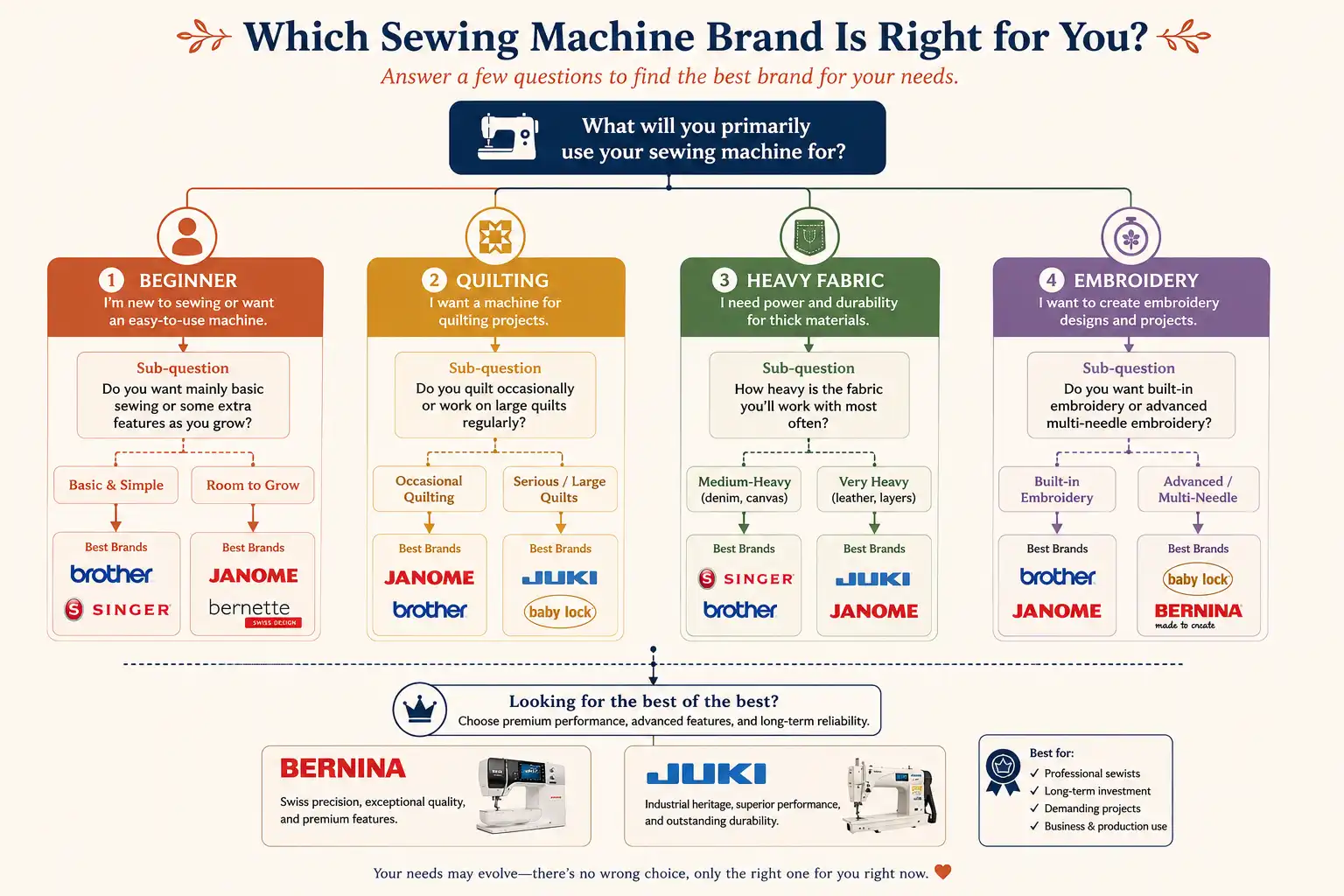
Choosing the right sewing machine brand doesn’t have to be complicated.
The best sewing machine brand isn’t simply the one with the highest rating; it’s the one that fits how you sew, your experience, and your long-term goals. A beginner learning to hem jeans has very different needs than a quilter creating heirloom blankets or a professional tailoring garments every day. By focusing on how you sew rather than chasing the most expensive or most popular name, you’ll be far more likely to choose a sewing machine you’ll enjoy using for years.
If you’re looking for a quick recommendation, here’s where we’d start:
| If You Want… * | *We Recommend…** |
|---|---|
| The best all-around brand | Brother |
| The easiest brand for beginners | Brother |
| The best long-term reliability | Janome |
| The best for quilting | Janome |
| The best for professional sewing | JUKI |
| The best premium machines | Bernina |
| The best for embroidery | Baby Lock |
| The best budget-friendly option | Singer |
| The best for heavy-duty materials | Sailrite |
| The best industrial machines | Consew |
Every brand featured in this guide has earned its reputation by excelling in a particular area. Instead of focusing solely on the brand name, think about the projects you’ll tackle most often and the features that will make sewing easier and more enjoyable.
A well-chosen sewing machine can become a creative partner for years, even decades. Taking the time to compare brands now will help you invest with confidence and spend more time sewing instead of second-guessing your purchase.
Ready to Find Your Perfect Sewing Machine?
Now that you understand what each brand does best, the next step is choosing a specific model.
Explore our in-depth buying guides, hands-on reviews, and comparison articles to find the sewing machine that matches your skill level, budget, and creative goals.
Recommended Reading
- Best Sewing Machines
- Best Sewing Machines for Beginners
- Best Sewing Machines for Quilting
- Best Embroidery Machines
- How to Choose a Sewing Machine
Happy sewing! 🧵✂️